2W3P | pdb_00002w3p

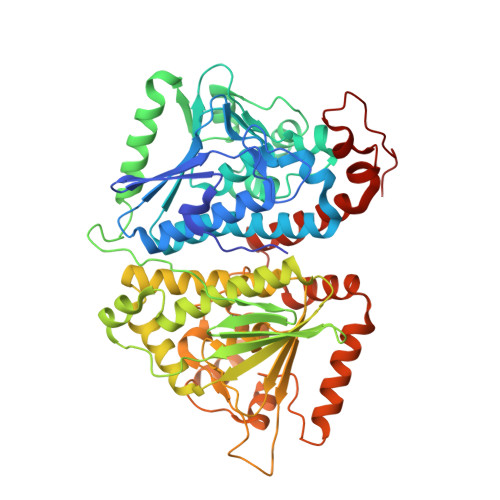
BoxC crystal structure


Experimental Data Snapshot

  • Method: X-RAY DIFFRACTION
  • Resolution: 1.50 Å
  • R-Value Free: 
    0.207 (Depositor), 0.201 (DCC) 
  • R-Value Work: 
    0.187 (Depositor), 0.183 (DCC) 
  • R-Value Observed: 
    0.188 (Depositor) 

wwPDB Validation 3D Report Full Report

Validation slider image for 2W3P

This is version 2.1 of the entry. See complete history

Literature

Structural and Biophysical Characterization of Boxc from Burkholderia Xenovorans Lb400: A Novel Ring-Cleaving Enzyme in the Crotonase Superfamily.

Bains, J.Leon, R.Boulanger, M.J.

(2009) J Biological Chem 284: 16377

  • DOI: https://doi.org/10.1074/jbc.M900226200
  • Primary Citation Related Structures: 
    2W3P

  • PubMed Abstract: 

    The mineralization of aromatic compounds by microorganisms relies on a structurally and functionally diverse group of ring-cleaving enzymes. The recently discovered benzoate oxidation pathway in Burkholderia xenovorans LB400 encodes a novel such ring-cleaving enzyme, termed BoxC, that catalyzes the conversion of 2,3-dihydro-2,3-dihydroxybenzoyl-CoA to 3,4-dehydroadipyl-CoA without the requirement for molecular oxygen. Sequence analysis indicates that BoxC is a highly divergent member of the crotonase superfamily and nearly double the size of the average superfamily member. The structure of BoxC determined to 1.5 A resolution reveals an intriguing structural demarcation. A highly divergent region in the C terminus probably serves as a structural scaffold for the conserved N terminus that encompasses the active site and, in conjunction with a conserved C-terminal helix, mediates dimer formation. Isothermal titration calorimetry and molecular docking simulations contribute to a detailed view of the active site, resulting in a compelling mechanistic model where a pair of conserved glutamate residues (Glu146 and Glu168) work in tandem to deprotonate the dihydroxylated ring substrate, leading to cleavage. A final deformylation step incorporating a water molecule and Cys111 as a general base completes the formation of 3,4-dehydroadipyl-CoA product. Overall, this study establishes the basis for BoxC as one of the most divergent members of the crotonase superfamily and provides the first structural insight into the mechanism of this novel class of ring-cleaving enzymes.


  • Organizational Affiliation
    • From the Departments of Biochemistry and Microbiology, Victoria, British Columbia V8W 3P6, Canada.

Macromolecule Content 

  • Total Structure Weight: 124 kDa 
  • Atom Count: 9,920 
  • Modeled Residue Count: 1,095 
  • Deposited Residue Count: 1,112 
  • Unique protein chains: 1

Macromolecules

Find similar proteins by:|  3D Structure
Entity ID: 1
MoleculeChains  Sequence LengthOrganismDetailsImage
BENZOYL-COA-DIHYDRODIOL LYASE
A, B
556Paraburkholderia xenovorans LB400Mutation(s): 0 
UniProt
Find proteins for Q13WK7 (Paraburkholderia xenovorans (strain LB400))
Explore Q13WK7 
Go to UniProtKB:  Q13WK7
Entity Groups
Sequence Clusters30% Identity50% Identity70% Identity90% Identity95% Identity100% Identity
UniProt GroupQ13WK7
Sequence Annotations
Expand
Reference Sequence

Small Molecules

Ligands 2 Unique
IDChains Name / Formula / InChI Key2D Diagram3D Interactions
GOL

Query on GOL


Download:Ideal Coordinates CCD File
E [auth A],
F [auth A],
I [auth B],
J [auth B]
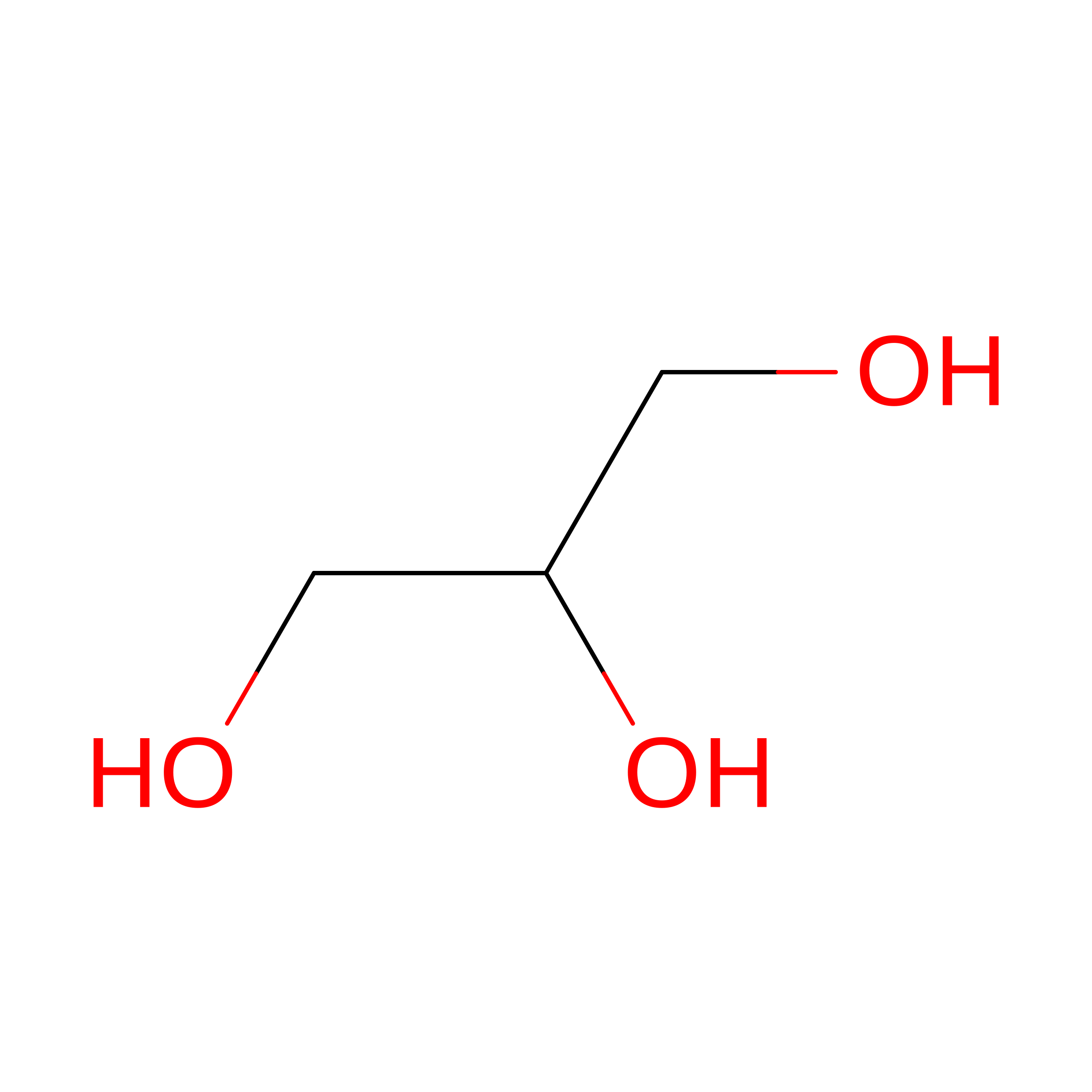
GLYCEROL
C3 H8 O3
PEDCQBHIVMGVHV-UHFFFAOYSA-N
BME

Query on BME


Download:Ideal Coordinates CCD File
C [auth A],
D [auth A],
G [auth B],
H [auth B]
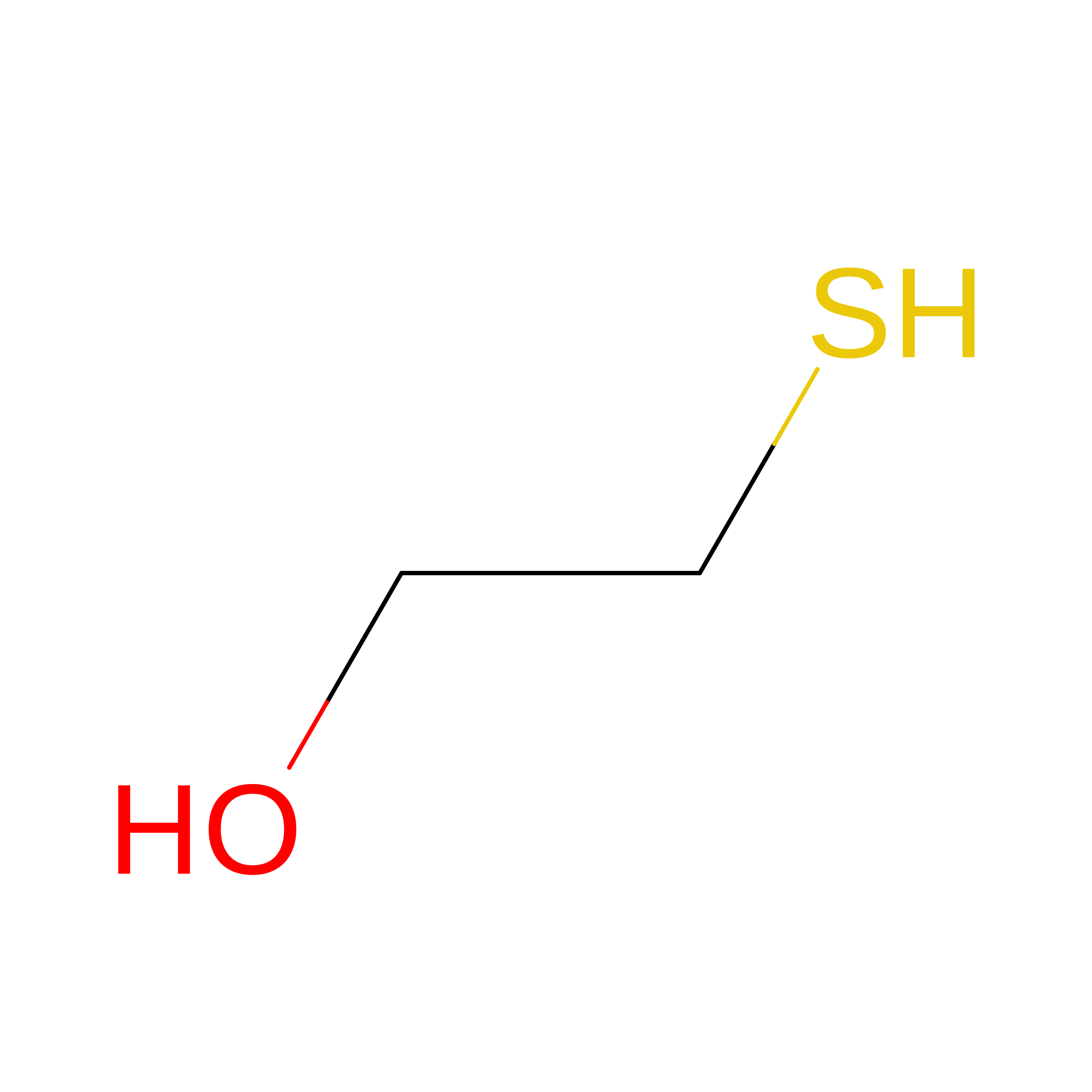
BETA-MERCAPTOETHANOL
C2 H6 O S
DGVVWUTYPXICAM-UHFFFAOYSA-N

Experimental Data & Validation

Experimental Data

  • Method: X-RAY DIFFRACTION
  • Resolution: 1.50 Å
  • R-Value Free:  0.207 (Depositor), 0.201 (DCC) 
  • R-Value Work:  0.187 (Depositor), 0.183 (DCC) 
  • R-Value Observed: 0.188 (Depositor) 
Space Group: P 21 21 21
Unit Cell:
Length ( Å )Angle ( ˚ )
a = 85.159α = 90
b = 99.847β = 90
c = 136.734γ = 90
Software Package:
Software NamePurpose
REFMACrefinement
d*TREKdata reduction
d*TREKdata scaling
SHARPphasing

Structure Validation

View Full Validation Report


Entry History 

Deposition Data

Revision History  (Full details and data files)

  • Version 1.0: 2009-04-14
    Type: Initial release
  • Version 1.1: 2011-05-08
    Changes: Version format compliance
  • Version 1.2: 2011-07-13
    Changes: Version format compliance
  • Version 2.0: 2017-07-05
    Changes: Advisory, Atomic model, Data collection, Derived calculations
  • Version 2.1: 2025-04-09
    Changes: Data collection, Database references, Other, Structure summary