2V3W | pdb_00002v3w

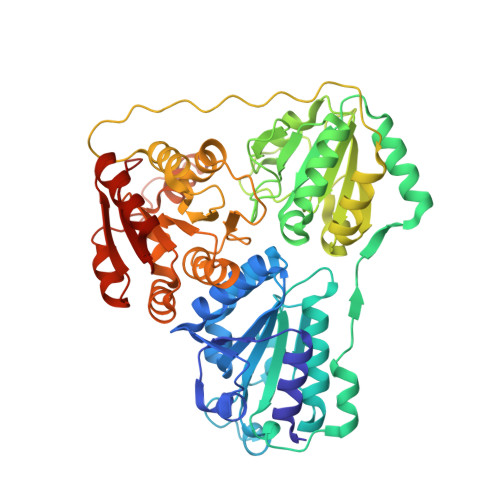
Crystal structure of the benzoylformate decarboxylase variant L461A from Pseudomonas putida


Experimental Data Snapshot

  • Method: X-RAY DIFFRACTION
  • Resolution: 2.20 Å
  • R-Value Free: 
    0.228 (Depositor), 0.228 (DCC) 
  • R-Value Work: 
    0.180 (Depositor), 0.182 (DCC) 
  • R-Value Observed: 
    0.182 (Depositor) 

Starting Model: experimental
View more details

wwPDB Validation 3D Report Full Report

Validation slider image for 2V3W

Ligand Structure Quality Assessment 


This is version 1.3 of the entry. See complete history

Literature

Rational Protein Design of Thdp-Dependent Enzymes-Engineering Stereoselectivity.

Gocke, D.Walter, L.Gauchenova, K.Kolter, G.Knoll, M.Berthold, C.L.Schneider, G.Pleiss, J.Muller, M.Pohl, M.

(2008) Chembiochem 9: 406

  • DOI: https://doi.org/10.1002/cbic.200700598
  • Primary Citation Related Structures: 
    2V3W

  • PubMed Abstract: 

    Benzoylformate decarboxylase (BFD) from Pseudomonas putida is an exceptional thiamin diphosphate-dependent enzyme, as it catalyzes the formation of (S)-2-hydroxy-1-phenylpropan-1-one from benzaldehyde and acetaldehyde. This is the only currently known S-selective reaction (92 % ee) catalyzed by this otherwise R-selective class of enzymes. Here we describe the molecular basis of the introduction of S selectivity into ThDP-dependent decarboxylases. By shaping the active site of BFD through the use of rational protein design, structural analysis, and molecular modeling, optimal steric stabilization of the acceptor aldehyde in a structural element called the S pocket was identified as the predominant interaction for adjusting stereoselectivity. Our studies revealed Leu461 as a hot spot for stereoselectivity in BFD. Exchange to alanine and glycine resulted in variants that catalyze the S-stereoselective addition of larger acceptor aldehydes, such as propanal with benzaldehyde and its derivatives-a reaction not catalyzed by the wild-type enzyme. Crystal structure analysis of the variant BFDL461A supports the modeling studies.


  • Organizational Affiliation
    • Institute of Molecular Enzyme Technology, Heinrich-Heine University Düsseldorf, 52426 Jülich, Germany.

Macromolecule Content 

  • Total Structure Weight: 227.67 kDa 
  • Atom Count: 16,911 
  • Modeled Residue Count: 2,104 
  • Deposited Residue Count: 2,112 
  • Unique protein chains: 1

Macromolecules

Find similar proteins by:|  3D Structure
Entity ID: 1
MoleculeChains  Sequence LengthOrganismDetailsImage
BENZOYLFORMATE DECARBOXYLASE
A, B, C, D
528Pseudomonas putidaMutation(s): 1 
EC: 4.1.1.7
UniProt
Find proteins for P20906 (Pseudomonas putida)
Explore P20906 
Go to UniProtKB:  P20906
Entity Groups
Sequence Clusters30% Identity50% Identity70% Identity90% Identity95% Identity100% Identity
UniProt GroupP20906
Sequence Annotations
Expand
Reference Sequence

Small Molecules

Ligands 3 Unique
IDChains Name / Formula / InChI Key2D Diagram3D Interactions
TPP

Query on TPP


Download:Ideal Coordinates CCD File
H [auth A],
L [auth B],
O [auth C],
R [auth D]
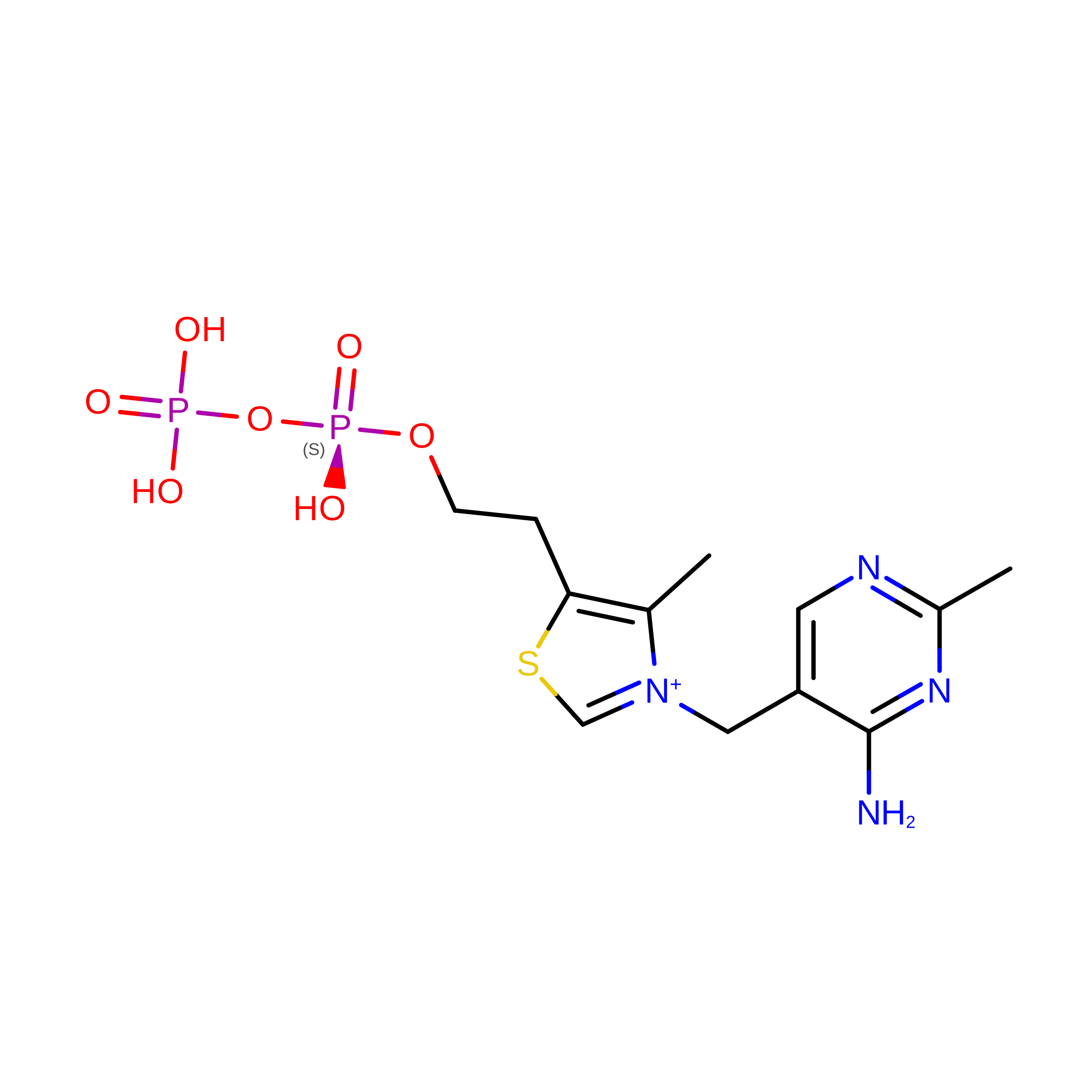
THIAMINE DIPHOSPHATE
C12 H19 N4 O7 P2 S
AYEKOFBPNLCAJY-UHFFFAOYSA-O
SO4

Query on SO4


Download:Ideal Coordinates CCD File
G [auth A],
K [auth B],
N [auth C],
Q [auth D]
SULFATE ION
O4 S
QAOWNCQODCNURD-UHFFFAOYSA-L
MG

Query on MG


Download:Ideal Coordinates CCD File
E [auth A]
F [auth A]
I [auth B]
J [auth B]
M [auth C]
E [auth A],
F [auth A],
I [auth B],
J [auth B],
M [auth C],
P [auth D]
MAGNESIUM ION
Mg
JLVVSXFLKOJNIY-UHFFFAOYSA-N

Experimental Data & Validation

Experimental Data

  • Method: X-RAY DIFFRACTION
  • Resolution: 2.20 Å
  • R-Value Free:  0.228 (Depositor), 0.228 (DCC) 
  • R-Value Work:  0.180 (Depositor), 0.182 (DCC) 
  • R-Value Observed: 0.182 (Depositor) 
Space Group: P 21 21 21
Unit Cell:
Length ( Å )Angle ( ˚ )
a = 95.704α = 90
b = 139.938β = 90
c = 169.054γ = 90
Software Package:
Software NamePurpose
REFMACrefinement
MOSFLMdata reduction
SCALAdata scaling
MOLREPphasing

Structure Validation

View Full Validation Report


Ligand Structure Quality Assessment 


Entry History 

Deposition Data

Revision History  (Full details and data files)

  • Version 1.0: 2008-01-22
    Type: Initial release
  • Version 1.1: 2012-10-10
    Changes: Database references, Derived calculations, Non-polymer description, Other, Version format compliance
  • Version 1.2: 2018-01-17
    Changes: Data collection
  • Version 1.3: 2023-12-13
    Changes: Data collection, Database references, Derived calculations, Other, Refinement description