2UVM | pdb_00002uvm

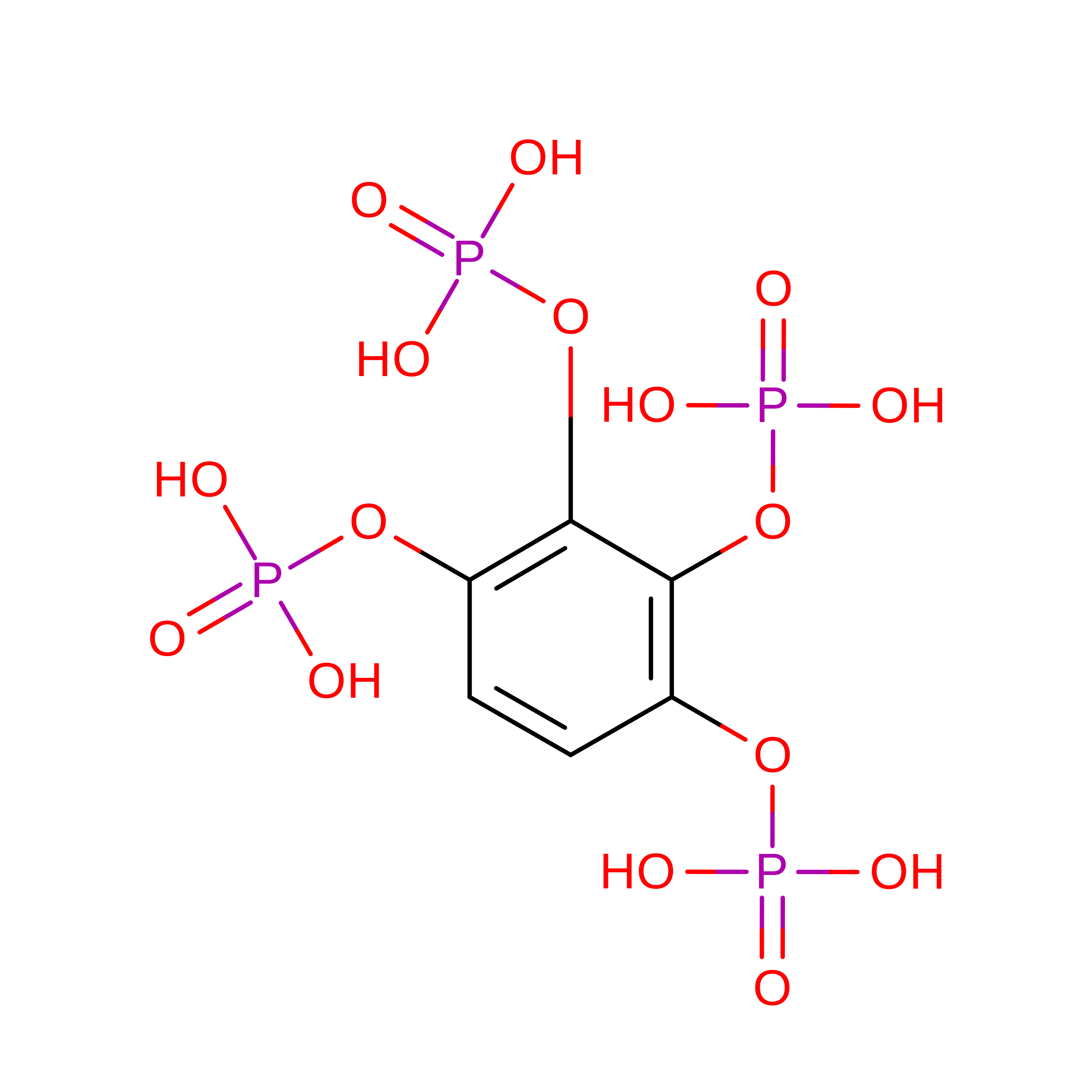
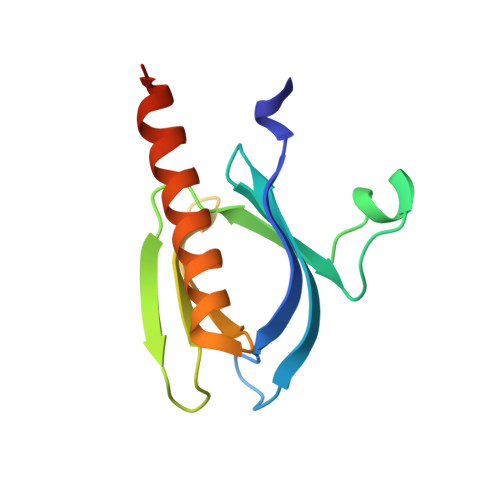
Structure of PKBalpha PH domain in complex with a novel inositol headgroup surrogate, benzene 1,2,3,4-tetrakisphosphate


Experimental Data Snapshot

  • Method: X-RAY DIFFRACTION
  • Resolution: 1.94 Å
  • R-Value Free: 
    0.269 (Depositor), 0.238 (DCC) 
  • R-Value Work: 
    0.252 (Depositor), 0.231 (DCC) 
  • R-Value Observed: 
    0.252 (Depositor) 

Starting Model: experimental
View more details

wwPDB Validation 3D Report Full Report

Validation slider image for 2UVM

Ligand Structure Quality Assessment 


This is version 1.3 of the entry. See complete history

Literature

Novel Inositol Phospholipid Headgroup Surrogate Crystallised in the Pleckstrin Homology Domain of Protein Kinase Balpha.

Mills, S.J.Komander, D.Trusselle, M.N.Safrany, S.T.Van Aalten, D.M.F.Potter, B.V.L.

(2007) ACS Chem Biol 2: 242

  • DOI: https://doi.org/10.1021/cb700019r
  • Primary Citation Related Structures: 
    2UVM

  • PubMed Abstract: 

    Protein kinase B (PKB/Akt) plays a key role in cell signaling. The PH domain of PKB binds phosphatidylinositol 3,4,5-trisphosphate translocating PKB to the plasma membrane for activation by 3-phosphoinositide-dependent protein kinase 1. The crystal structure of the headgroup inositol 1,3,4,5-tetrakisphosphate Ins(1,3,4,5)P4-PKB complex facilitates in silico ligand design. The novel achiral analogue benzene 1,2,3,4-tetrakisphosphate (Bz(1,2,3,4)P4) possesses phosphate regiochemistry different from that of Ins(1,3,4,5)P4 and surprisingly binds with similar affinity as the natural headgroup. Bz(1,2,3,4)P4 co-crystallizes with the PKBalpha PH domain in a fashion also predictable in silico. The 2-phosphate of Bz(1,2,3,4)P4 does not interact with any residue, and the D5-phosphate of Ins(1,3,4,5)P4 is not mimicked by Bz(1,2,3,4)P4. Bz(1,2,3,4)P4 is an example of a simple inositol phosphate surrogate crystallized in a protein, and this approach could be applied to design modulators of inositol polyphosphate binding proteins.

Macromolecule Content 

  • Total Structure Weight: 15.17 kDa 
  • Atom Count: 1,009 
  • Modeled Residue Count: 116 
  • Deposited Residue Count: 123 
  • Unique protein chains: 1

Macromolecules

Find similar proteins by:|  3D Structure
Entity ID: 1
MoleculeChains  Sequence LengthOrganismDetailsImage
RAC-ALPHA SERINE/THREONINE-PROTEIN KINASE123Homo sapiensMutation(s): 0 
EC: 2.7.11.1
UniProt & NIH Common Fund Data Resources
Find proteins for P31749 (Homo sapiens)
Explore P31749 
Go to UniProtKB:  P31749
PHAROS:  P31749
GTEx:  ENSG00000142208 
Entity Groups
Sequence Clusters30% Identity50% Identity70% Identity90% Identity95% Identity100% Identity
UniProt GroupP31749
Sequence Annotations
Expand
Reference Sequence

Small Molecules

Ligands 2 Unique
IDChains Name / Formula / InChI Key2D Diagram3D Interactions
GVF

Query on GVF


Download:Ideal Coordinates CCD File
B [auth A]BENZENE-1,2,3,4-TETRAYL TETRAKIS[DIHYDROGEN (PHOSPHATE)]
C6 H10 O16 P4
UKRGHRHHBNLNDD-UHFFFAOYSA-N
NA

Query on NA


Download:Ideal Coordinates CCD File
C [auth A]SODIUM ION
Na
FKNQFGJONOIPTF-UHFFFAOYSA-N
Binding Affinity Annotations 
IDSourceBinding Affinity
GVF BindingDB:  2UVM Ki: 80 (nM) from 1 assay(s)

Experimental Data & Validation

Experimental Data

  • Method: X-RAY DIFFRACTION
  • Resolution: 1.94 Å
  • R-Value Free:  0.269 (Depositor), 0.238 (DCC) 
  • R-Value Work:  0.252 (Depositor), 0.231 (DCC) 
  • R-Value Observed: 0.252 (Depositor) 
Space Group: C 1 2 1
Unit Cell:
Length ( Å )Angle ( ˚ )
a = 80.029α = 90
b = 34.04β = 112.25
c = 44.944γ = 90
Software Package:
Software NamePurpose
CNSrefinement
DENZOdata reduction
SCALEPACKdata scaling
CNSphasing

Structure Validation

View Full Validation Report


Ligand Structure Quality Assessment 


Entry History 

Deposition Data

Revision History  (Full details and data files)

  • Version 1.0: 2007-04-17
    Type: Initial release
  • Version 1.1: 2011-05-08
    Changes: Version format compliance
  • Version 1.2: 2011-07-13
    Changes: Version format compliance
  • Version 1.3: 2023-12-13
    Changes: Data collection, Database references, Derived calculations, Other, Refinement description