2SPT | pdb_00002spt

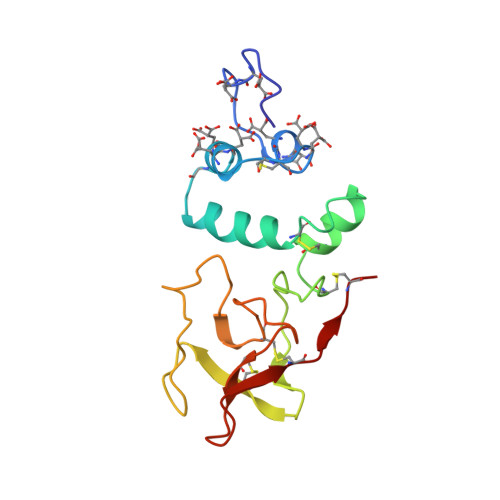
DIFFERENCES IN THE METAL ION STRUCTURE BETWEEN SR-AND CA-PROTHROMBIN FRAGMENT 1


Experimental Data Snapshot

  • Method: X-RAY DIFFRACTION
  • Resolution: 2.50 Å
  • R-Value Observed: 
    0.167 (Depositor) 

wwPDB Validation 3D Report Full Report

Validation slider image for 2SPT

This is version 1.5 of the entry. See complete history

Literature

Differences in the metal ion structure between Sr- and Ca-prothrombin fragment 1.

Seshadri, T.P.Skrzypczak-Jankun, E.Yin, M.Tulinsky, A.

(1994) Biochemistry 33: 1087-1092

  • DOI: https://doi.org/10.1021/bi00171a006
  • Primary Citation Related Structures: 
    2SPT

  • PubMed Abstract: 

    The structure of Sr-prothrombin fragment 1 has been solved and refined by restrained least-squares methods at 2.5-A resolution to a crystallographic R value of 0.167. The protein structure is very similar to that of Ca-fragment 1. A polymeric array of five Sr2+ ions separated by about 4.0 A is buried among six gamma-carboxyglutamic acid (Gla) residues; three other Sr2+ ions interact with other Gla residues and are located further apart. One of these was not found in the Ca-fragment 1 structure. The coordination of the Sr2+ ions resembles that of Ca2+, but there are some significant differences between them. The most notable is the lack of water coordination with Sr2+ ions and two conformations for Gla 8, which change the coordination of Sr-2 and Sr-3. A hexose moiety of an oligosaccharide was located in the vicinity of Asn101 that was flexibly disordered in Ca-fragment 1. The new Sr2+ ion found may be involved in metal ion phospholipid binding interactions along with Sr-1, and Sr-7, Sr-8.


  • Organizational Affiliation
    • Department of Chemistry, Michigan State University, East Lansing 48824.

Macromolecule Content 

  • Total Structure Weight: 17.65 kDa 
  • Atom Count: 1,270 
  • Modeled Residue Count: 145 
  • Deposited Residue Count: 145 
  • Unique protein chains: 1

Macromolecules

Find similar proteins by:|  3D Structure
Entity ID: 1
MoleculeChains  Sequence LengthOrganismDetailsImage
PROTHROMBIN145Bos taurusMutation(s): 0 
EC: 3.4.21.5
UniProt
Find proteins for P00735 (Bos taurus)
Explore P00735 
Go to UniProtKB:  P00735
Entity Groups
Sequence Clusters30% Identity50% Identity70% Identity90% Identity95% Identity100% Identity
UniProt GroupP00735
Glycosylation
Glycosylation Sites: 1
Sequence Annotations
Expand
Reference Sequence

Small Molecules

Ligands 2 Unique
IDChains Name / Formula / InChI Key2D Diagram3D Interactions
NAG

Query on NAG


Download:Ideal Coordinates CCD File
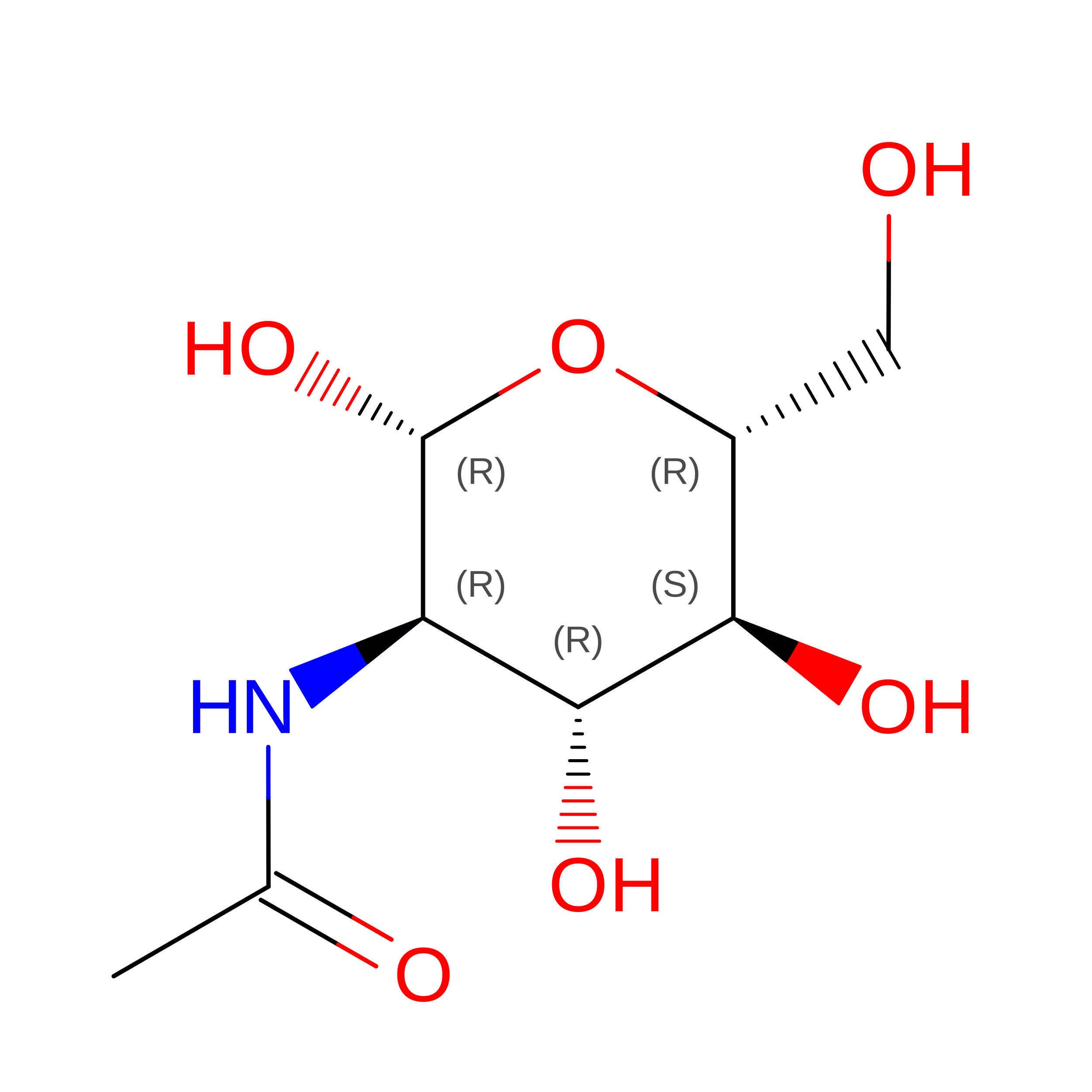
B [auth A]2-acetamido-2-deoxy-beta-D-glucopyranose
C8 H15 N O6
OVRNDRQMDRJTHS-FMDGEEDCSA-N
SR

Query on SR


Download:Ideal Coordinates CCD File
C [auth A]
D [auth A]
E [auth A]
F [auth A]
G [auth A]
C [auth A],
D [auth A],
E [auth A],
F [auth A],
G [auth A],
H [auth A],
I [auth A],
J [auth A]
STRONTIUM ION
Sr
PWYYWQHXAPXYMF-UHFFFAOYSA-N
Modified Residues  1 Unique
IDChains TypeFormula2D DiagramParent
CGU
Query on CGU
A
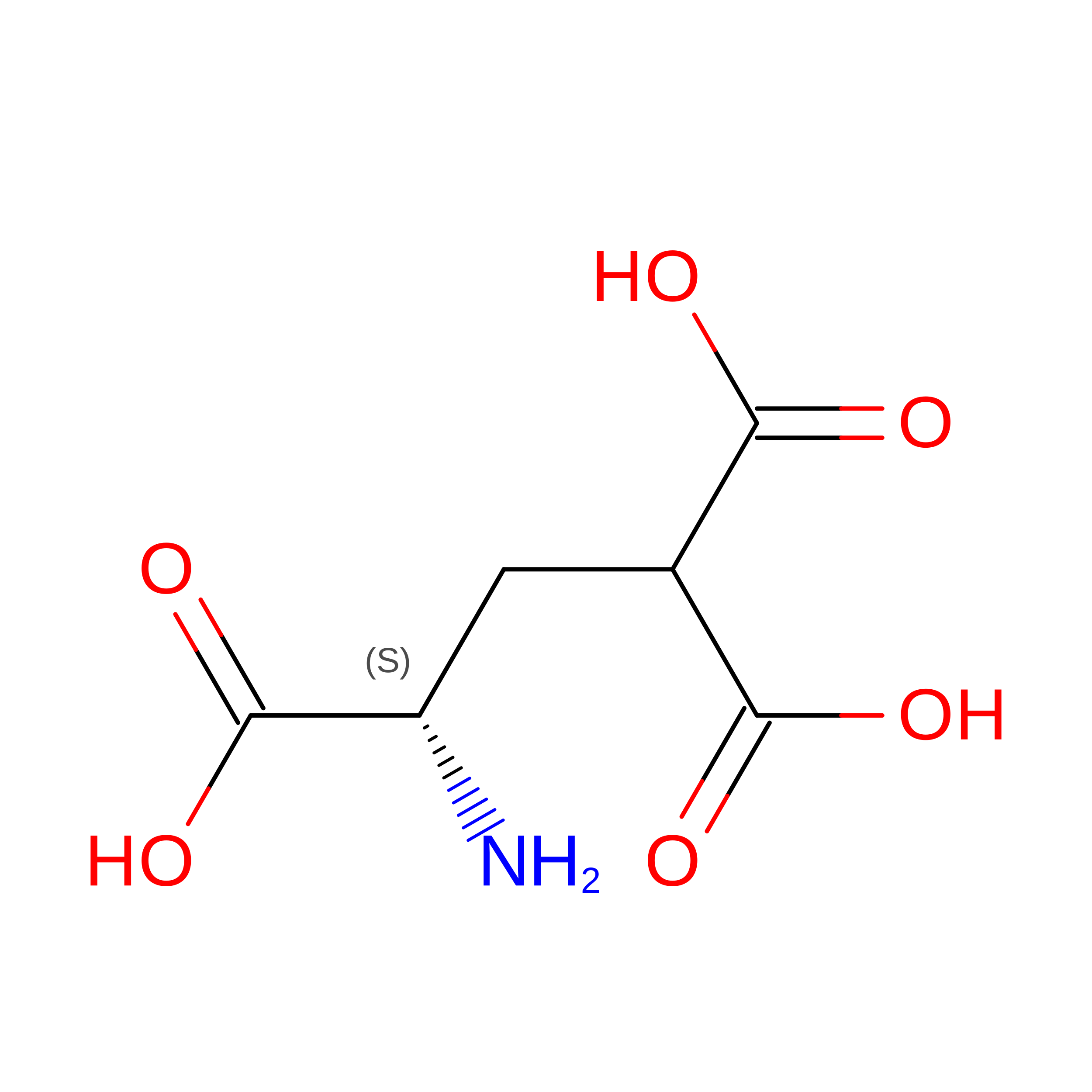
L-PEPTIDE LINKINGC6 H9 N O6GLU

Experimental Data & Validation

Experimental Data

  • Method: X-RAY DIFFRACTION
  • Resolution: 2.50 Å
  • R-Value Observed: 0.167 (Depositor) 
Space Group: P 21 21 21
Unit Cell:
Length ( Å )Angle ( ˚ )
a = 39.69α = 90
b = 54.12β = 90
c = 131.17γ = 90
Software Package:
Software NamePurpose
PROFFTrefinement
PROLSQrefinement

Structure Validation

View Full Validation Report


Entry History 

Deposition Data

  • Released Date: 1994-05-31 
  • Deposition Author(s): Tulinsky, A.

Revision History  (Full details and data files)

  • Version 1.0: 1994-05-31
    Type: Initial release
  • Version 1.1: 2008-03-25
    Changes: Version format compliance
  • Version 1.2: 2011-07-13
    Changes: Non-polymer description, Version format compliance
  • Version 1.3: 2017-11-29
    Changes: Derived calculations, Other
  • Version 1.4: 2020-07-29
    Type: Remediation
    Reason: Carbohydrate remediation
    Changes: Data collection, Database references, Derived calculations, Structure summary
  • Version 1.5: 2025-03-26
    Changes: Data collection, Database references, Derived calculations, Structure summary