2RDE | pdb_00002rde

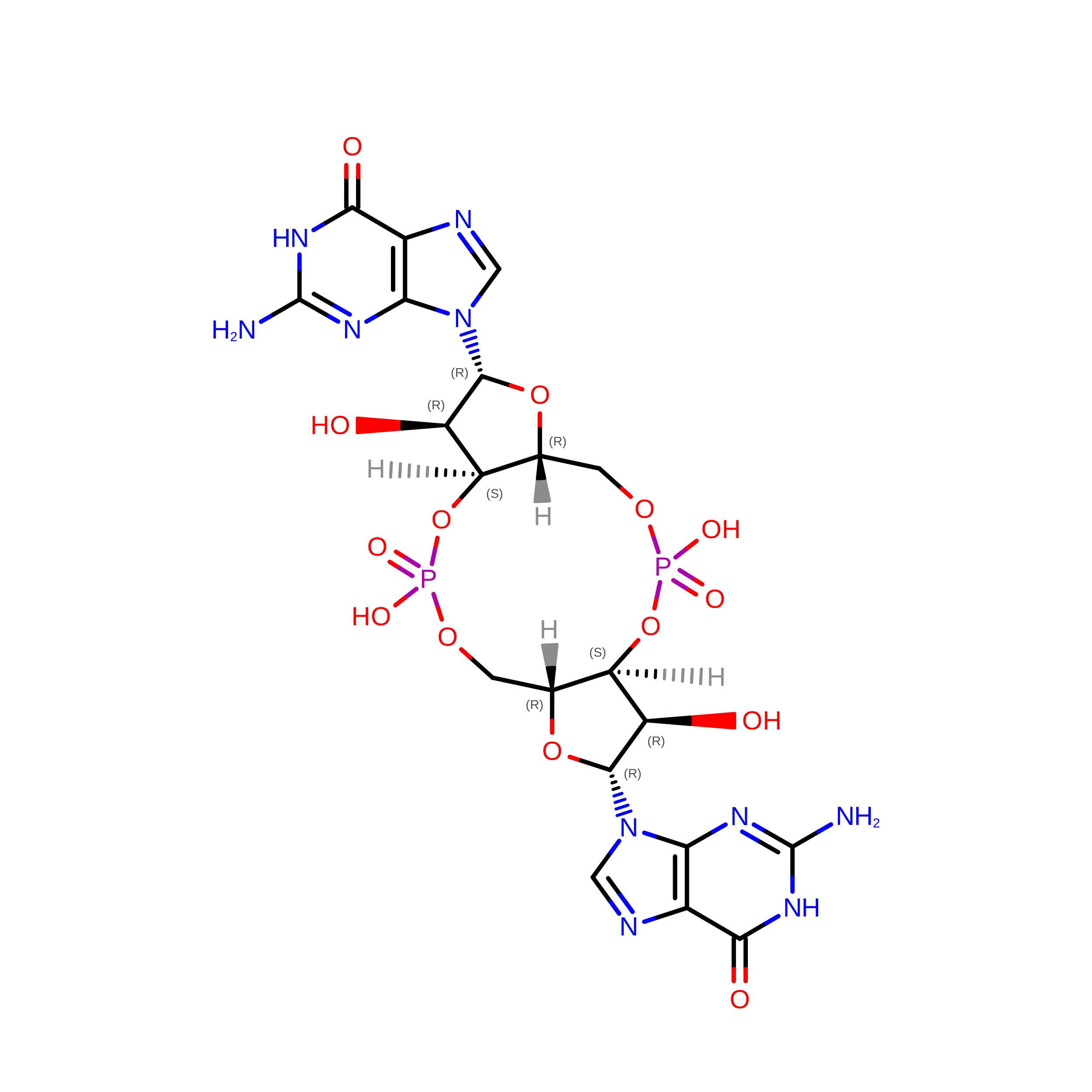
Crystal structure of VCA0042 complexed with c-di-GMP


Experimental Data Snapshot

  • Method: X-RAY DIFFRACTION
  • Resolution: 1.92 Å
  • R-Value Free: 
    0.209 (Depositor), 0.200 (DCC) 
  • R-Value Work: 
    0.195 (Depositor), 0.195 (DCC) 

Starting Model: experimental
View more details

wwPDB Validation 3D Report Full Report

Validation slider image for 2RDE

Ligand Structure Quality Assessment 


This is version 1.3 of the entry. See complete history

Literature

The structural basis of cyclic diguanylate signal transduction by PilZ domains.

Benach, J.Swaminathan, S.S.Tamayo, R.Handelman, S.K.Folta-Stogniew, E.Ramos, J.E.Forouhar, F.Neely, H.Seetharaman, J.Camilli, A.Hunt, J.F.

(2007) EMBO J 26: 5153-5166

  • DOI: https://doi.org/10.1038/sj.emboj.7601918
  • Primary Citation Related Structures: 
    2RDE

  • PubMed Abstract: 

    The second messenger cyclic diguanylate (c-di-GMP) controls the transition between motile and sessile growth in eubacteria, but little is known about the proteins that sense its concentration. Bioinformatics analyses suggested that PilZ domains bind c-di-GMP and allosterically modulate effector pathways. We have determined a 1.9 A crystal structure of c-di-GMP bound to VCA0042/PlzD, a PilZ domain-containing protein from Vibrio cholerae. Either this protein or another specific PilZ domain-containing protein is required for V. cholerae to efficiently infect mice. VCA0042/PlzD comprises a C-terminal PilZ domain plus an N-terminal domain with a similar beta-barrel fold. C-di-GMP contacts seven of the nine strongly conserved residues in the PilZ domain, including three in a seven-residue long N-terminal loop that undergoes a conformational switch as it wraps around c-di-GMP. This switch brings the PilZ domain into close apposition with the N-terminal domain, forming a new allosteric interaction surface that spans these domains and the c-di-GMP at their interface. The very small size of the N-terminal conformational switch is likely to explain the facile evolutionary diversification of the PilZ domain.


  • Organizational Affiliation
    • Department of Biological Sciences, Northeast Structural Genomics Consortium, Columbia University, New York, NY 10027, USA.

Macromolecule Content 

  • Total Structure Weight: 57.87 kDa 
  • Atom Count: 4,194 
  • Modeled Residue Count: 449 
  • Deposited Residue Count: 502 
  • Unique protein chains: 1

Macromolecules

Find similar proteins by:|  3D Structure
Entity ID: 1
MoleculeChains  Sequence LengthOrganismDetailsImage
Uncharacterized protein VCA0042
A, B
251Vibrio cholerae O395Mutation(s): 0 
Gene Names: vca0042VC0395_0091
UniProt
Find proteins for A0A0H3ADR8 (Vibrio cholerae serotype O1 (strain ATCC 39541 / Classical Ogawa 395 / O395))
Explore A0A0H3ADR8 
Go to UniProtKB:  A0A0H3ADR8
Entity Groups
Sequence Clusters30% Identity50% Identity70% Identity90% Identity95% Identity100% Identity
UniProt GroupA0A0H3ADR8
Sequence Annotations
Expand
Reference Sequence

Small Molecules

Ligands 1 Unique
IDChains Name / Formula / InChI Key2D Diagram3D Interactions
C2E

Query on C2E


Download:Ideal Coordinates CCD File
C [auth A],
D [auth B]
9,9'-[(2R,3R,3aS,5S,7aR,9R,10R,10aS,12S,14aR)-3,5,10,12-tetrahydroxy-5,12-dioxidooctahydro-2H,7H-difuro[3,2-d:3',2'-j][1,3,7,9,2,8]tetraoxadiphosphacyclododecine-2,9-diyl]bis(2-amino-1,9-dihydro-6H-purin-6-one)
C20 H24 N10 O14 P2
PKFDLKSEZWEFGL-MHARETSRSA-N

Experimental Data & Validation

Experimental Data

  • Method: X-RAY DIFFRACTION
  • Resolution: 1.92 Å
  • R-Value Free:  0.209 (Depositor), 0.200 (DCC) 
  • R-Value Work:  0.195 (Depositor), 0.195 (DCC) 
Space Group: P 1
Unit Cell:
Length ( Å )Angle ( ˚ )
a = 47.006α = 99.88
b = 55.4β = 97.09
c = 58.044γ = 106.8
Software Package:
Software NamePurpose
DENZOdata reduction
SCALEPACKdata scaling
CNSrefinement
PDB_EXTRACTdata extraction
ADSCdata collection
HKL-2000data reduction
COMOphasing

Structure Validation

View Full Validation Report


Ligand Structure Quality Assessment 


Entry History 

Revision History  (Full details and data files)

  • Version 1.0: 2007-10-30
    Type: Initial release
  • Version 1.1: 2011-07-13
    Changes: Source and taxonomy, Version format compliance
  • Version 1.2: 2017-10-25
    Changes: Refinement description
  • Version 1.3: 2023-08-30
    Changes: Data collection, Database references, Derived calculations, Refinement description, Structure summary