2R0T | pdb_00002r0t

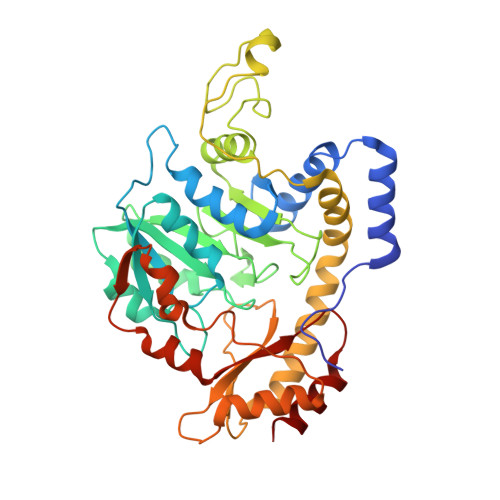
Crystal structure of GDP-4-keto-6-deoxymannose-3-dehydratase with a trapped PLP-glutamate geminal diamine


Experimental Data Snapshot

  • Method: X-RAY DIFFRACTION
  • Resolution: 1.90 Å
  • R-Value Free: 
    0.255 (Depositor) 
  • R-Value Work: 
    0.183 (Depositor), 0.179 (DCC) 
  • R-Value Observed: 
    0.185 (Depositor) 

Starting Model: experimental
View more details

wwPDB Validation 3D Report Full Report

Validation slider image for 2R0T

Ligand Structure Quality Assessment 


This is version 1.6 of the entry. See complete history

Literature

A Structural Study of GDP-4-Keto-6-Deoxy-d-Mannose-3-Dehydratase: Caught in the Act of Geminal Diamine Formation

Cook, P.D.Holden, H.M.

(2007) Biochemistry 46: 14215-14224

  • DOI: https://doi.org/10.1021/bi701686s
  • Primary Citation Related Structures: 
    2R0T

  • PubMed Abstract: 

    Di- and trideoxysugars are an important class of carbohydrates synthesized by certain plants, fungi, and bacteria. Colitose, for example, is a 3,6-dideoxysugar found in the O-antigens of Gram-negative bacteria such as Escherichia coli, Salmonella enterica, Yersinia pseudotuberculosis, and Vibrio cholerae, among others. These types of dideoxysugars are thought to serve as antigenic determinants and to play key roles in bacterial defense and survival. Four enzymes are required for the biochemical synthesis of colitose starting from mannose-1-phosphate. The focus of this investigation, GDP-4-keto-6-deoxy-d-mannose-3-dehydratase (ColD), catalyzes the third step in the pathway, namely the PLP-dependent removal of the C3'-hydroxyl group from GDP-4-keto-6-deoxymannose. Whereas most PLP-dependent enzymes contain an active site lysine, ColD utilizes a histidine as its catalytic acid/base. The ping-pong mechanism of the enzyme first involves the conversion of PLP to PMP followed by the dehydration step. Here we present the three-dimensional structure of a site-directed mutant form of ColD whereby the active site histidine has been replaced with a lysine. The electron density reveals that the geminal diamine, a tetrahedral intermediate in the formation of PMP from PLP, has been trapped within the active site region. Functional assays further demonstrate that this mutant form of ColD cannot catalyze the dehydration reaction.


  • Organizational Affiliation
    • Department of Biochemistry, University of Wisconsin, Madison, Wisconsin 53706, USA.

Macromolecule Content 

  • Total Structure Weight: 89.44 kDa 
  • Atom Count: 6,494 
  • Modeled Residue Count: 772 
  • Deposited Residue Count: 780 
  • Unique protein chains: 1

Macromolecules

Find similar proteins by:|  3D Structure
Entity ID: 1
MoleculeChains  Sequence LengthOrganismDetailsImage
Pyridoxamine 5-phosphate-dependent dehydrase
A, B
390Escherichia coliMutation(s): 1 
Gene Names: wbdK
EC: 2.6.1
UniProt
Find proteins for Q9F118 (Escherichia coli)
Explore Q9F118 
Go to UniProtKB:  Q9F118
Entity Groups
Sequence Clusters30% Identity50% Identity70% Identity90% Identity95% Identity100% Identity
UniProt GroupQ9F118
Sequence Annotations
Expand
Reference Sequence

Small Molecules

Ligands 1 Unique
IDChains Name / Formula / InChI Key2D Diagram3D Interactions
PGU

Query on PGU


Download:Ideal Coordinates CCD File
C [auth A],
D [auth B]
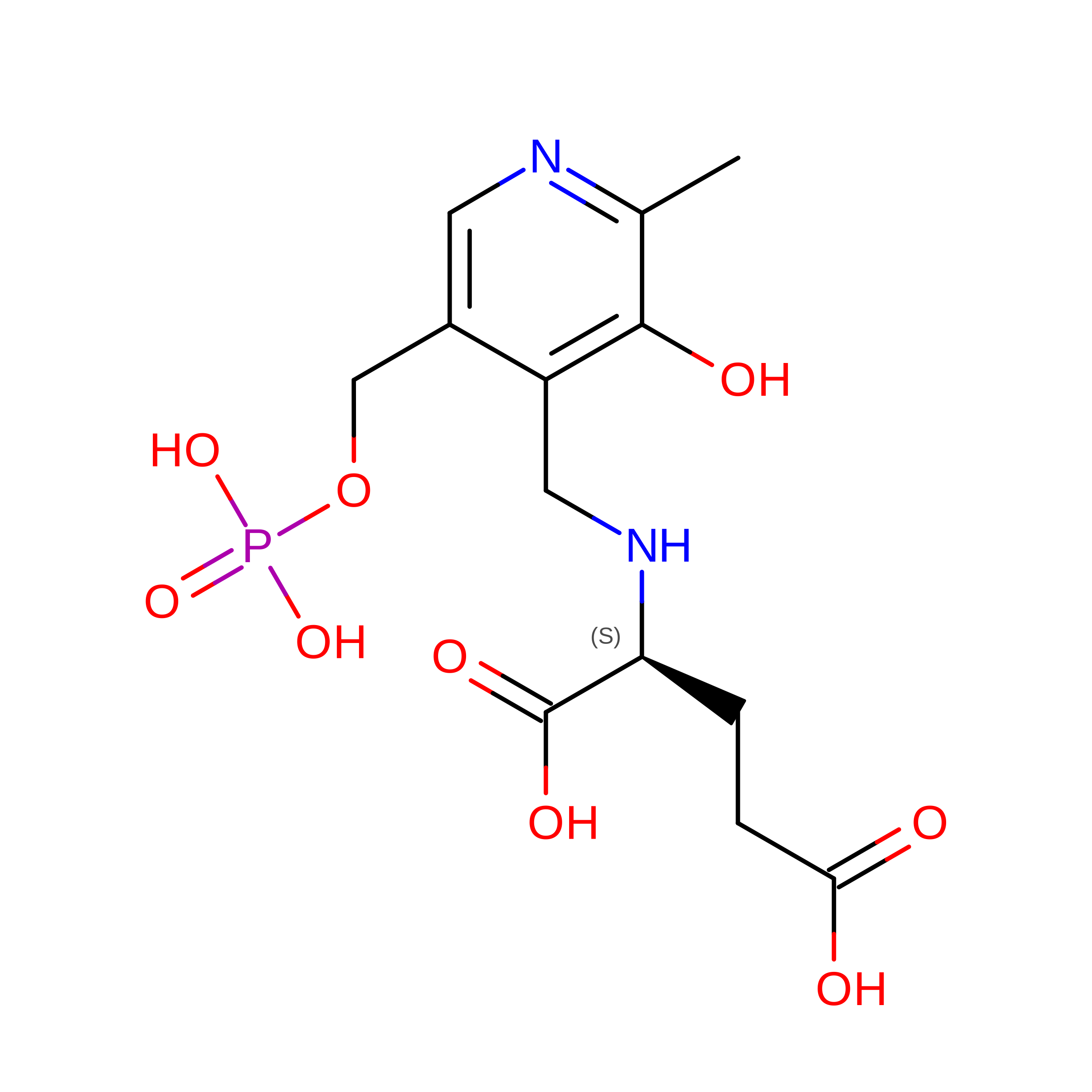
N-({3-hydroxy-2-methyl-5-[(phosphonooxy)methyl]pyridin-4-yl}methyl)-L-glutamic acid
C13 H19 N2 O9 P
JMRKOGDJNHPMHS-JTQLQIEISA-N

Experimental Data & Validation

Experimental Data

  • Method: X-RAY DIFFRACTION
  • Resolution: 1.90 Å
  • R-Value Free:  0.255 (Depositor) 
  • R-Value Work:  0.183 (Depositor), 0.179 (DCC) 
  • R-Value Observed: 0.185 (Depositor) 
Space Group: P 1 21 1
Unit Cell:
Length ( Å )Angle ( ˚ )
a = 69.908α = 90
b = 72.905β = 107.94
c = 86.959γ = 90
Software Package:
Software NamePurpose
EPMRphasing
TNTrefinement
PDB_EXTRACTdata extraction
cosmodata collection
SAINTdata reduction
SADABSdata scaling

Structure Validation

View Full Validation Report


Ligand Structure Quality Assessment 


Entry History 

Deposition Data

Revision History  (Full details and data files)

  • Version 1.0: 2007-12-18
    Type: Initial release
  • Version 1.1: 2011-07-13
    Changes: Version format compliance
  • Version 1.2: 2016-12-14
    Changes: Structure summary
  • Version 1.3: 2020-09-09
    Changes: Database references, Derived calculations, Structure summary
  • Version 1.4: 2021-10-20
    Changes: Database references
  • Version 1.5: 2023-08-30
    Changes: Data collection, Refinement description
  • Version 1.6: 2024-11-06
    Changes: Structure summary