2QXG | pdb_00002qxg

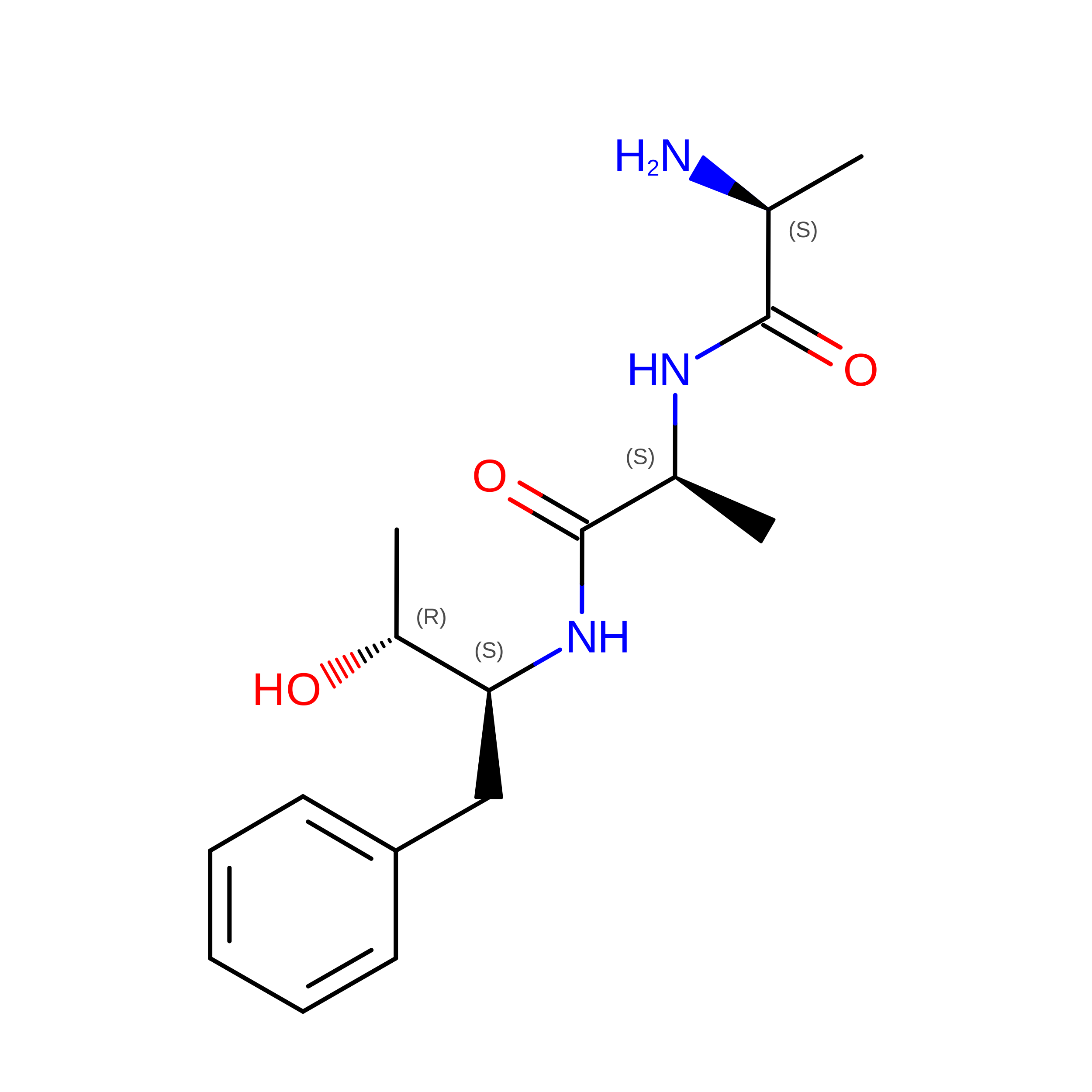
Crystal Structure of Human Kallikrein 7 in Complex with Ala-Ala-Phe-chloromethylketone


Experimental Data Snapshot

  • Method: X-RAY DIFFRACTION
  • Resolution: 2.60 Å
  • R-Value Free: 
    0.292 (Depositor), 0.300 (DCC) 
  • R-Value Work: 
    0.266 (Depositor), 0.273 (DCC) 
  • R-Value Observed: 
    0.266 (Depositor) 

Starting Model: experimental
View more details

wwPDB Validation 3D Report Full Report

Validation slider image for 2QXG

Ligand Structure Quality Assessment 


This is version 1.3 of the entry. See complete history

Literature

Chymotryptic specificity determinants in the 1.0 A structure of the zinc-inhibited human tissue kallikrein 7.

Debela, M.Hess, P.Magdolen, V.Schechter, N.M.Steiner, T.Huber, R.Bode, W.Goettig, P.

(2007) Proc Natl Acad Sci U S A 104: 16086-16091

  • DOI: https://doi.org/10.1073/pnas.0707811104
  • Primary Citation Related Structures: 
    2QXG, 2QXH, 2QXI, 2QXJ

  • PubMed Abstract: 

    hK7 or human stratum corneum chymotryptic enzyme belongs to the human tissue kallikrein (hKs) serine proteinase family and is strongly expressed in the upper layers of the epidermis. It participates in skin desquamation but is also implicated in diverse skin diseases and is a potential biomarker of ovarian cancer. We have solved x-ray structures of recombinant active hK7 at medium and atomic resolution in the presence of the inhibitors succinyl-Ala-Ala-Pro-Phe-chloromethyl ketone and Ala-Ala-Phe-chloromethyl ketone. The most distinguishing features of hK7 are the short 70-80 loop and the unique S1 pocket, which prefers P1 Tyr residues, as shown by kinetic data. Similar to several other kallikreins, the enzyme activity is inhibited by Zn(2+) and Cu(2+) at low micromolar concentrations. Biochemical analyses of the mutants H99A and H41F confirm that only the metal-binding site at His(99) close to the catalytic triad accounts for the noncompetitive Zn(2+) inhibition type. Additionally, hK7 exhibits large positively charged surface patches, representing putative exosites for prime side substrate recognition.


  • Organizational Affiliation
    • Max-Planck-Institut für Biochemie, Proteinase Research Group, Am Klopferspitz 18, 82152 Martinsried, Germany.

Macromolecule Content 

  • Total Structure Weight: 49.58 kDa 
  • Atom Count: 3,684 
  • Modeled Residue Count: 448 
  • Deposited Residue Count: 448 
  • Unique protein chains: 1

Macromolecules

Find similar proteins by:|  3D Structure
Entity ID: 1
MoleculeChains  Sequence LengthOrganismDetailsImage
Kallikrein-7
A, B
224Homo sapiensMutation(s): 0 
Gene Names: KLK7PRSS6SCCE
EC: 3.4.21.117
UniProt & NIH Common Fund Data Resources
Find proteins for P49862 (Homo sapiens)
Explore P49862 
Go to UniProtKB:  P49862
PHAROS:  P49862
GTEx:  ENSG00000169035 
Entity Groups
Sequence Clusters30% Identity50% Identity70% Identity90% Identity95% Identity100% Identity
UniProt GroupP49862
Sequence Annotations
Expand
Reference Sequence

Small Molecules

Experimental Data & Validation

Experimental Data

  • Method: X-RAY DIFFRACTION
  • Resolution: 2.60 Å
  • R-Value Free:  0.292 (Depositor), 0.300 (DCC) 
  • R-Value Work:  0.266 (Depositor), 0.273 (DCC) 
  • R-Value Observed: 0.266 (Depositor) 
Space Group: P 1 21 1
Unit Cell:
Length ( Å )Angle ( ˚ )
a = 66.603α = 90
b = 42.708β = 108.53
c = 84.882γ = 90
Software Package:
Software NamePurpose
CNSrefinement
HKL-2000data reduction
HKL-2000data scaling
PHASERphasing

Structure Validation

View Full Validation Report


Ligand Structure Quality Assessment 


Entry History 

Deposition Data

Revision History  (Full details and data files)

  • Version 1.0: 2008-01-08
    Type: Initial release
  • Version 1.1: 2011-07-13
    Changes: Version format compliance
  • Version 1.2: 2023-08-30
    Changes: Data collection, Database references, Derived calculations, Refinement description
  • Version 1.3: 2024-10-30
    Changes: Structure summary