2QF6 | pdb_00002qf6

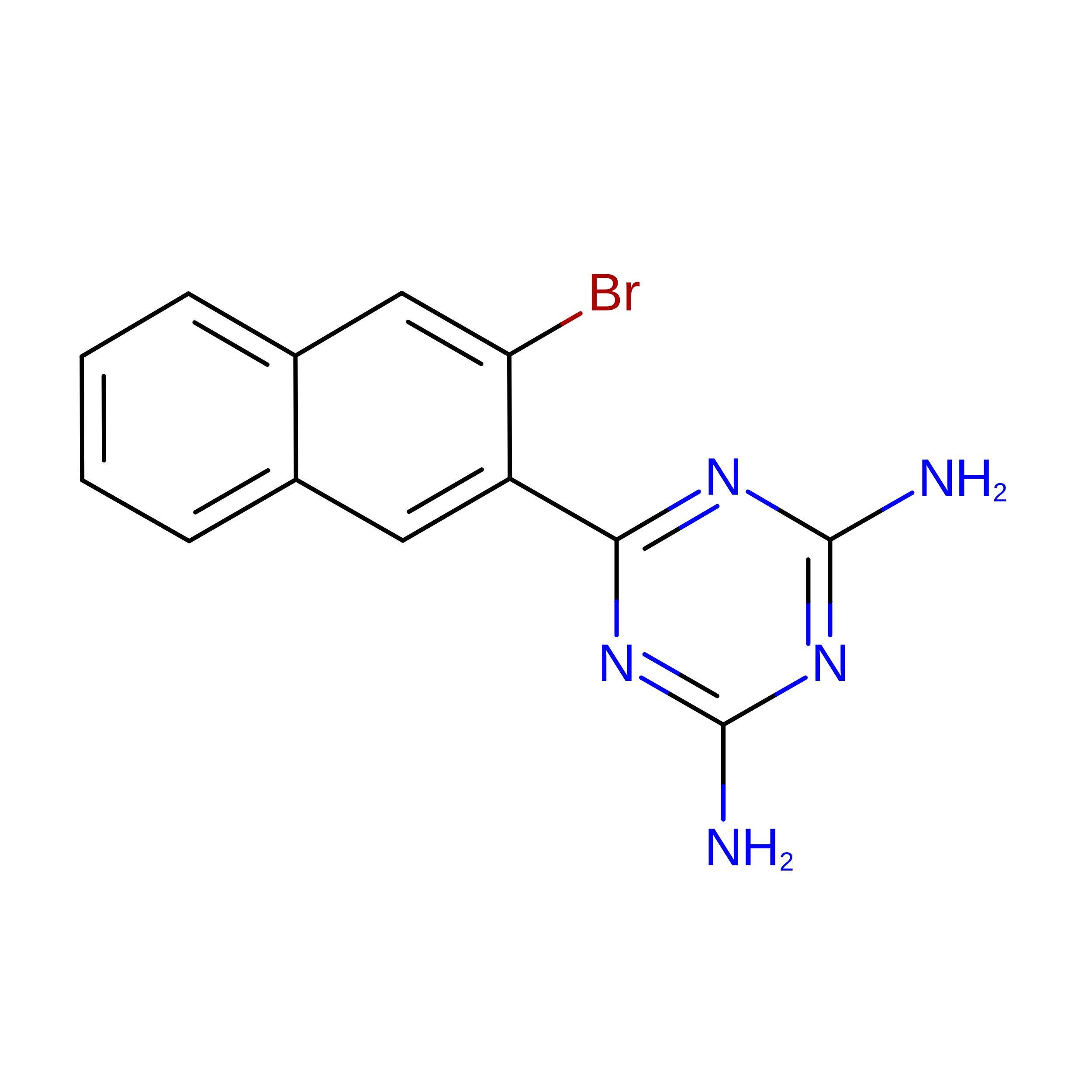
HSP90 complexed with A56322


Experimental Data Snapshot

  • Method: X-RAY DIFFRACTION
  • Resolution: 3.10 Å
  • R-Value Free: 
    0.284 (Depositor) 
  • R-Value Work: 
    0.231 (Depositor) 
  • R-Value Observed: 
    0.290 (Depositor) 

Starting Model: experimental
View more details

wwPDB Validation 3D Report Full Report

Validation slider image for 2QF6

This is version 1.2 of the entry. See complete history

Literature

Discovery and design of novel HSP90 inhibitors using multiple fragment-based design strategies.

Huth, J.R.Park, C.Petros, A.M.Kunzer, A.R.Wendt, M.D.Wang, X.Lynch, C.L.Mack, J.C.Swift, K.M.Judge, R.A.Chen, J.Richardson, P.L.Jin, S.Tahir, S.K.Matayoshi, E.D.Dorwin, S.A.Ladror, U.S.Severin, J.M.Walter, K.A.Bartley, D.M.Fesik, S.W.Elmore, S.W.Hajduk, P.J.

(2007) Chem Biol Drug Des 70: 1-12

  • DOI: https://doi.org/10.1111/j.1747-0285.2007.00535.x
  • Primary Citation Related Structures: 
    2QF6, 2QFO, 2QG0, 2QG2

  • PubMed Abstract: 

    The molecular chaperone HSP90 has been shown to facilitate cancer cell survival by stabilizing key proteins responsible for a malignant phenotype. We report here the results of parallel fragment-based drug design approaches in the design of novel HSP90 inhibitors. Initial aminopyrimidine leads were elaborated using high-throughput organic synthesis to yield nanomolar inhibitors of the enzyme. Second site leads were also identified which bound to HSP90 in two distinct conformations, an 'open' and 'closed' form. Intriguingly, linked fragment approaches targeting both of these conformations were successful in producing novel, micromolar inhibitors. Overall, this study shows that, with only a few fragment hits, multiple lead series can be generated for HSP90 due to the inherent flexibility of the active site. Thus, ample opportunities exist to use these lead series in the development of clinically useful HSP90 inhibitors for the treatment of cancers.


  • Organizational Affiliation
    • Global Pharmaceutical Research and Development, Abbott Laboratories, Abbott Park, IL 60064, USA.

Macromolecule Content 

  • Total Structure Weight: 93.86 kDa 
  • Atom Count: 6,718 
  • Modeled Residue Count: 828 
  • Deposited Residue Count: 828 
  • Unique protein chains: 1

Macromolecules

Find similar proteins by:|  3D Structure
Entity ID: 1
MoleculeChains  Sequence LengthOrganismDetailsImage
Heat shock protein HSP 90-alpha
A, B, C, D
207Homo sapiensMutation(s): 0 
Gene Names: HSP90AA1HSP90AHSPC1HSPCA
EC: 3.6.4.10
UniProt & NIH Common Fund Data Resources
Find proteins for P07900 (Homo sapiens)
Explore P07900 
Go to UniProtKB:  P07900
PHAROS:  P07900
GTEx:  ENSG00000080824 
Entity Groups
Sequence Clusters30% Identity50% Identity70% Identity90% Identity95% Identity100% Identity
UniProt GroupP07900
Sequence Annotations
Expand
Reference Sequence

Experimental Data & Validation

Experimental Data

  • Method: X-RAY DIFFRACTION
  • Resolution: 3.10 Å
  • R-Value Free:  0.284 (Depositor) 
  • R-Value Work:  0.231 (Depositor) 
  • R-Value Observed: 0.290 (Depositor) 
Space Group: P 43 21 2
Unit Cell:
Length ( Å )Angle ( ˚ )
a = 118.824α = 90
b = 118.824β = 90
c = 180.779γ = 90
Software Package:
Software NamePurpose
CNXrefinement
HKL-2000data collection
HKL-2000data reduction
HKL-2000data scaling
CNSphasing

Structure Validation

View Full Validation Report


Entry History 

Deposition Data

  • Released Date: 2008-07-01 
  • Deposition Author(s): Park, C.H.

Revision History  (Full details and data files)

  • Version 1.0: 2008-07-01
    Type: Initial release
  • Version 1.1: 2011-07-13
    Changes: Version format compliance
  • Version 1.2: 2023-08-30
    Changes: Data collection, Database references, Derived calculations, Refinement description