2PL7 | pdb_00002pl7

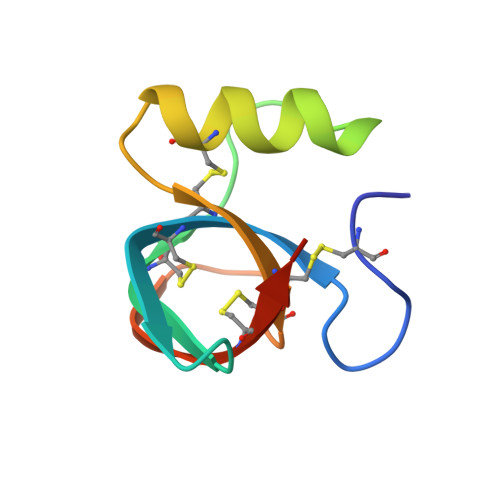
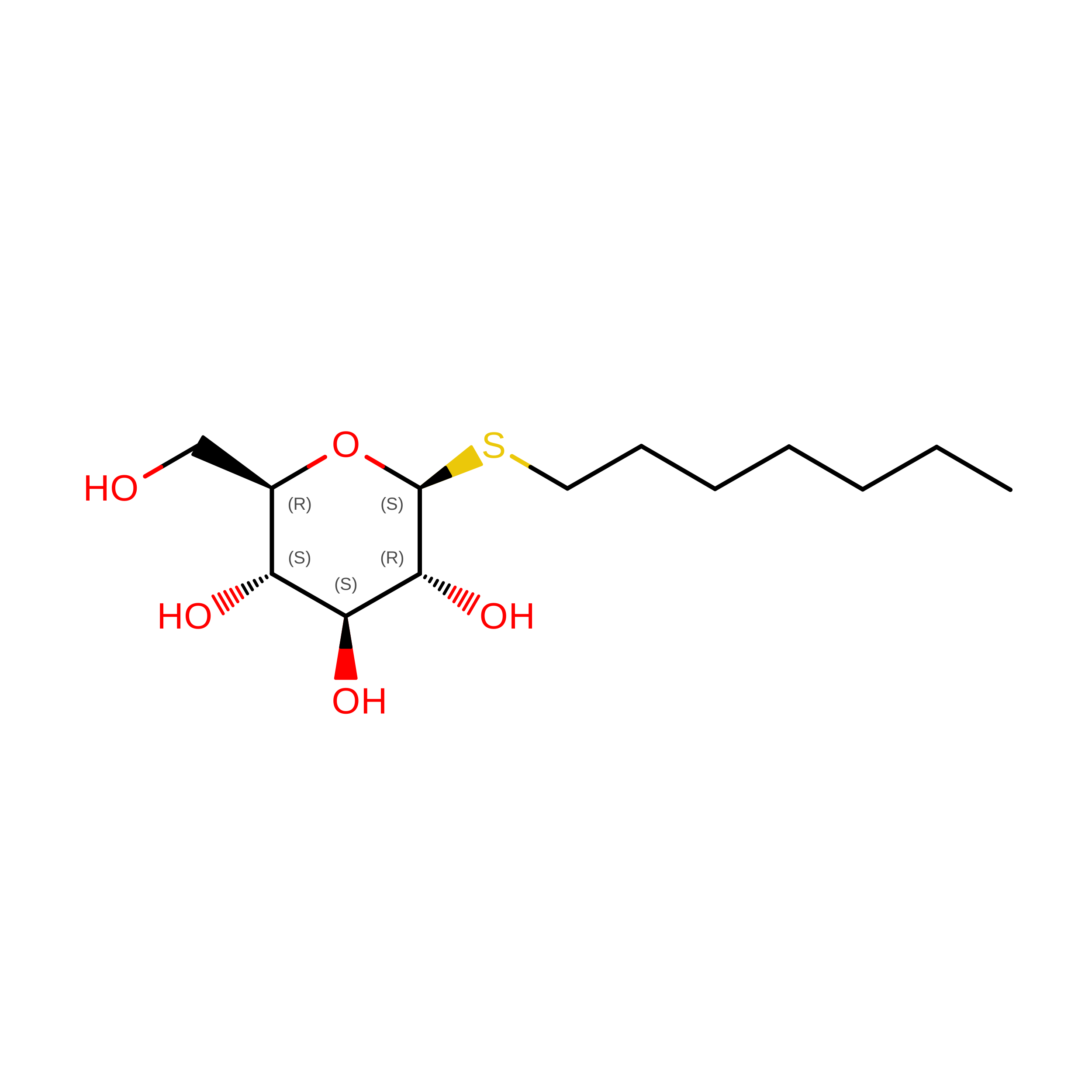
Orhorhombic crystal structure of hydrophobin HFBII in the presence of a detergent


Experimental Data Snapshot

  • Method: X-RAY DIFFRACTION
  • Resolution: 1.00 Å
  • R-Value Free: 
    0.151 (Depositor) 
  • R-Value Observed: 
    0.180 (Depositor) 

Starting Model: experimental
View more details

wwPDB Validation 3D Report Full Report

Validation slider image for 2PL7

Ligand Structure Quality Assessment 


This is version 1.5 of the entry. See complete history

Literature

Crystal Structures of Hydrophobin HFBII in the Presence of Detergent Implicate the Formation of Fibrils and Monolayer Films.

Kallio, J.M.Linder, M.B.Rouvinen, J.

(2007) J Biological Chem 282: 28733-28739

  • DOI: https://doi.org/10.1074/jbc.M704238200
  • Primary Citation Related Structures: 
    2PL6, 2PL7

  • PubMed Abstract: 

    Hydrophobins are small, amphiphilic proteins secreted by filamentous fungi. Their functionality arises from a patch of hydrophobic residues on the protein surface. Spontaneous self-assembly of hydrophobins leads to the formation of an amphiphilic layer that remarkably reduces the surface tension of water. We have determined by x-ray diffraction two new crystal structures of Trichoderma reesei hydrophobin HFBII in the presence of a detergent. The monoclinic crystal structure (2.2A resolution, R = 22, R(free) = 28) is composed of layers of hydrophobin molecules where the hydrophobic surface areas of the molecules are aligned within the layer. Viewed perpendicular to the aligned hydrophobic surface areas, the molecules in the layer pack together to form six-membered rings, thus leaving small pores in the layer. Similar packing has been observed in the atomic force microscopy images of the self-assembled layers of class II hydrophobin, indicating that the crystal structure resembles that of natural hydrophobin film. The orthorhombic crystal structure (1.0 A resolution, R = 13, R(free) = 15) is composed of fiber-like arrays of protein molecules. Rodlet structures have been observed on amphiphilic layers formed by class I hydrophobins; fibrils of class II hydrophobins appear by vigorous shaking. We propose that the structure of the fibrils and/or rodlets is similar to that observed in the crystal structure.


  • Organizational Affiliation
    • Department of Chemistry, University of Joensuu, P. O. Box 111, 80101 Joensuu, Finland. Electronic address: johanna.kallio@joensuu.fi.

Macromolecule Content 

  • Total Structure Weight: 14.79 kDa 
  • Atom Count: 1,139 
  • Modeled Residue Count: 134 
  • Deposited Residue Count: 142 
  • Unique protein chains: 1

Macromolecules

Find similar proteins by:|  3D Structure
Entity ID: 1
MoleculeChains  Sequence LengthOrganismDetailsImage
Hydrophobin-2
A, B
71Trichoderma reeseiMutation(s): 0 
UniProt
Find proteins for P79073 (Hypocrea jecorina)
Explore P79073 
Go to UniProtKB:  P79073
Entity Groups
Sequence Clusters30% Identity50% Identity70% Identity90% Identity95% Identity100% Identity
UniProt GroupP79073
Sequence Annotations
Expand
Reference Sequence

Small Molecules

Experimental Data & Validation

Experimental Data

  • Method: X-RAY DIFFRACTION
  • Resolution: 1.00 Å
  • R-Value Free:  0.151 (Depositor) 
  • R-Value Observed: 0.180 (Depositor) 
Space Group: P 21 21 21
Unit Cell:
Length ( Å )Angle ( ˚ )
a = 25.3α = 90
b = 57.1β = 90
c = 72.1γ = 90
Software Package:
Software NamePurpose
XSCALEdata scaling
PHASERphasing
SHELXrefinement
PDB_EXTRACTdata extraction
MAR345dtbdata collection
XDSdata reduction
SHELXL-97refinement

Structure Validation

View Full Validation Report


Ligand Structure Quality Assessment 


Entry History 

Deposition Data

Revision History  (Full details and data files)

  • Version 1.0: 2007-07-17
    Type: Initial release
  • Version 1.1: 2007-09-27
    Changes: Version format compliance
  • Version 1.2: 2011-07-13
    Changes: Version format compliance
  • Version 1.3: 2020-07-29
    Type: Remediation
    Reason: Carbohydrate remediation
    Changes: Data collection, Derived calculations, Structure summary
  • Version 1.4: 2023-08-30
    Changes: Data collection, Database references, Refinement description, Structure summary
  • Version 1.5: 2024-11-13
    Changes: Structure summary