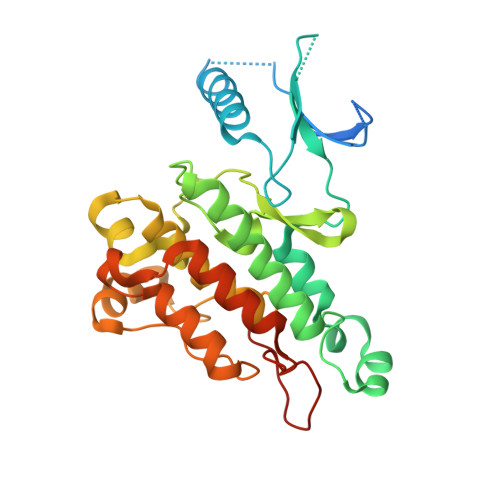
2OSC | pdb_00002osc

Synthesis, Structural Analysis, and SAR Studies of Triazine Derivatives as Potent, Selective Tie-2 Inhibitors


Experimental Data Snapshot

  • Method: X-RAY DIFFRACTION
  • Resolution: 2.80 Å
  • R-Value Free: 
    0.306 (Depositor) 
  • R-Value Work: 
    0.251 (Depositor) 

wwPDB Validation 3D Report Full Report

Validation slider image for 2OSC

This is version 1.4 of the entry. See complete history

Literature

Synthesis, structural analysis, and SAR studies of triazine derivatives as potent, selective Tie-2 inhibitors.

Hodous, B.L.Geuns-Meyer, S.D.Hughes, P.E.Albrecht, B.K.Bellon, S.Caenepeel, S.Cee, V.J.Chaffee, S.C.Emery, M.Fretland, J.Gallant, P.Gu, Y.Johnson, R.E.Kim, J.L.Long, A.M.Morrison, M.Olivieri, P.R.Patel, V.F.Polverino, A.Rose, P.Wang, L.Zhao, H.

(2007) Bioorg Med Chem Lett 17: 2886-2889

  • DOI: https://doi.org/10.1016/j.bmcl.2007.02.067
  • Primary Citation Related Structures: 
    2OO8, 2OSC

  • PubMed Abstract: 

    A novel class of selective Tie-2 inhibitors was derived from a multi-kinase inhibitor 1. By reversing the amide connectivity and incorporating aminotriazine or aminopyridine hinge-binding moieties, excellent Tie-2 potency and KDR selectivity could be achieved with 3-substituted terminal aryl rings. X-ray co-crystal structure analysis aided inhibitor design. This series was evaluated on the basis of potency, selectivity, and rat pharmacokinetic parameters.


  • Organizational Affiliation
    • Department of Medicinal Chemistry, Amgen Inc., One Kendall Square, Building 1000, Cambridge, MA 02139, USA. bhodous@amgen.com

Macromolecule Content 

  • Total Structure Weight: 36.7 kDa 
  • Atom Count: 2,071 
  • Modeled Residue Count: 255 
  • Deposited Residue Count: 317 
  • Unique protein chains: 1

Macromolecules

Find similar proteins by:|  3D Structure
Entity ID: 1
MoleculeChains  Sequence LengthOrganismDetailsImage
Angiopoietin-1 receptor317Homo sapiensMutation(s): 0 
Gene Names: TEKTIE2
EC: 2.7.10.1
UniProt & NIH Common Fund Data Resources
Find proteins for Q02763 (Homo sapiens)
Explore Q02763 
Go to UniProtKB:  Q02763
PHAROS:  Q02763
GTEx:  ENSG00000120156 
Entity Groups
Sequence Clusters30% Identity50% Identity70% Identity90% Identity95% Identity100% Identity
UniProt GroupQ02763
Sequence Annotations
Expand
Reference Sequence

Small Molecules

Ligands 1 Unique
IDChains Name / Formula / InChI Key2D Diagram3D Interactions
MUH

Query on MUH


Download:Ideal Coordinates CCD File
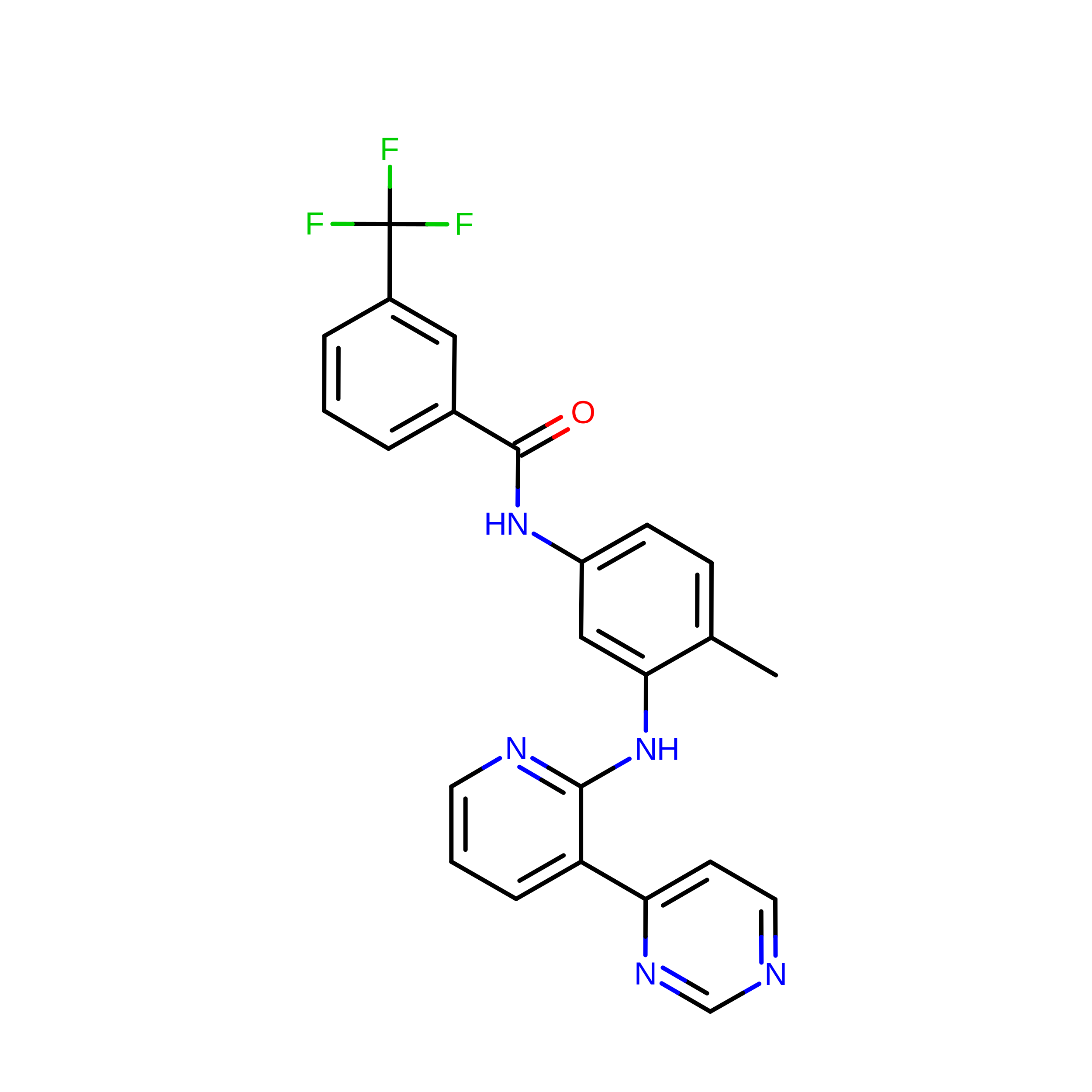
B [auth A]N-{4-METHYL-3-[(3-PYRIMIDIN-4-YLPYRIDIN-2-YL)AMINO]PHENYL}-3-(TRIFLUOROMETHYL)BENZAMIDE
C24 H18 F3 N5 O
NESXBRNDMQUVNG-UHFFFAOYSA-N

Experimental Data & Validation

Experimental Data

  • Method: X-RAY DIFFRACTION
  • Resolution: 2.80 Å
  • R-Value Free:  0.306 (Depositor) 
  • R-Value Work:  0.251 (Depositor) 
Space Group: P 41 21 2
Unit Cell:
Length ( Å )Angle ( ˚ )
a = 62.995α = 90
b = 62.995β = 90
c = 178.814γ = 90
Software Package:
Software NamePurpose
CrystalCleardata collection
AMoREphasing
CNSrefinement
DENZOdata reduction
SCALEPACKdata scaling

Structure Validation

View Full Validation Report


Entry History 

Deposition Data

Revision History  (Full details and data files)

  • Version 1.0: 2007-03-20
    Type: Initial release
  • Version 1.1: 2008-05-01
    Changes: Version format compliance
  • Version 1.2: 2011-07-13
    Changes: Version format compliance
  • Version 1.3: 2018-04-04
    Changes: Data collection
  • Version 1.4: 2024-02-21
    Changes: Data collection, Database references, Derived calculations