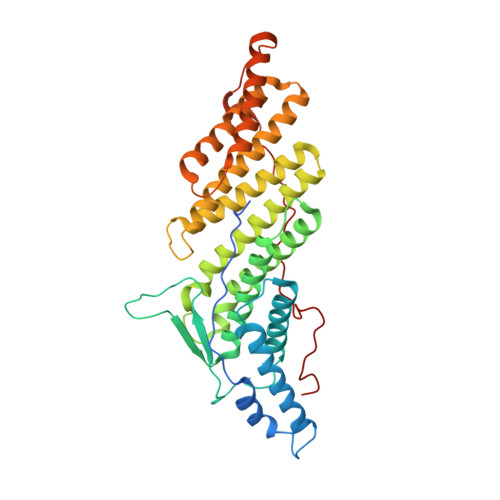
2OEW | pdb_00002oew

Structure of ALIX/AIP1 Bro1 Domain


Experimental Data Snapshot

  • Method: X-RAY DIFFRACTION
  • Resolution: 2.55 Å
  • R-Value Free: 
    0.274 (Depositor), 0.263 (DCC) 
  • R-Value Work: 
    0.208 (Depositor), 0.199 (DCC) 
  • R-Value Observed: 
    0.212 (Depositor) 

Starting Model: experimental
View more details

wwPDB Validation 3D Report Full Report

Validation slider image for 2OEW

This is version 1.4 of the entry. See complete history

Literature

Structural and Biochemical Studies of ALIX/AIP1 and Its Role in Retrovirus Budding

Fisher, R.D.Chung, H.Y.Zhai, Q.Robinson, H.Sundquist, W.I.Hill, C.P.

(2007) Cell 128: 841-852

  • DOI: https://doi.org/10.1016/j.cell.2007.01.035
  • Primary Citation Related Structures: 
    2OEV, 2OEW, 2OEX

  • PubMed Abstract: 

    ALIX/AIP1 functions in enveloped virus budding, endosomal protein sorting, and many other cellular processes. Retroviruses, including HIV-1, SIV, and EIAV, bind and recruit ALIX through YPX(n)L late-domain motifs (X = any residue; n = 1-3). Crystal structures reveal that human ALIX is composed of an N-terminal Bro1 domain and a central domain that is composed of two extended three-helix bundles that form elongated arms that fold back into a "V." The structures also reveal conformational flexibility in the arms that suggests that the V domain may act as a flexible hinge in response to ligand binding. YPX(n)L late domains bind in a conserved hydrophobic pocket on the second arm near the apex of the V, whereas CHMP4/ESCRT-III proteins bind a conserved hydrophobic patch on the Bro1 domain, and both interactions are required for virus budding. ALIX therefore serves as a flexible, extended scaffold that connects retroviral Gag proteins to ESCRT-III and other cellular-budding machinery.


  • Organizational Affiliation
    • Department of Biochemistry, University of Utah School of Medicine, Salt Lake City, UT 84112, USA.

Macromolecule Content 

  • Total Structure Weight: 42.74 kDa 
  • Atom Count: 2,910 
  • Modeled Residue Count: 358 
  • Deposited Residue Count: 380 
  • Unique protein chains: 1

Macromolecules

Find similar proteins by:|  3D Structure
Entity ID: 1
MoleculeChains  Sequence LengthOrganismDetailsImage
Programmed cell death 6-interacting protein380Homo sapiensMutation(s): 0 
Gene Names: PDCD6IPAIP1ALIXKIAA1375
UniProt & NIH Common Fund Data Resources
Find proteins for Q8WUM4 (Homo sapiens)
Explore Q8WUM4 
Go to UniProtKB:  Q8WUM4
PHAROS:  Q8WUM4
GTEx:  ENSG00000170248 
Entity Groups
Sequence Clusters30% Identity50% Identity70% Identity90% Identity95% Identity100% Identity
UniProt GroupQ8WUM4
Sequence Annotations
Expand
Reference Sequence

Experimental Data & Validation

Experimental Data

  • Method: X-RAY DIFFRACTION
  • Resolution: 2.55 Å
  • R-Value Free:  0.274 (Depositor), 0.263 (DCC) 
  • R-Value Work:  0.208 (Depositor), 0.199 (DCC) 
  • R-Value Observed: 0.212 (Depositor) 
Space Group: C 1 2 1
Unit Cell:
Length ( Å )Angle ( ˚ )
a = 120.678α = 90
b = 63.243β = 122.15
c = 76.384γ = 90
Software Package:
Software NamePurpose
DENZOdata reduction
SCALEPACKdata scaling
PHASERphasing
REFMACrefinement
PDB_EXTRACTdata extraction
CrystalCleardata collection

Structure Validation

View Full Validation Report


Entry History 

Deposition Data

Revision History  (Full details and data files)

  • Version 1.0: 2007-03-27
    Type: Initial release
  • Version 1.1: 2008-05-01
    Changes: Version format compliance
  • Version 1.2: 2011-07-13
    Changes: Version format compliance
  • Version 1.3: 2017-10-18
    Changes: Refinement description
  • Version 1.4: 2023-08-30
    Changes: Data collection, Database references, Refinement description