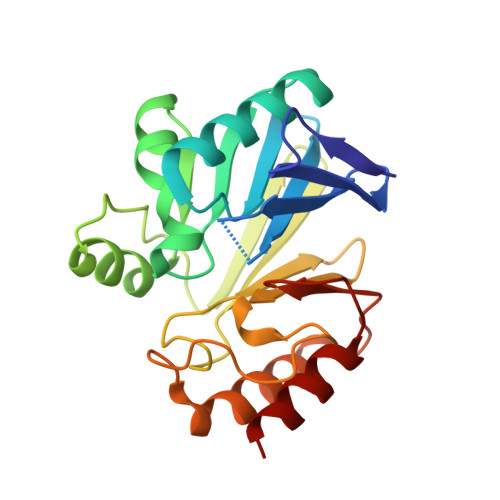
2NXA | pdb_00002nxa

Structure of Zn-dependent Metallo-Beta-Lactamase from Bacillus Cereus R121H, C221D Double Mutant


Experimental Data Snapshot

  • Method: X-RAY DIFFRACTION
  • Resolution: 2.29 Å
  • R-Value Free: 
    0.256 (Depositor) 
  • R-Value Work: 
    0.163 (Depositor) 
  • R-Value Observed: 
    0.167 (Depositor) 

Starting Model: experimental
View more details

wwPDB Validation 3D Report Full Report

Validation slider image for 2NXA

This is version 1.4 of the entry. See complete history

Literature

The Zn2 position in metallo-beta-lactamases is critical for activity: a study on chimeric metal sites on a conserved protein scaffold.

Gonzalez, J.M.Medrano Martin, F.J.Costello, A.L.Tierney, D.L.Vila, A.J.

(2007) J Mol Biology 373: 1141-1156

  • DOI: https://doi.org/10.1016/j.jmb.2007.08.031
  • Primary Citation Related Structures: 
    2NXA, 2NYP, 2NZE, 2NZF

  • PubMed Abstract: 

    Metallo-beta-lactamases (MbetaLs) are bacterial Zn(II)-dependent hydrolases that confer broad-spectrum resistance to beta-lactam antibiotics. These enzymes can be subdivided into three subclasses (B1, B2 and B3) that differ in their metal binding sites and their characteristic tertiary structure. To date there are no clinically useful pan-MbetaL inhibitors available, mainly due to the unawareness of key catalytic features common to all MbetaL brands. Here we have designed, expressed and characterized two double mutants of BcII, a di-Zn(II) B1-MbetaL from Bacillus cereus, namely BcII-R121H/C221D (BcII-HD) and BcII-R121H/C221S (BcII-HS). These mutants display modified environments at the so-called Zn2 site or DCH site, reproducing the metal coordination environments of structurally related metallohydrolases. Through a combination of structural and functional studies, we found that BcII-HD is an impaired beta-lactamase even as a di-Zn(II) enzyme, whereas BcII-HS exhibits the ability to exist as mono or di-Zn(II) species in solution, with different catalytic performances. We show that these effects result from an altered position of Zn2, which is incapable of providing a productive interaction with the substrate beta-lactam ring. These results indicate that the position of Zn2 is essential for a productive substrate binding and hydrolysis.


  • Organizational Affiliation
    • Departamento de Química Biológica, Instituto de Biología Molecular y Celular de Rosario, IBR-CONICET. Facultad de Ciencias Bioquímicas y Farmacéuticas, Universidad Nacional de Rosario, Rosario, S2002LRK, Argentina.

Macromolecule Content 

  • Total Structure Weight: 24.35 kDa 
  • Atom Count: 1,812 
  • Modeled Residue Count: 215 
  • Deposited Residue Count: 221 
  • Unique protein chains: 1

Macromolecules

Find similar proteins by:|  3D Structure
Entity ID: 1
MoleculeChains  Sequence LengthOrganismDetailsImage
Beta-lactamase II221Bacillus cereusMutation(s): 2 
Gene Names: blm
EC: 3.5.2.6
UniProt
Find proteins for P04190 (Bacillus cereus)
Explore P04190 
Go to UniProtKB:  P04190
Entity Groups
Sequence Clusters30% Identity50% Identity70% Identity90% Identity95% Identity100% Identity
UniProt GroupP04190
Sequence Annotations
Expand
Reference Sequence

Small Molecules

Ligands 1 Unique
IDChains Name / Formula / InChI Key2D Diagram3D Interactions
ZN

Query on ZN


Download:Ideal Coordinates CCD File
B [auth A]ZINC ION
Zn
PTFCDOFLOPIGGS-UHFFFAOYSA-N

Experimental Data & Validation

Experimental Data

  • Method: X-RAY DIFFRACTION
  • Resolution: 2.29 Å
  • R-Value Free:  0.256 (Depositor) 
  • R-Value Work:  0.163 (Depositor) 
  • R-Value Observed: 0.167 (Depositor) 
Space Group: C 1 2 1
Unit Cell:
Length ( Å )Angle ( ˚ )
a = 52.471α = 90
b = 61.008β = 92.85
c = 68.674γ = 90
Software Package:
Software NamePurpose
REFMACrefinement
PDB_EXTRACTdata extraction
MAR345dtbdata collection
HKL-2000data reduction
HKL-2000data scaling
AMoREphasing

Structure Validation

View Full Validation Report


Entry History 

Deposition Data

Revision History  (Full details and data files)

  • Version 1.0: 2007-05-22
    Type: Initial release
  • Version 1.1: 2008-05-01
    Changes: Version format compliance
  • Version 1.2: 2011-07-13
    Changes: Version format compliance
  • Version 1.3: 2021-10-20
    Changes: Database references, Derived calculations
  • Version 1.4: 2023-08-30
    Changes: Data collection, Refinement description