Find PDB structures and Computed Structure Models (CSM) by combining queries from tools in this suite: Attribute Search, Sequence Similarity, Sequence Motif, 3D Similarity, and 3D Motif with 'AND' logic.
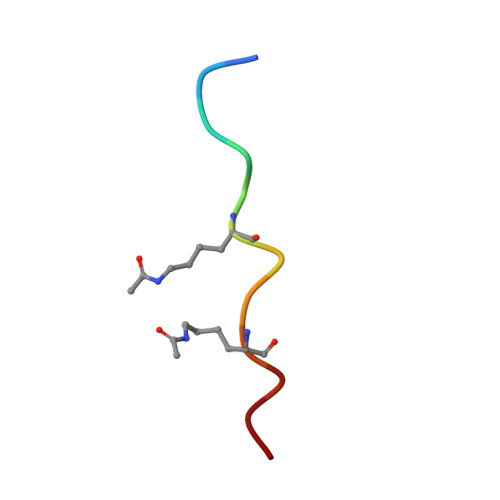
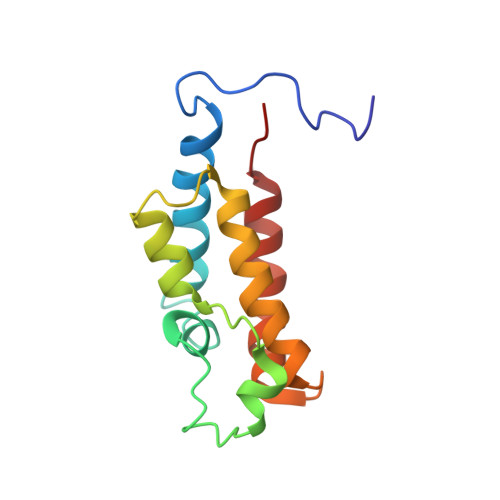
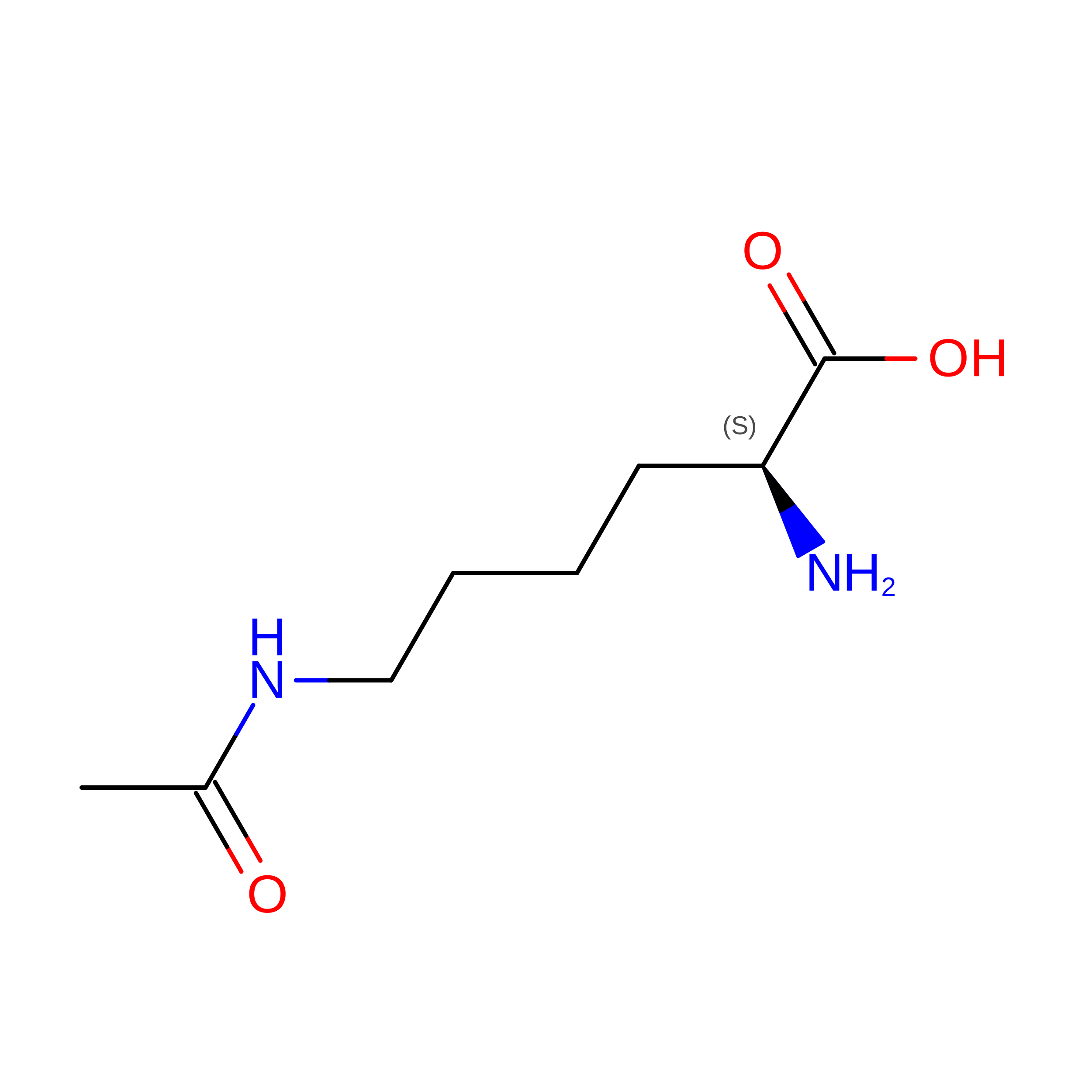
Twist is a key transcription activator of epithelial-mesenchymal transition (EMT). It remains unclear how Twist induces gene expression. Here we report a mechanism by which Twist recruits BRD4 to direct WNT5A expression in basal-like breast cancer (BLBC). Twist contains a "histone H4-mimic" GK-X-GK motif that is diacetylated by Tip60. The diacetylated Twist binds the second bromodomain of BRD4, whose first bromodomain interacts with acetylated H4, thereby constructing an activated Twist/BRD4/P-TEFb/RNA-Pol II complex at the WNT5A promoter and enhancer. Pharmacologic inhibition of the Twist-BRD4 association reduced WNT5A expression and suppressed invasion, cancer stem cell (CSC)-like properties, and tumorigenicity of BLBC cells. Our study indicates that the interaction with BRD4 is critical for the oncogenic function of Twist in BLBC.
Organizational Affiliation:
Department of Molecular and Cellular Biochemistry, College of Medicine, University of Kentucky, Lexington, KY 40506, USA; Markey Cancer Center, College of Medicine, University of Kentucky, Lexington, KY 40506, USA.
Department of Molecular and Cellular Biochemistry, College of Medicine, University of Kentucky, Lexington, KY 40506, USA; Markey Cancer Center, College of Medicine, University of Kentucky, Lexington, KY 40506, USA; Sun Yat-sen University Cancer Center, State Key Laboratory of Oncology in South China, and Collaborative Innovation Center of Cancer Medicine, Guangzhou 510060, China.
Department of Structural and Chemical Biology, Icahn School of Medicine at Mount Sinai, New York, NY 10029, USA.
Department of Molecular and Biomedical Pharmacology, College of Medicine, University of Kentucky, Lexington, KY 40506, USA; Markey Cancer Center, College of Medicine, University of Kentucky, Lexington, KY 40506, USA.
Department of Pathophysiology, Shanghai Key Laboratory for Tumor Microenvironment and Inflammation, and Translation Medicine Center, Shanghai Chest Hospital, Shanghai Jiao Tong University School of Medicine, Shanghai 200025, China.
Sun Yat-sen University Cancer Center, State Key Laboratory of Oncology in South China, and Collaborative Innovation Center of Cancer Medicine, Guangzhou 510060, China.
Department of Oncology, the First Affiliated Hospital of Soochow University, Suzhou 215006, China.
Markey Cancer Center, College of Medicine, University of Kentucky, Lexington, KY 40506, USA.
Department of Molecular and Cellular Biochemistry, College of Medicine, University of Kentucky, Lexington, KY 40506, USA.
Department of Molecular and Cellular Oncology, University of Texas M.D. Anderson Cancer Center, Houston, TX 77030, USA.
Department of Molecular and Cellular Biochemistry, College of Medicine, University of Kentucky, Lexington, KY 40506, USA; Department of Surgery, College of Medicine, University of Kentucky, Lexington, KY 40506, USA; Markey Cancer Center, College of Medicine, University of Kentucky, Lexington, KY 40506, USA.
Department of Structural and Chemical Biology, Icahn School of Medicine at Mount Sinai, New York, NY 10029, USA. Electronic address: ming-ming.zhou@mssm.edu.
Department of Molecular and Cellular Biochemistry, College of Medicine, University of Kentucky, Lexington, KY 40506, USA; Markey Cancer Center, College of Medicine, University of Kentucky, Lexington, KY 40506, USA; Sun Yat-sen University Cancer Center, State Key Laboratory of Oncology in South China, and Collaborative Innovation Center of Cancer Medicine, Guangzhou 510060, China. Electronic address: peter.zhou@uky.edu.

 Download Mendeley