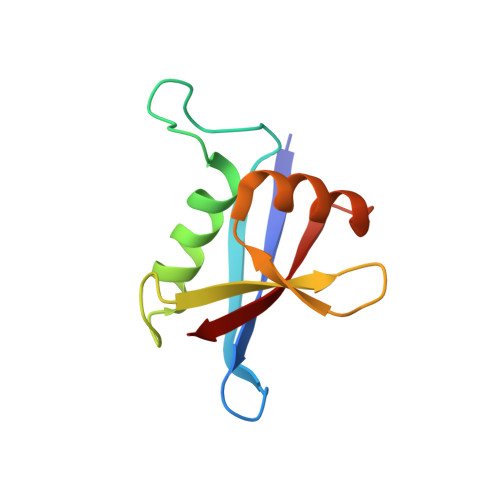
2KTR | pdb_00002ktr

NMR structure of p62 PB1 dimer determined based on PCS


Experimental Data Snapshot

  • Method: SOLUTION NMR
  • Conformers Calculated: 100 
  • Conformers Submitted: 10 
  • Selection Criteria: structures with the lowest energy 

wwPDB Validation 3D Report Full Report

Validation slider image for 2KTR

This is version 1.3 of the entry. See complete history

Literature

PCS-based structure determination of protein-protein complexes

Saio, T.Yokochi, M.Kumeta, H.Inagaki, F.

(2010) J Biomol NMR 46: 271-280

  • DOI: https://doi.org/10.1007/s10858-010-9401-4
  • Primary Citation Related Structures: 
    2KTR

  • PubMed Abstract: 

    A simple and fast nuclear magnetic resonance method for docking proteins using pseudo-contact shift (PCS) and (1)H(N)/(15)N chemical shift perturbation is presented. PCS is induced by a paramagnetic lanthanide ion that is attached to a target protein using a lanthanide binding peptide tag anchored at two points. PCS provides long-range (approximately 40 A) distance and angular restraints between the lanthanide ion and the observed nuclei, while the (1)H(N)/(15)N chemical shift perturbation data provide loose contact-surface information. The usefulness of this method was demonstrated through the structure determination of the p62 PB1-PB1 complex, which forms a front-to-back 20 kDa homo-oligomer. As p62 PB1 does not intrinsically bind metal ions, the lanthanide binding peptide tag was attached to one subunit of the dimer at two anchoring points. Each monomer was treated as a rigid body and was docked based on the backbone PCS and backbone chemical shift perturbation data. Unlike NOE-based structural determination, this method only requires resonance assignments of the backbone (1)H(N)/(15)N signals and the PCS data obtained from several sets of two-dimensional (15)N-heteronuclear single quantum coherence spectra, thus facilitating rapid structure determination of the protein-protein complex.


  • Organizational Affiliation
    • Graduate School of Life Science, Hokkaido University, Sapporo, 001-0021, Japan.

Macromolecule Content 

  • Total Structure Weight: 24.39 kDa 
  • Atom Count: 1,549 
  • Modeled Residue Count: 197 
  • Deposited Residue Count: 217 
  • Unique protein chains: 2

Macromolecules

Find similar proteins by:|  3D Structure
Entity ID: 1
MoleculeChains  Sequence LengthOrganismDetailsImage
Sequestosome-1117Rattus norvegicusMutation(s): 3 
UniProt
Find proteins for O08623 (Rattus norvegicus)
Explore O08623 
Go to UniProtKB:  O08623
Entity Groups
Sequence Clusters30% Identity50% Identity70% Identity90% Identity95% Identity100% Identity
UniProt GroupO08623
Sequence Annotations
Expand
Reference Sequence
Find similar proteins by:|  3D Structure
Entity ID: 2
MoleculeChains  Sequence LengthOrganismDetailsImage
Sequestosome-1100Rattus norvegicusMutation(s): 4 
UniProt
Find proteins for O08623 (Rattus norvegicus)
Explore O08623 
Go to UniProtKB:  O08623
Entity Groups
Sequence Clusters30% Identity50% Identity70% Identity90% Identity95% Identity100% Identity
UniProt GroupO08623
Sequence Annotations
Expand
Reference Sequence

Small Molecules

Ligands 1 Unique
IDChains Name / Formula / InChI Key2D Diagram3D Interactions
TB

Query on TB


Download:Ideal Coordinates CCD File
C [auth A]TERBIUM(III) ION
Tb
HKCRVXUAKWXBLE-UHFFFAOYSA-N

Experimental Data & Validation

Experimental Data

  • Method: SOLUTION NMR
  • Conformers Calculated: 100 
  • Conformers Submitted: 10 
  • Selection Criteria: structures with the lowest energy 

Structure Validation

View Full Validation Report


Entry History 

Deposition Data

Revision History  (Full details and data files)

  • Version 1.0: 2010-04-07
    Type: Initial release
  • Version 1.1: 2011-07-13
    Changes: Version format compliance
  • Version 1.2: 2021-11-10
    Changes: Data collection, Database references
  • Version 1.3: 2024-05-29
    Changes: Data collection