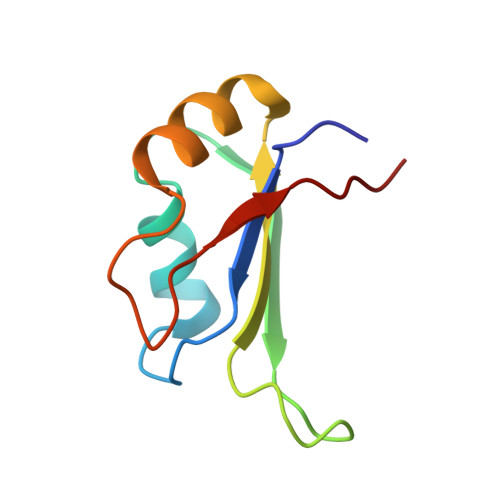
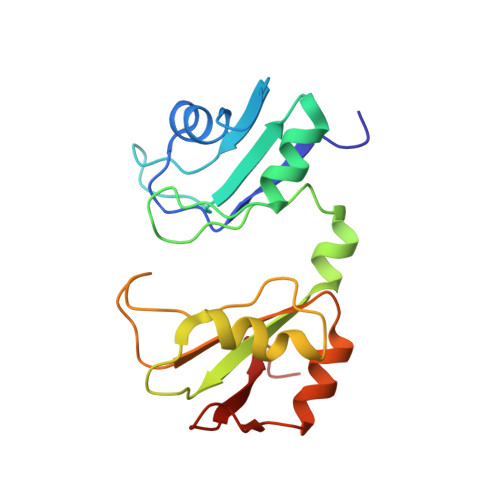
2KM8 | pdb_00002km8

Interdomain RRM packing contributes to RNA recognition in the rna15, hrp1, anchor RNA 3' processing ternary complex


Experimental Data Snapshot

  • Method: SOLUTION NMR
  • Conformers Calculated: 100 
  • Conformers Submitted: 10 
  • Selection Criteria: structures with the lowest energy 

wwPDB Validation 3D Report Full Report

Validation slider image for 2KM8

This is version 1.4 of the entry. See complete history

Literature

Novel Protein-Protein Contacts Facilitate mRNA 3'-Processing Signal Recognition by Rna15 and Hrp1.

Leeper, T.C.Qu, X.Lu, C.Moore, C.Varani, G.

(2010) J Mol Biology 401: 334-349

  • DOI: https://doi.org/10.1016/j.jmb.2010.06.032
  • Primary Citation Related Structures: 
    2KM8

  • PubMed Abstract: 

    Precise 3'-end processing of mRNA is essential for correct gene expression, yet in yeast, 3'-processing signals consist of multiple ambiguous sequence elements. Two neighboring elements upstream of the cleavage site are particularly important for the accuracy (positioning element) and efficiency (efficiency element) of 3'-processing and are recognized by the RNA-binding proteins Rna15 and Hrp1, respectively. In vivo, these interactions are strengthened by the scaffolding protein Rna14 that stabilizes their association. The NMR structure of the 34 -kDa ternary complex of the RNA recognition motif (RRM) domains of Hrp1 and Rna15 bound to this pair of RNA elements was determined by residual dipolar coupling and paramagnetic relaxation experiments. It reveals how each of the proteins binds to RNA and introduces a novel class of protein-protein contact in regions of previously unknown function. These interdomain contacts had previously been overlooked in other multi-RRM structures, although a careful analysis suggests that they may be frequently present. Mutations in the regions of these contacts disrupt 3'-end processing, suggesting that they may structurally organize the ribonucleoprotein complexes responsible for RNA processing.


  • Organizational Affiliation
    • Department of Chemistry, University of Washington, Seattle, WA 98195-1700, USA. tleeper@uakron.edu

Macromolecule Content 

  • Total Structure Weight: 32.51 kDa 
  • Atom Count: 2,273 
  • Modeled Residue Count: 264 
  • Deposited Residue Count: 264 
  • Unique protein chains: 2
  • Unique nucleic acid chains: 1

Macromolecules


Find similar proteins by:|  3D Structure
Entity ID: 2
MoleculeChains  Sequence LengthOrganismDetailsImage
mRNA 3'-end-processing protein RNA1584Saccharomyces cerevisiaeMutation(s): 0 
Gene Names: 2.1RNA15YGL044C
UniProt
Find proteins for P25299 (Saccharomyces cerevisiae (strain ATCC 204508 / S288c))
Explore P25299 
Go to UniProtKB:  P25299
Entity Groups
Sequence Clusters30% Identity50% Identity70% Identity90% Identity95% Identity100% Identity
UniProt GroupP25299
Sequence Annotations
Expand
Reference Sequence
Find similar proteins by:|  3D Structure
Entity ID: 3
MoleculeChains  Sequence LengthOrganismDetailsImage
Nuclear polyadenylated RNA-binding protein 4167Saccharomyces cerevisiaeMutation(s): 0 
Gene Names: HRP1NAB4NAB5YOL123W
UniProt
Find proteins for Q99383 (Saccharomyces cerevisiae (strain ATCC 204508 / S288c))
Explore Q99383 
Go to UniProtKB:  Q99383
Entity Groups
Sequence Clusters30% Identity50% Identity70% Identity90% Identity95% Identity100% Identity
UniProt GroupQ99383
Sequence Annotations
Expand
Reference Sequence
Find similar nucleic acids by:  Sequence
Entity ID: 1
MoleculeChains LengthOrganismImage
5'-R(P*UP*AP*UP*AP*UP*AP*UP*AP*AP*UP*AP*AP*U)-3'13N/A
Sequence Annotations
Expand
Reference Sequence

Experimental Data & Validation

Experimental Data

  • Method: SOLUTION NMR
  • Conformers Calculated: 100 
  • Conformers Submitted: 10 
  • Selection Criteria: structures with the lowest energy 

Structure Validation

View Full Validation Report


Entry History 

Deposition Data

Revision History  (Full details and data files)

  • Version 1.0: 2010-07-28
    Type: Initial release
  • Version 1.1: 2011-07-13
    Changes: Version format compliance
  • Version 1.2: 2020-02-26
    Changes: Data collection, Database references, Derived calculations, Other
  • Version 1.3: 2023-06-14
    Changes: Database references, Other
  • Version 1.4: 2024-05-08
    Changes: Data collection, Database references