Download Mendeley
Solubility-dependent structural formation of a 25-residue, natively unfolded protein, induced by addition of a seven-residue peptide fragment
Araki, M., Tamura, A.(2009) FEBS J 276: 2336-2347
- PubMed: 19292861 Search on PubMed
- DOI: https://doi.org/10.1111/j.1742-4658.2009.06961.x
- Primary Citation Related Structures:
2KFQ - PubMed Abstract:
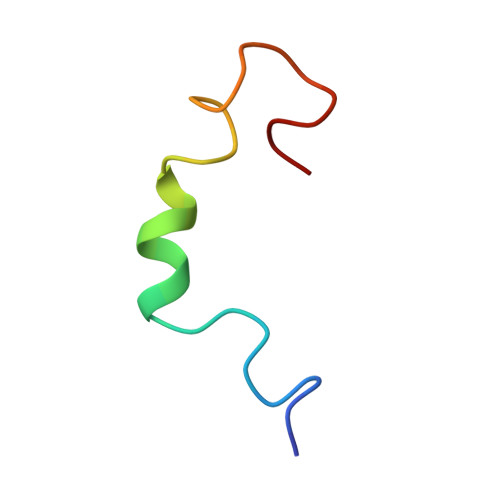
To elucidate the architectural principle of protein structure, we focused on sequestration from solvent, which is a common characteristic of folding and self-associative precipitation. Because protein solubility can be regarded as a basis for the potential ability to sequester from solvent, we assume that poorly soluble proteins tend not only to precipitate, but also to form solution structures. To examine this, the solubility of a 25-residue, natively unfolded protein, modified from a zinc-finger domain of transcription factor Sp1, was disturbed by adding a seven-residue hydrophobic peptide fragment to the C-terminus. NMR and ultracentrifuge measurements of the resulting sequence showed that a dissolved species forms an alpha-helical structure in a 15-20 molecule oligomer. To elucidate the mechanism by which the structure forms, we prepared two variants in which the added fragments are less hydrophobic; the structural stabilities were then measured at various pH values. A fairly good correlation was observed between stability and hydration potential, whereas a much stronger correlation was observed between stability and solubility, indicating that the stability is more strongly dependent on the ability to precipitate than on dehydration. These results show that, among poorly soluble protein molecules, dissolved species can be transformed from the solvent-exposed unfolded state into a loosely packed structure via intermolecular interactions. Because decreasing the protein solubility does not require the primary sequence to have a sophisticated design, such a protein structure might form readily and frequently, compared with the well-packed structure found in native proteins.
- Graduate School of Science, Kobe University, Kobe, Nada, Japan.
Organizational Affiliation: