Download Mendeley
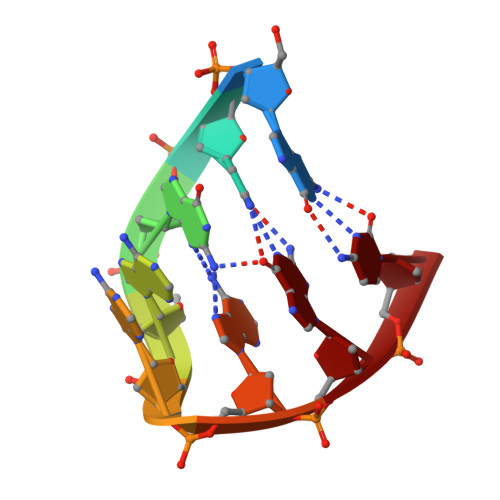
Nucleic acid folding determined by mesoscale modeling and NMR spectroscopy: solution structure of d(GCGAAAGC).
Santini, G.P., Cognet, J.A., Xu, D., Singarapu, K.K., Herve du Penhoat, C.(2009) J Phys Chem B 113: 6881-6893
- PubMed: 19374420 Search on PubMed
- DOI: https://doi.org/10.1021/jp8100656
- Primary Citation Related Structures:
2K71 - PubMed Abstract:
Determination of DNA solution structure is a difficult task even with the high-sensitivity method used here based on simulated annealing with 35 restraints/residue (Cryoprobe 750 MHz NMR). The conformations of both the phosphodiester linkages and the dinucleotide segment encompassing the sharp turn in single-stranded DNA are often underdetermined. To obtain higher quality structures of a DNA GNRA loop, 5'-d(GCGAAAGC)-3', we have used a mesoscopic molecular modeling approach, called Biopolymer Chain Elasticity (BCE), to provide reference conformations. By construction, these models are the least deformed hairpin loop conformation derived from canonical B-DNA at the nucleotide level. We have further explored this molecular conformation at the torsion angle level with AMBER molecular mechanics using different possible (epsilon,zeta) constraints to interpret the 31P NMR data. This combined approach yields a more accurate molecular conformation, compatible with all the NMR data, than each method taken separately, NMR/DYANA or BCE/AMBER. In agreement with the principle of minimal deformation of the backbone, the hairpin motif is stabilized by maximal base-stacking interactions on both the 5'- and 3'-sides and by a sheared G.A mismatch base pair between the first and last loop nucleotides. The sharp turn is located between the third and fourth loop nucleotides, and only two torsion angles beta6 and gamma6 deviate strongly with respect to canonical B-DNA structure. Two other torsion angle pairs epsilon3,zeta3 and epsilon5,zeta5 exhibit the newly recognized stable conformation BIIzeta+ (-70 degrees, 140 degrees). This combined approach has proven to be useful for the interpretation of an unusual 31P chemical shift in the 5'-d(GCGAAAGC)-3' hairpin.
- Laboratoire de Biophysique Moleculaire, Cellulaire et Tissulaire, UMR 7033 CNRS, Universite Pierre et Marie Curie Paris 6, Genopole Campus 1, 5 rue Henri Desbrueres, Evry 91030, France.
Organizational Affiliation: