Download Mendeley
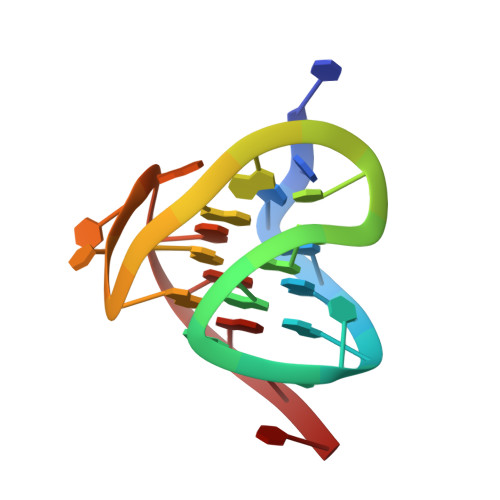
Structure of the Hybrid-2 type intramolecular human telomeric G-quadruplex in K+ solution: insights into structure polymorphism of the human telomeric sequence
Dai, J., Carver, M., Punchihewa, C., Jones, R.A., Yang, D.(2007) Nucleic Acids Res 35: 4927-4940
- PubMed: 17626043 Search on PubMedSearch on PubMed Central
- DOI: https://doi.org/10.1093/nar/gkm522
- Primary Citation Related Structures:
2JPZ - PubMed Abstract:
Formation of the G-quadruplex in the human telomeric sequence can inhibit the activity of telomerase, thus the intramolecular telomeric G-quadruplexes have been considered as an attractive anticancer target. Information of intramolecular telomeric G-quadruplex structures formed under physiological conditions is important for structure-based drug design. Here, we report the first structure of the major intramolecular G-quadruplex formed in a native, non-modified human telomeric sequence in K(+) solution. This is a hybrid-type mixed parallel/antiparallel-G-stranded G-quadruplex, one end of which is covered by a novel T:A:T triple capping structure. This structure (Hybrid-2) and the previously reported Hybrid-1 structure differ in their loop arrangements, strand orientations and capping structures. The distinct capping structures appear to be crucial for the favored formation of the specific hybrid-type intramolecular telomeric G-quadruplexes, and may provide specific binding sites for drug targeting. Our study also shows that while the hybrid-type G-quadruplexes appear to be the major conformations in K(+) solution, human telomeric sequences are always in equilibrium between Hybrid-1 and Hybrid-2 structures, which is largely determined by the 3'-flanking sequence. Furthermore, both hybrid-type G-quadruplexes suggest a straightforward means for multimer formation with effective packing in the human telomeric sequence and provide important implications for drug targeting of G-quadruplexes in human telomeres.
- College of Pharmacy, The University of Arizona, 1703 E. Mabel St, Tucson, AZ 85721, USA.
Organizational Affiliation: