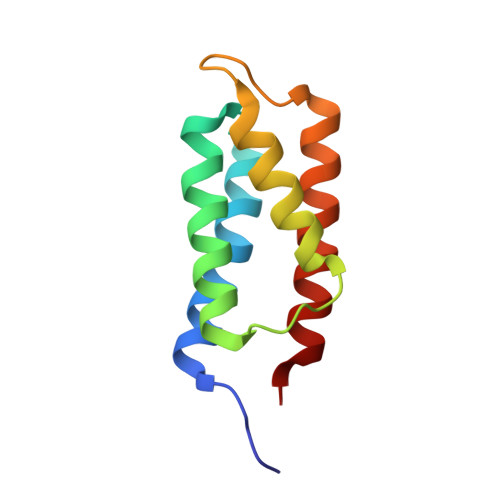
2J9V | pdb_00002j9v

2 Angstrom X-ray structure of the yeast ESCRT-I Vps28 C-terminus


Experimental Data Snapshot

  • Method: X-RAY DIFFRACTION
  • Resolution: 2.00 Å
  • R-Value Free: 
    0.255 (Depositor), 0.248 (DCC) 
  • R-Value Work: 
    0.228 (Depositor), 0.225 (DCC) 
  • R-Value Observed: 
    0.229 (Depositor) 

Starting Model: experimental
View more details

wwPDB Validation 3D Report Full Report

Validation slider image for 2J9V

This is version 1.4 of the entry. See complete history

Literature

Structural Insight Into the Escrt-I/-II Link and its Role in Mvb Trafficking.

Gill, D.J.Teo, H.Sun, J.Perisic, O.Veprintsev, D.B.Emr, S.D.Williams, R.L.

(2007) EMBO J 26: 600

  • DOI: https://doi.org/10.1038/sj.emboj.7601501
  • Primary Citation Related Structures: 
    2J9U, 2J9V, 2J9W

  • PubMed Abstract: 

    ESCRT (endosomal sorting complex required for transport) complexes orchestrate efficient sorting of ubiquitinated transmembrane receptors to lysosomes via multivesicular bodies (MVBs). Yeast ESCRT-I and ESCRT-II interact directly in vitro; however, this association is not detected in yeast cytosol. To gain understanding of the molecular mechanisms of this link, we have characterised the ESCRT-I/-II supercomplex and determined the crystal structure of its interface. The link is formed by the vacuolar protein sorting (Vps)28 C-terminus (ESCRT-I) binding with nanomolar affinity to the Vps36-NZF-N zinc-finger domain (ESCRT-II). A hydrophobic patch on the Vps28-CT four-helix bundle contacts the hydrophobic knuckles of Vps36-NZF-N. Mutation of the ESCRT-I/-II link results in a cargo-sorting defect in yeast. Interestingly, the two Vps36 NZF domains, NZF-N and NZF-C, despite having the same core fold, use distinct surfaces to bind ESCRT-I or ubiquitinated cargo. We also show that a new component of ESCRT-I, Mvb12 (YGR206W), engages ESCRT-I directly with nanomolar affinity to form a 1:1:1:1 heterotetramer. Mvb12 does not affect the affinity of ESCRT-I for ESCRT-II in vitro. Our data suggest a complex regulatory mechanism for the ESCRT-I/-II link in yeast.


  • Organizational Affiliation
    • MRC Laboratory of Molecular Biology, Medical Research Council Centre, Cambridge, UK. djg38@mrc-lmb.cam.ac.uk

Macromolecule Content 

  • Total Structure Weight: 11.57 kDa 
  • Atom Count: 870 
  • Modeled Residue Count: 99 
  • Deposited Residue Count: 99 
  • Unique protein chains: 1

Macromolecules

Find similar proteins by:|  3D Structure
Entity ID: 1
MoleculeChains  Sequence LengthOrganismDetailsImage
VACUOLAR PROTEIN SORTING-ASSOCIATED PROTEIN 2899Saccharomyces cerevisiaeMutation(s): 0 
UniProt
Find proteins for Q02767 (Saccharomyces cerevisiae (strain ATCC 204508 / S288c))
Explore Q02767 
Go to UniProtKB:  Q02767
Entity Groups
Sequence Clusters30% Identity50% Identity70% Identity90% Identity95% Identity100% Identity
UniProt GroupQ02767
Sequence Annotations
Expand
Reference Sequence

Experimental Data & Validation

Experimental Data

  • Method: X-RAY DIFFRACTION
  • Resolution: 2.00 Å
  • R-Value Free:  0.255 (Depositor), 0.248 (DCC) 
  • R-Value Work:  0.228 (Depositor), 0.225 (DCC) 
  • R-Value Observed: 0.229 (Depositor) 
Space Group: C 2 2 21
Unit Cell:
Length ( Å )Angle ( ˚ )
a = 44.69α = 90
b = 128.581β = 90
c = 50.276γ = 90
Software Package:
Software NamePurpose
REFMACrefinement
MOSFLMdata reduction
SCALAdata scaling
PHASERphasing

Structure Validation

View Full Validation Report


Entry History 

Deposition Data

Revision History  (Full details and data files)

  • Version 1.0: 2007-01-23
    Type: Initial release
  • Version 1.1: 2011-05-08
    Changes: Version format compliance
  • Version 1.2: 2011-07-13
    Changes: Version format compliance
  • Version 1.3: 2018-01-24
    Changes: Source and taxonomy
  • Version 1.4: 2024-05-01
    Changes: Data collection, Database references, Other, Refinement description