2J5C | pdb_00002j5c

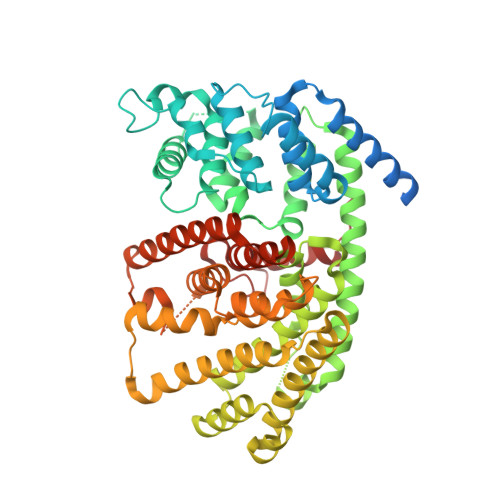
Rational conversion of substrate and product specificity in a monoterpene synthase. Structural insights into the molecular basis of rapid evolution.


Experimental Data Snapshot

  • Method: X-RAY DIFFRACTION
  • Resolution: 1.95 Å
  • R-Value Free: 
    0.235 (Depositor), 0.232 (DCC) 
  • R-Value Work: 
    0.218 (Depositor), 0.214 (DCC) 
  • R-Value Observed: 
    0.218 (Depositor) 

Starting Model: experimental
View more details

wwPDB Validation 3D Report Full Report

Validation slider image for 2J5C

This is version 1.4 of the entry. See complete history

Literature

Rational Conversion of Substrate and Product Specificity in a Salvia Monoterpene Synthase: Structural Insights Into the Evolution of Terpene Synthase Function.

Kampranis, S.C.Ioannidis, D.Purvis, A.Mahrez, W.Ninga, E.Katerelos, N.A.Anssour, S.Dunwell, J.M.Degenhardt, J.Makris, A.M.Goodenough, P.W.Johnson, C.B.

(2007) Plant Cell 19: 1994

  • DOI: https://doi.org/10.1105/tpc.106.047779
  • Primary Citation Related Structures: 
    2J5C

  • PubMed Abstract: 

    Terpene synthases are responsible for the biosynthesis of the complex chemical defense arsenal of plants and microorganisms. How do these enzymes, which all appear to share a common terpene synthase fold, specify the many different products made almost entirely from one of only three substrates? Elucidation of the structure of 1,8-cineole synthase from Salvia fruticosa (Sf-CinS1) combined with analysis of functional and phylogenetic relationships of enzymes within Salvia species identified active-site residues responsible for product specificity. Thus, Sf-CinS1 was successfully converted to a sabinene synthase with a minimum number of rationally predicted substitutions, while identification of the Asn side chain essential for water activation introduced 1,8-cineole and alpha-terpineol activity to Salvia pomifera sabinene synthase. A major contribution to product specificity in Sf-CinS1 appears to come from a local deformation within one of the helices forming the active site. This deformation is observed in all other mono- or sesquiterpene structures available, pointing to a conserved mechanism. Moreover, a single amino acid substitution enlarged the active-site cavity enough to accommodate the larger farnesyl pyrophosphate substrate and led to the efficient synthesis of sesquiterpenes, while alternate single substitutions of this critical amino acid yielded five additional terpene synthases.


  • Organizational Affiliation
    • Department of Natural Products and Biotechnology, Mediterranean Agronomic Institute of Chania, Chania, Greece. sotirios@maich.gr

Macromolecule Content 

  • Total Structure Weight: 134.84 kDa 
  • Atom Count: 8,468 
  • Modeled Residue Count: 976 
  • Deposited Residue Count: 1,138 
  • Unique protein chains: 1

Macromolecules

Find similar proteins by:|  3D Structure
Entity ID: 1
MoleculeChains  Sequence LengthOrganismDetailsImage
1,8-CINEOLE SYNTHASE
A, B
569Salvia fruticosaMutation(s): 0 
EC: 4.2.3 (PDB Primary Data), 4.2.3.111 (UniProt), 4.2.3.15 (UniProt), 4.2.3.108 (UniProt)
UniProt
Find proteins for A6XH05 (Salvia fruticosa)
Explore A6XH05 
Go to UniProtKB:  A6XH05
Entity Groups
Sequence Clusters30% Identity50% Identity70% Identity90% Identity95% Identity100% Identity
UniProt GroupA6XH05
Sequence Annotations
Expand
Reference Sequence

Experimental Data & Validation

Experimental Data

  • Method: X-RAY DIFFRACTION
  • Resolution: 1.95 Å
  • R-Value Free:  0.235 (Depositor), 0.232 (DCC) 
  • R-Value Work:  0.218 (Depositor), 0.214 (DCC) 
  • R-Value Observed: 0.218 (Depositor) 
Space Group: C 2 2 21
Unit Cell:
Length ( Å )Angle ( ˚ )
a = 124.55α = 90
b = 171.15β = 90
c = 123.81γ = 90
Software Package:
Software NamePurpose
CNSrefinement
MOSFLMdata reduction
SCALAdata scaling
MOLREPphasing

Structure Validation

View Full Validation Report


Entry History 

Revision History  (Full details and data files)

  • Version 1.0: 2007-06-26
    Type: Initial release
  • Version 1.1: 2011-05-08
    Changes: Version format compliance
  • Version 1.2: 2011-07-13
    Changes: Version format compliance
  • Version 1.3: 2019-05-08
    Changes: Data collection, Derived calculations, Experimental preparation, Other
  • Version 1.4: 2023-12-13
    Changes: Data collection, Database references, Other, Refinement description