2J5A | pdb_00002j5a

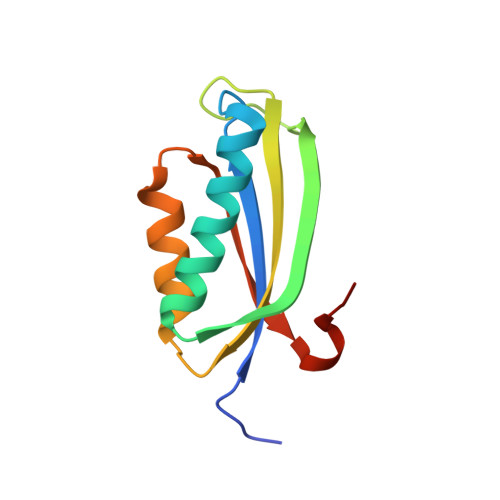
Folding of S6 structures with divergent amino-acid composition: pathway flexibility within partly overlapping foldons


Experimental Data Snapshot

  • Method: X-RAY DIFFRACTION
  • Resolution: 2.30 Å
  • R-Value Free: 
    0.274 (Depositor), 0.261 (DCC) 
  • R-Value Work: 
    0.223 (Depositor), 0.215 (DCC) 
  • R-Value Observed: 
    0.225 (Depositor) 

Starting Model: experimental
View more details

wwPDB Validation 3D Report Full Report

Validation slider image for 2J5A

This is version 1.3 of the entry. See complete history

Literature

Folding of S6 Structures with Divergent Amino Acid Composition: Pathway Flexibility within Partly Overlapping Foldons.

Olofsson, M.Hansson, S.Hedberg, L.Logan, D.T.Oliveberg, M.

(2007) J Mol Biology 365: 237

  • DOI: https://doi.org/10.1016/j.jmb.2006.09.016
  • Primary Citation Related Structures: 
    2J5A

  • PubMed Abstract: 

    Studies of circular permutants have demonstrated that the folding reaction of S6 from Thermus thermophilus (S6(T)) is malleable and responds in an ordered manner to changes of the sequence separation between interacting residues: the S6(T) permutants retain a common nucleation pattern in the form of a two-strand-helix motif that can be recruited from different parts of the structure. To further test the robustness of the two-strand-helix nucleus we have here determined the crystal structure and folding reaction of an evolutionary divergent S6 protein from the hyperthermophilic bacterium Aquifex aeolicus (S6(A)). Although the overall topology of S6(A) is very similar to that of S6(T) the architecture of the hydrophobic core is radically different by containing a large proportion of stacked Phe side-chains. Despite this disparate core composition, the folding rate constant and the kinetic m values of S6(A) are identical to those of S6(T). The folding nucleus of S6(A) is also found to retain the characteristic two-strand-helix motif of the S6(T) permutants, but with a new structural emphasis. The results suggest that the protein folding reaction is linked to topology only in the sense that the native-state topology determines the repertoire of accessible nucleation motifs. If the native structure allows several equivalent ways of recruiting a productive nucleus the folding reaction is free to redistribute within these topological constraints.


  • Organizational Affiliation
    • Department of Biochemistry, Umeå University, SE-901 87 Umeå, Sweden.

Macromolecule Content 

  • Total Structure Weight: 13.48 kDa 
  • Atom Count: 962 
  • Modeled Residue Count: 106 
  • Deposited Residue Count: 110 
  • Unique protein chains: 1

Macromolecules

Find similar proteins by:|  3D Structure
Entity ID: 1
MoleculeChains  Sequence LengthOrganismDetailsImage
30S RIBOSOMAL PROTEIN S6110Aquifex aeolicusMutation(s): 0 
UniProt
Find proteins for O66474 (Aquifex aeolicus (strain VF5))
Explore O66474 
Go to UniProtKB:  O66474
Entity Groups
Sequence Clusters30% Identity50% Identity70% Identity90% Identity95% Identity100% Identity
UniProt GroupO66474
Sequence Annotations
Expand
Reference Sequence

Small Molecules

Ligands 1 Unique
IDChains Name / Formula / InChI Key2D Diagram3D Interactions
NA

Query on NA


Download:Ideal Coordinates CCD File
B [auth A]SODIUM ION
Na
FKNQFGJONOIPTF-UHFFFAOYSA-N

Experimental Data & Validation

Experimental Data

  • Method: X-RAY DIFFRACTION
  • Resolution: 2.30 Å
  • R-Value Free:  0.274 (Depositor), 0.261 (DCC) 
  • R-Value Work:  0.223 (Depositor), 0.215 (DCC) 
  • R-Value Observed: 0.225 (Depositor) 
Space Group: P 32 2 1
Unit Cell:
Length ( Å )Angle ( ˚ )
a = 75.57α = 90
b = 75.57β = 90
c = 55.5γ = 120
Software Package:
Software NamePurpose
REFMACrefinement
XDSdata reduction
XSCALEdata scaling
PHASERphasing

Structure Validation

View Full Validation Report


Entry History 

Deposition Data

Revision History  (Full details and data files)

  • Version 1.0: 2006-10-25
    Type: Initial release
  • Version 1.1: 2011-07-13
    Changes: Advisory, Version format compliance
  • Version 1.2: 2019-05-08
    Changes: Data collection, Experimental preparation, Other
  • Version 1.3: 2023-12-13
    Changes: Data collection, Database references, Derived calculations, Other, Refinement description