2IXE | pdb_00002ixe

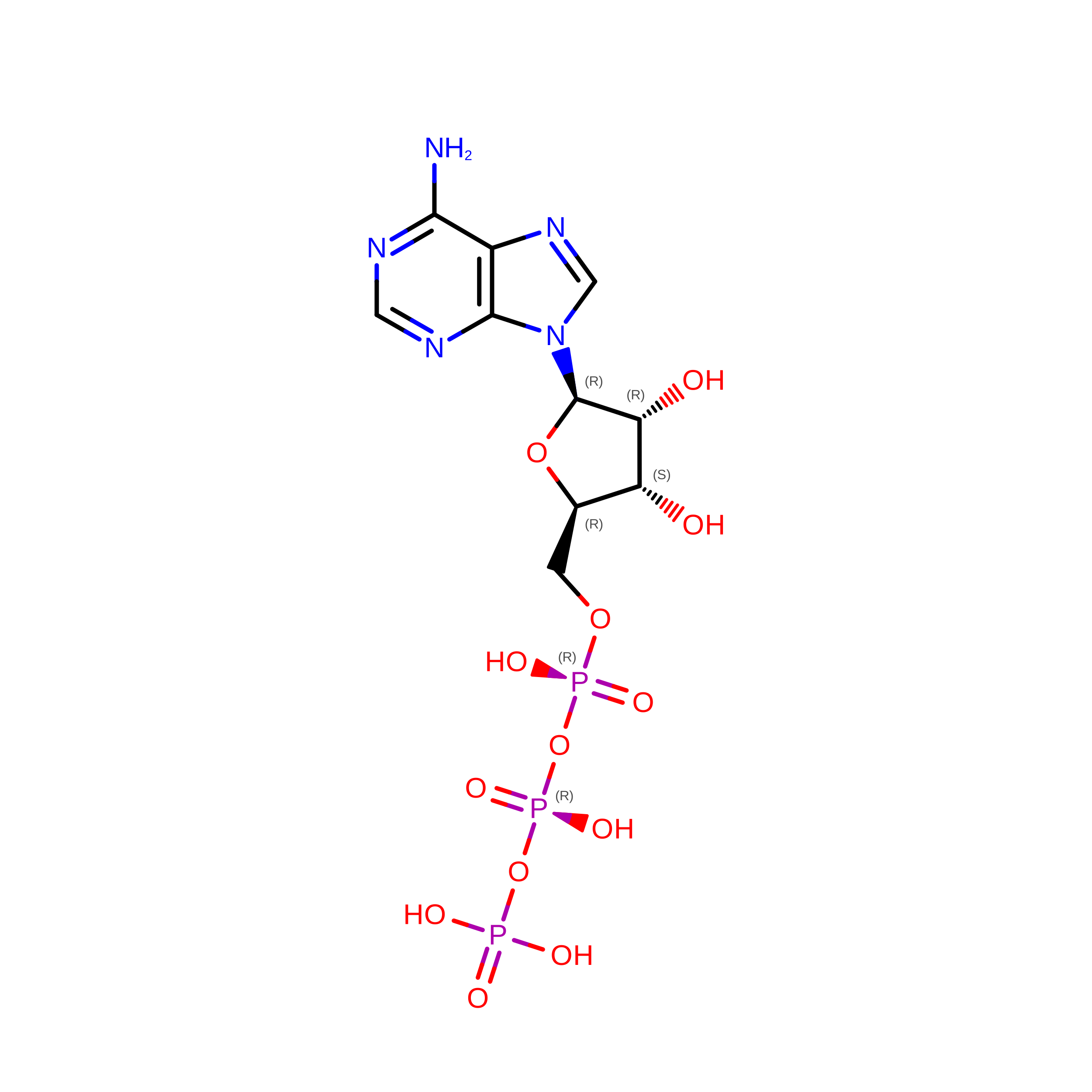
Crystal structure of the ATPase domain of TAP1 with ATP (D645N mutant)


Experimental Data Snapshot

  • Method: X-RAY DIFFRACTION
  • Resolution: 2.00 Å
  • R-Value Free: 
    0.241 (Depositor), 0.249 (DCC) 
  • R-Value Work: 
    0.199 (Depositor), 0.204 (DCC) 
  • R-Value Observed: 
    0.202 (Depositor) 

Starting Model: experimental
View more details

wwPDB Validation 3D Report Full Report

Validation slider image for 2IXE

Ligand Structure Quality Assessment 


This is version 1.4 of the entry. See complete history

Literature

Distinct Structural and Functional Properties of the ATPase Sites in an Asymmetric Abc Transporter.

Procko, E.Ferrin-O'Connell, I.Ng, S.-L.Gaudet, R.

(2001) Mol Cell 24: 51

  • DOI: https://doi.org/10.1016/j.molcel.2006.07.034
  • Primary Citation Related Structures: 
    2IXE, 2IXF, 2IXG

  • PubMed Abstract: 

    The ABC transporter associated with antigen processing (TAP) shuttles cytosolic peptides into the endoplasmic reticulum for loading onto class I MHC molecules. Transport is fueled by ATP binding and hydrolysis at two distinct cytosolic ATPase sites. One site comprises consensus motifs shared among most ABC transporters, while the second has substituted, degenerate motifs. Biochemical and crystallography experiments with a TAP cytosolic domain demonstrate that the consensus ATPase site has high catalytic activity and facilitates ATP-dependent dimerization of the cytosolic domains, which is an important conformational change during transport. In contrast, the degenerate site is defective in dimerization and ATP hydrolysis. Full-length TAP mutagenesis demonstrates the necessity for at least one consensus site, supporting our conclusion that the consensus site is the principal facilitator of substrate transport. Since asymmetry of the ATPase site motifs is a feature of many mammalian homologs, our proposed model has broad implications for ABC transporters.


  • Organizational Affiliation
    • Department of Molecular and Cellular Biology, Harvard University, Cambridge, MA 02138, USA.

Macromolecule Content 

  • Total Structure Weight: 60.12 kDa 
  • Atom Count: 4,203 
  • Modeled Residue Count: 499 
  • Deposited Residue Count: 542 
  • Unique protein chains: 1

Macromolecules

Find similar proteins by:|  3D Structure
Entity ID: 1
MoleculeChains  Sequence LengthOrganismDetailsImage
ANTIGEN PEPTIDE TRANSPORTER 1A,
B [auth D]
271Rattus norvegicusMutation(s): 1 
EC: 7.4.2.14
UniProt
Find proteins for P36370 (Rattus norvegicus)
Explore P36370 
Go to UniProtKB:  P36370
Entity Groups
Sequence Clusters30% Identity50% Identity70% Identity90% Identity95% Identity100% Identity
UniProt GroupP36370
Sequence Annotations
Expand
Reference Sequence

Experimental Data & Validation

Experimental Data

  • Method: X-RAY DIFFRACTION
  • Resolution: 2.00 Å
  • R-Value Free:  0.241 (Depositor), 0.249 (DCC) 
  • R-Value Work:  0.199 (Depositor), 0.204 (DCC) 
  • R-Value Observed: 0.202 (Depositor) 
Space Group: P 41 21 2
Unit Cell:
Length ( Å )Angle ( ˚ )
a = 80.431α = 90
b = 80.431β = 90
c = 168.115γ = 90
Software Package:
Software NamePurpose
REFMACrefinement
HKL-2000data reduction
HKL-2000data scaling
MOLREPphasing

Structure Validation

View Full Validation Report


Ligand Structure Quality Assessment 


Entry History 

Deposition Data

Revision History  (Full details and data files)

  • Version 1.0: 2006-10-11
    Type: Initial release
  • Version 1.1: 2011-07-13
    Changes: Advisory, Refinement description, Version format compliance
  • Version 1.2: 2019-05-08
    Changes: Data collection, Experimental preparation, Other
  • Version 1.3: 2019-05-15
    Changes: Data collection, Experimental preparation
  • Version 1.4: 2023-12-13
    Changes: Data collection, Database references, Derived calculations, Other, Refinement description