2I99 | pdb_00002i99

Crystal structure of human Mu_crystallin at 2.6 Angstrom


Experimental Data Snapshot

  • Method: X-RAY DIFFRACTION
  • Resolution: 2.60 Å
  • R-Value Free: 
    0.262 (Depositor), 0.252 (DCC) 
  • R-Value Work: 
    0.213 (Depositor), 0.204 (DCC) 

Starting Model: experimental
View more details

wwPDB Validation 3D Report Full Report

Validation slider image for 2I99

Ligand Structure Quality Assessment 


This is version 1.6 of the entry. See complete history

Literature

Crystal structure of human {micro}-crystallin complexed with NADPH

Cheng, Z.Sun, L.He, J.Gong, W.

(2007) Protein Sci 16: 329-335

  • DOI: https://doi.org/10.1110/ps.062556907
  • Primary Citation Related Structures: 
    2I99

  • PubMed Abstract: 

    Human cytosolic 3,5,3'-triiodo-L-thyronine-binding protein, also called mu-crystallin or CRYM, plays important physiological roles in transporting 3,5,3'-triiodo-L-thyronine (T(3)) into nuclei and regulating thyroid-hormone-related gene expression. The crystal structure of human CRYM's bacterial homolog Pseudomonas putida ornithine cyclodeaminase and Archaeoglobus fulgidus alanine dehydrogenase have been available, but no CRYM structure has been reported. Here, we report the crystal structure of human CRYM bound with NADPH refined to 2.6 A, and there is one dimer in the asymmetric unit. The structure contains two domains: a Rossmann fold-like NADPH-binding domain and a dimerization domain. Different conformations of the loop Arg83-His92 have been observed in two monomers of human CRYM in the same asymmetric unit. The peptide bond of Val89-Pro90 is a trans-configuration in one monomer but a cis-configuration in the other. A detailed comparison of the human mu-crystallin structure with its structurally characterized homologs including the overall comparison and superposition of active sites was conducted. Finally, a putative T(3)-binding site in human CRYM is proposed based on comparison with structural homologs.


  • Organizational Affiliation
    • National Laboratory of Biomacromolecules, Institute of Biophysics, Chinese Academy of Sciences, Beijing 100101, People's Republic of China.

Macromolecule Content 

  • Total Structure Weight: 68.59 kDa 
  • Atom Count: 4,960 
  • Modeled Residue Count: 623 
  • Deposited Residue Count: 624 
  • Unique protein chains: 1

Macromolecules

Find similar proteins by:|  3D Structure
Entity ID: 1
MoleculeChains  Sequence LengthOrganismDetailsImage
Mu-crystallin homolog
A, B
312Homo sapiensMutation(s): 0 
Gene Names: CRYMTHBP
EC: 1.5.1.25 (UniProt), 1.5.1.1 (UniProt)
UniProt & NIH Common Fund Data Resources
Find proteins for Q14894 (Homo sapiens)
Explore Q14894 
Go to UniProtKB:  Q14894
PHAROS:  Q14894
GTEx:  ENSG00000103316 
Entity Groups
Sequence Clusters30% Identity50% Identity70% Identity90% Identity95% Identity100% Identity
UniProt GroupQ14894
Sequence Annotations
Expand
Reference Sequence

Small Molecules

Ligands 1 Unique
IDChains Name / Formula / InChI Key2D Diagram3D Interactions
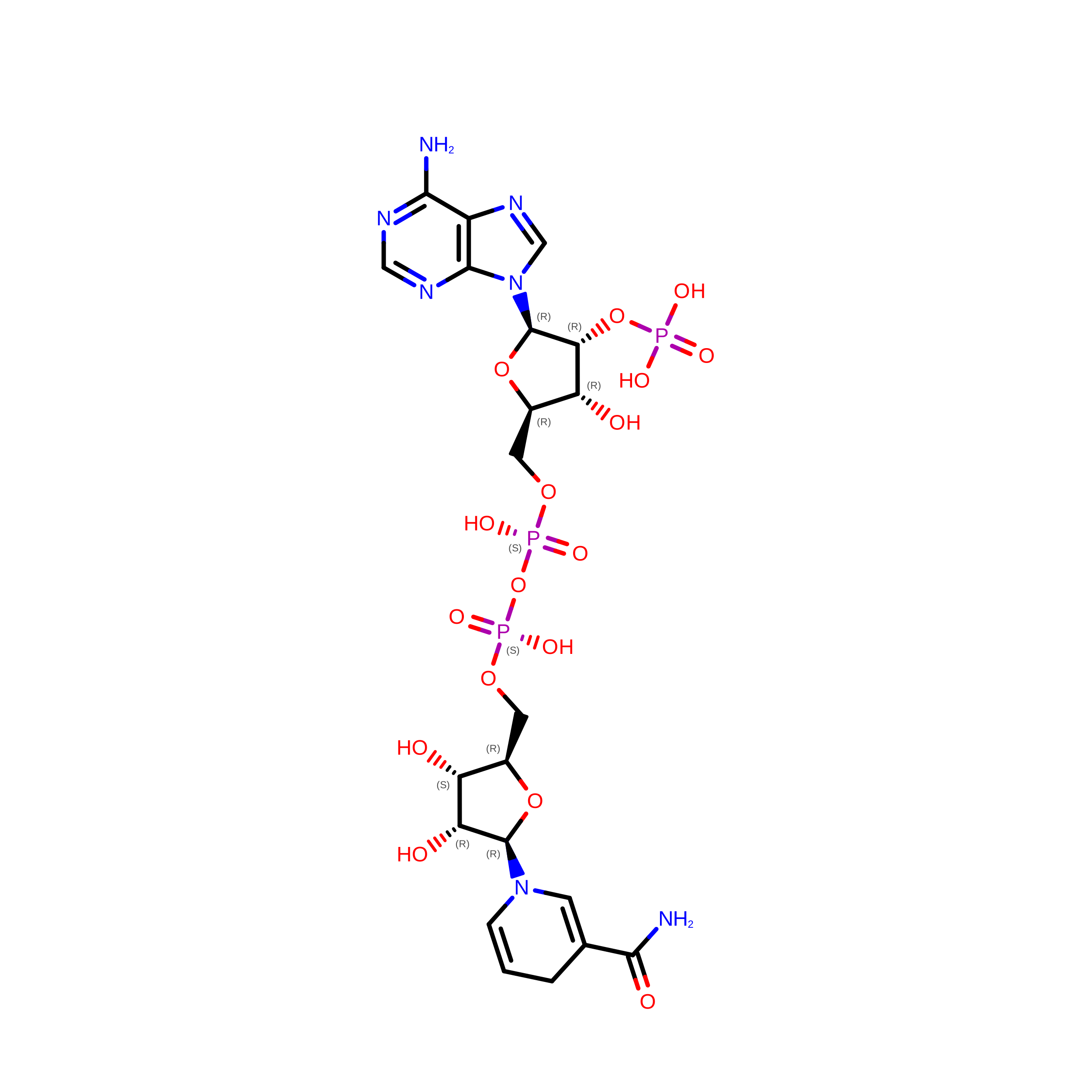
NDP

Query on NDP


Download:Ideal Coordinates CCD File
C [auth A],
D [auth B]
NADPH DIHYDRO-NICOTINAMIDE-ADENINE-DINUCLEOTIDE PHOSPHATE
C21 H30 N7 O17 P3
ACFIXJIJDZMPPO-NNYOXOHSSA-N

Experimental Data & Validation

Experimental Data

  • Method: X-RAY DIFFRACTION
  • Resolution: 2.60 Å
  • R-Value Free:  0.262 (Depositor), 0.252 (DCC) 
  • R-Value Work:  0.213 (Depositor), 0.204 (DCC) 
Space Group: P 21 21 21
Unit Cell:
Length ( Å )Angle ( ˚ )
a = 70.98α = 90
b = 90.86β = 90
c = 101.183γ = 90
Software Package:
Software NamePurpose
DENZOdata reduction
SCALEPACKdata scaling
MOLREPphasing
CNSrefinement
PDB_EXTRACTdata extraction
HKL-2000data collection
HKL-2000data reduction

Structure Validation

View Full Validation Report


Ligand Structure Quality Assessment 


Entry History 

Deposition Data

Revision History  (Full details and data files)

  • Version 1.0: 2007-02-27
    Type: Initial release
  • Version 1.1: 2008-05-01
    Changes: Version format compliance
  • Version 1.2: 2011-07-13
    Changes: Version format compliance
  • Version 1.3: 2012-05-23
    Changes: Other
  • Version 1.4: 2017-10-18
    Changes: Advisory, Refinement description
  • Version 1.5: 2018-08-08
    Changes: Data collection
  • Version 1.6: 2023-10-25
    Changes: Advisory, Data collection, Database references, Derived calculations, Refinement description