2HJI | pdb_00002hji

Structural model for the Fe-containing isoform of acireductone dioxygenase


Experimental Data Snapshot

  • Method: SOLUTION NMR
  • Conformers Calculated: 300 
  • Conformers Submitted: 14 
  • Selection Criteria: back calculated data agree with experimental NOESY spectrum,structures with acceptable covalent geometry 

wwPDB Validation 3D Report Full Report

Validation slider image for 2HJI

This is version 1.4 of the entry. See complete history

Literature

One Protein, Two Enzymes Revisited: A Structural Entropy Switch Interconverts the Two Isoforms of Acireductone Dioxygenase

Ju, T.Goldsmith, R.B.Chai, S.C.Maroney, M.J.Pochapsky, S.S.Pochapsky, T.C.

(2006) J Mol Biology 363: 823-834

  • DOI: https://doi.org/10.1016/j.jmb.2006.08.060
  • Primary Citation Related Structures: 
    2HJI

  • PubMed Abstract: 

    Acireductone dioxygenase (ARD) catalyzes different reactions between O2 and 1,2-dihydroxy-3-oxo-5-(methylthio)pent-1-ene (acireductone) depending upon the metal bound in the active site. Ni2+ -ARD cleaves acireductone to formate, CO and methylthiopropionate. If Fe2+ is bound (ARD'), the same substrates yield methylthioketobutyrate and formate. The two forms differ in structure, and are chromatographically separable. Paramagnetism of Fe2+ renders the active site of ARD' inaccessible to standard NMR methods. The structure of ARD' has been determined using Fe2+ binding parameters determined by X-ray absorption spectroscopy and NMR restraints from H98S ARD, a metal-free diamagnetic protein that is isostructural with ARD'. ARD' retains the beta-sandwich fold of ARD, but a structural entropy switch increases order at one end of a two-helix system that bisects the beta-sandwich and decreases order at the other upon interconversion of ARD and ARD', causing loss of the C-terminal helix in ARD' and rearrangements of residues involved in substrate orientation in the active site.


  • Organizational Affiliation
    • Department of Chemistry, Brandeis University, MS 015, Waltham, MA 02454-9110, USA.

Macromolecule Content 

  • Total Structure Weight: 20.28 kDa 
  • Atom Count: 1,255 
  • Modeled Residue Count: 156 
  • Deposited Residue Count: 179 
  • Unique protein chains: 1

Macromolecules

Find similar proteins by:|  3D Structure
Entity ID: 1
MoleculeChains  Sequence LengthOrganismDetailsImage
E-2/E-2' protein179Klebsiella oxytocaMutation(s): 0 
EC: 1.13.11.54 (PDB Primary Data), 1.13.11.53 (UniProt)
UniProt
Find proteins for Q9ZFE7 (Klebsiella oxytoca)
Explore Q9ZFE7 
Go to UniProtKB:  Q9ZFE7
Entity Groups
Sequence Clusters30% Identity50% Identity70% Identity90% Identity95% Identity100% Identity
UniProt GroupQ9ZFE7
Sequence Annotations
Expand
Reference Sequence

Small Molecules

Ligands 1 Unique
IDChains Name / Formula / InChI Key2D Diagram3D Interactions
FE2

Query on FE2


Download:Ideal Coordinates CCD File
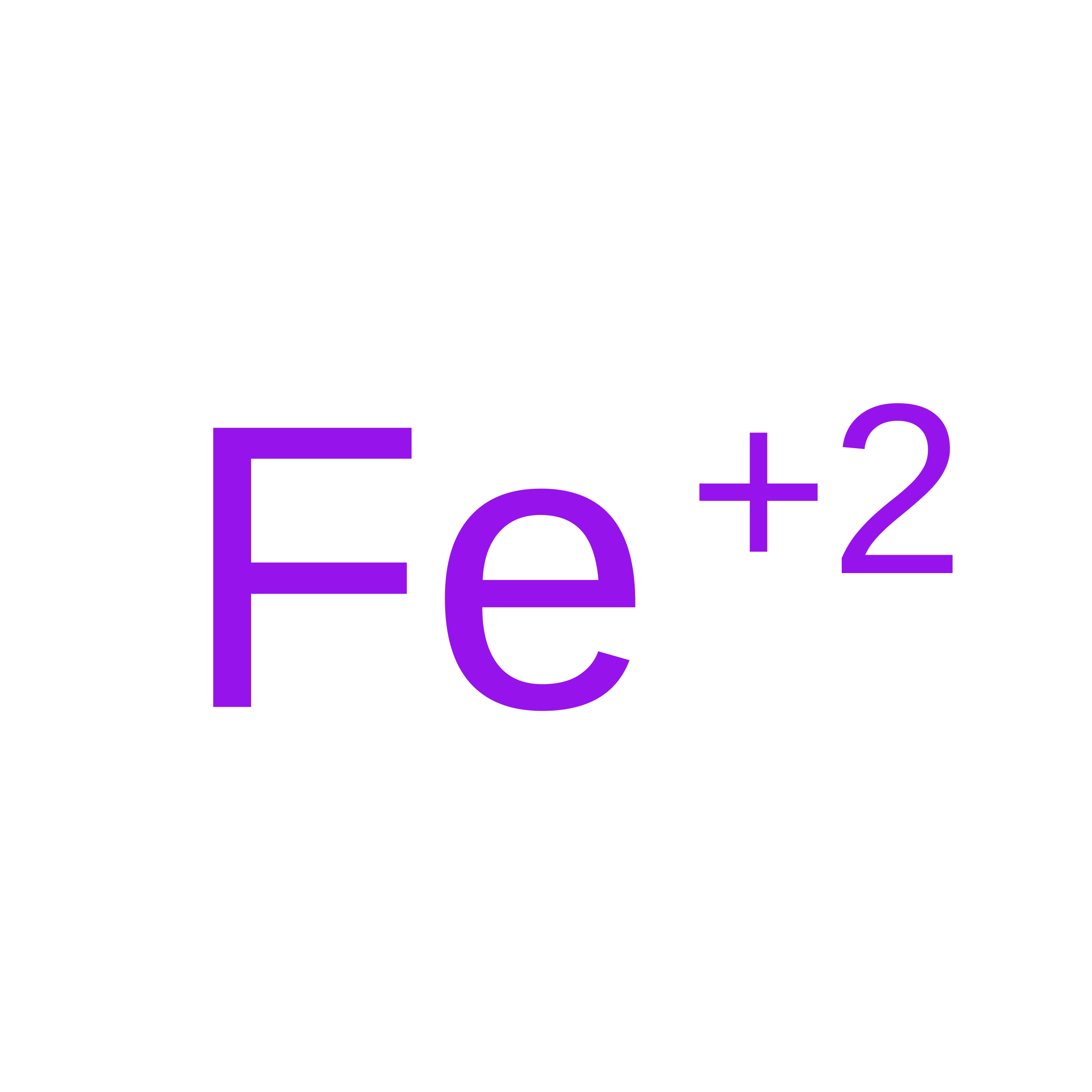
B [auth A]FE (II) ION
Fe
CWYNVVGOOAEACU-UHFFFAOYSA-N

Experimental Data & Validation

Experimental Data

  • Method: SOLUTION NMR
  • Conformers Calculated: 300 
  • Conformers Submitted: 14 
  • Selection Criteria: back calculated data agree with experimental NOESY spectrum,structures with acceptable covalent geometry 

Structure Validation

View Full Validation Report


Entry History 

Deposition Data

Revision History  (Full details and data files)

  • Version 1.0: 2006-10-24
    Type: Initial release
  • Version 1.1: 2008-05-01
    Changes: Version format compliance
  • Version 1.2: 2011-07-13
    Changes: Version format compliance
  • Version 1.3: 2022-03-09
    Changes: Database references, Derived calculations
  • Version 1.4: 2024-05-29
    Changes: Data collection