2HGO | pdb_00002hgo

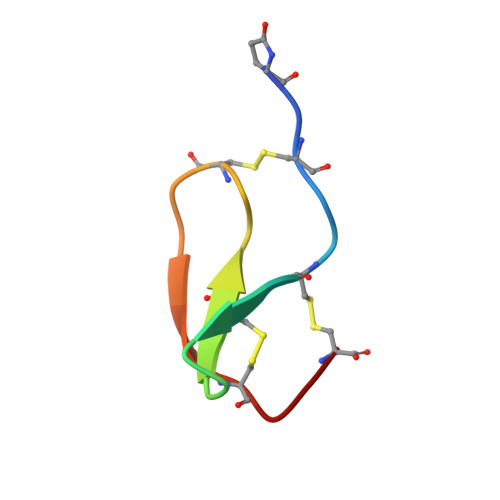
NMR structure of Cassiicolin


Experimental Data Snapshot

  • Method: SOLUTION NMR
  • Conformers Calculated: 30 
  • Conformers Submitted: 20 
  • Selection Criteria: structures with the lowest energy 

wwPDB Validation 3D Report Full Report

Validation slider image for 2HGO

This is version 2.2 of the entry. See complete history

Literature

Structural Analysis of Cassiicolin, a Host-selective Protein Toxin from Corynespora cassiicola

Barthe, P.Pujade-Renaud, V.Breton, F.Gargani, D.Thai, R.Roumestand, C.de Lamotte, F.

(2007) J Mol Biology 367: 89-101

  • DOI: https://doi.org/10.1016/j.jmb.2006.11.086
  • Primary Citation Related Structures: 
    2HGO

  • PubMed Abstract: 

    Cassiicolin is a host-selective toxin (HST) produced by the fungus Corynespora cassiicola (strain CCP). It is responsible for the Corynespora leaf fall (CLF) disease, which is among the main pathologies affecting rubber tree (Hevea brasiliensis). Working on purified cassiicolin and using electron microscopy, we have demonstrated that this 27-residue O-glycosylated protein is able to induce cellular damages identical to those induced by the fungus on rubber tree leaves and displays the same host selectivity. The solution structure and disulfide pairing of cassiicolin have been determined using NMR spectroscopy and simulated annealing calculations. Cassiicolin appears to have an original structure with a prolate ellipsoid shape. It adopts an over-all fold consisting of three strands arranged in a right-handed twisted, antiparallel beta-sheet knitted by three disulfide bonds. Its conformation resembles that found in small trypsine-like inhibitors isolated from the brain, the fat body and the hemolymph of locust grasshoppers. But cassiicolin has no sequence homology with these protease inhibitors, and lacks their characteristic substrate-binding loop. Probably, this motif represents one of the few highly stabilized "minimal" scaffolds, with a high sequence permissiveness, that nature has selected to evolve over different phyla and to support different functions. The knowledge of the 3D structure opens the way to the delineation of the mechanism of action of the toxin using site-directed mutagenesis.


  • Organizational Affiliation
    • Centre de Biochimie Structurale, UMR 5048 CNRS/UM1-UMR 554 Inserm/UM1, 29 rue de Navacelles, 34090 Montpellier Cedex, France.

Macromolecule Content 

  • Total Structure Weight: 2.9 kDa 
  • Atom Count: 197 
  • Modeled Residue Count: 27 
  • Deposited Residue Count: 27 
  • Unique protein chains: 1

Macromolecules

Find similar proteins by:|  3D Structure
Entity ID: 1
MoleculeChains  Sequence LengthOrganismDetailsImage
CASSIICOLIN27Corynespora cassiicolaMutation(s): 1 
UniProt
Find proteins for P84902 (Corynespora cassiicola)
Explore P84902 
Go to UniProtKB:  P84902
Entity Groups
Sequence Clusters30% Identity50% Identity70% Identity90% Identity95% Identity100% Identity
UniProt GroupP84902
Sequence Annotations
Expand
Reference Sequence

Small Molecules

Ligands 1 Unique
IDChains Name / Formula / InChI Key2D Diagram3D Interactions
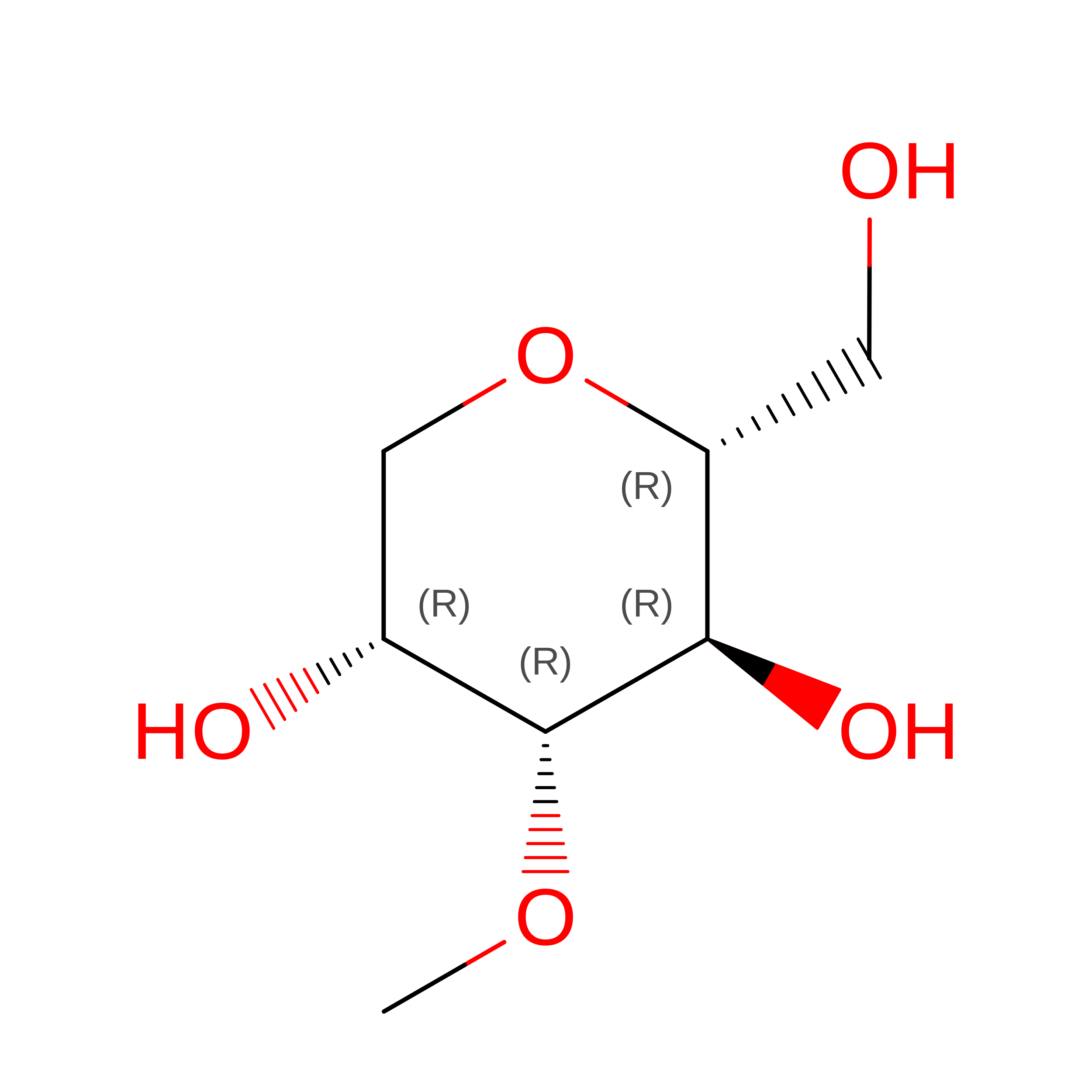
3HD

Query on 3HD


Download:Ideal Coordinates CCD File
B [auth A]1,5-anhydro-3-O-methyl-D-mannitol
C7 H14 O5
GWYGLRYBQUSWAT-DBRKOABJSA-N
Modified Residues  1 Unique
IDChains TypeFormula2D DiagramParent
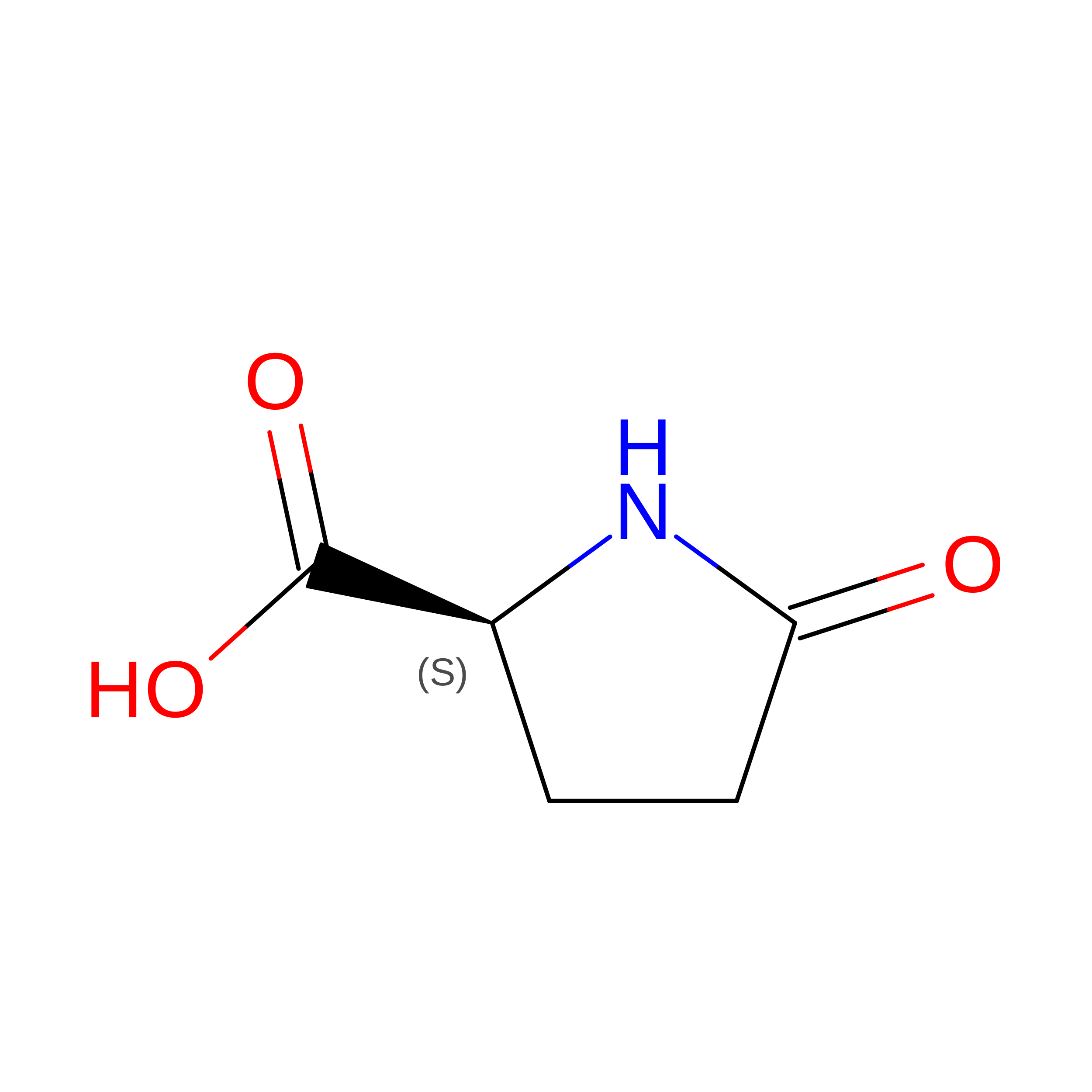
PCA
Query on PCA
A
L-PEPTIDE LINKINGC5 H7 N O3GLN

Experimental Data & Validation

Experimental Data

  • Method: SOLUTION NMR
  • Conformers Calculated: 30 
  • Conformers Submitted: 20 
  • Selection Criteria: structures with the lowest energy 

Structure Validation

View Full Validation Report


Entry History 

Deposition Data

Revision History  (Full details and data files)

  • Version 1.0: 2007-02-27
    Type: Initial release
  • Version 1.1: 2008-05-01
    Changes: Version format compliance
  • Version 1.2: 2011-07-13
    Changes: Version format compliance
  • Version 2.0: 2019-12-25
    Changes: Data collection, Database references, Derived calculations, Polymer sequence
  • Version 2.1: 2020-07-29
    Type: Remediation
    Reason: Carbohydrate remediation
    Changes: Derived calculations, Structure summary
  • Version 2.2: 2024-11-06
    Changes: Data collection, Database references, Structure summary