2GQN | pdb_00002gqn

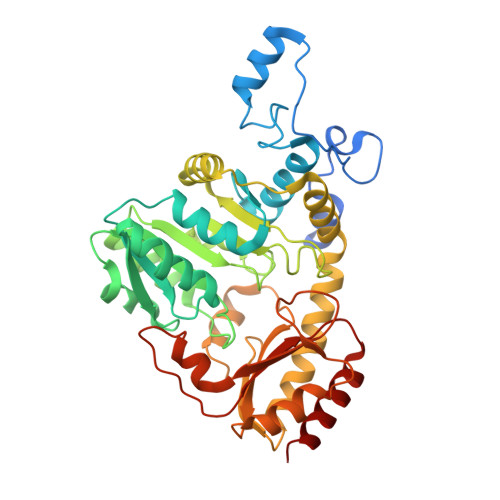
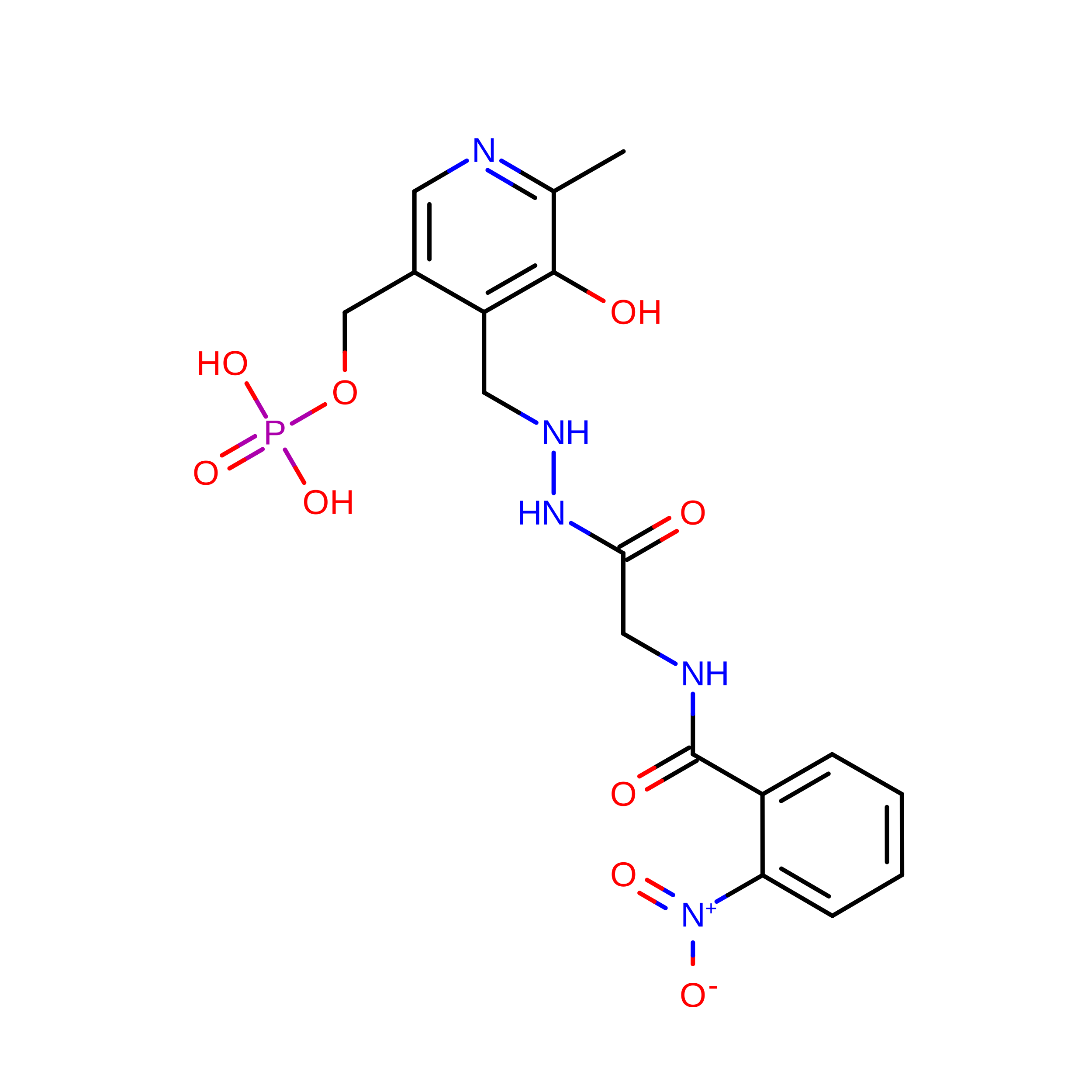
Cystathionine Beta-Lyase (CBL) from Escherichia Coli in complex with N-Hydrazinocarbonylmethyl-2-Nitro-Benzamide


Experimental Data Snapshot

  • Method: X-RAY DIFFRACTION
  • Resolution: 1.80 Å
  • R-Value Free: 
    0.227 (Depositor), 0.252 (DCC) 
  • R-Value Work: 
    0.174 (Depositor), 0.200 (DCC) 
  • R-Value Observed: 
    0.177 (Depositor) 

wwPDB Validation 3D Report Full Report

Validation slider image for 2GQN

Ligand Structure Quality Assessment 


This is version 1.3 of the entry. See complete history

Literature

Inhibitors of Bacterial Cystathionine beta-Lyase: Leads for New Antimicrobial Agents and Probes of Enzyme Structure and Function.

Ejim, L.J.Blanchard, J.E.Koteva, K.P.Sumerfield, R.Elowe, N.H.Chechetto, J.D.Brown, E.D.Junop, M.S.Wright, G.D.

(2007) J Med Chem 50: 755-764

  • DOI: https://doi.org/10.1021/jm061132r
  • Primary Citation Related Structures: 
    2FQ6, 2GQN

  • PubMed Abstract: 

    The biosynthesis of methionine is an attractive antibiotic target given its importance in protein and DNA metabolism and its absence in mammals. We have performed a high-throughput screen of the methionine biosynthesis enzyme cystathionine beta-lyase (CBL) against a library of 50 000 small molecules and have identified several compounds that inhibit CBL enzyme activity in vitro. These hit molecules were of two classes: those that blocked CBL activity with mixed steady-state inhibition and those that covalently interacted with the enzyme at the active site pyridoxal phosphate cofactor with slow-binding inhibition kinetics. We determined the crystal structure of one of the slow-binding inhibitors in complex with CBL and used this structure as a guide in the synthesis of a small, focused library of analogues, some of which had improved enzyme inhibition properties. These studies provide the first lead molecules for antimicrobial agents that target cystathionine beta-lyase in methionine biosynthesis.


  • Organizational Affiliation
    • Antimicrobial Research Centre, McMaster High Throughput Screening Laboratory, Department of Biochemistry and Biomedical Sciences, McMaster University, Ontario L8N 3Z5, Canada.

Macromolecule Content 

  • Total Structure Weight: 91.8 kDa 
  • Atom Count: 7,044 
  • Modeled Residue Count: 783 
  • Deposited Residue Count: 830 
  • Unique protein chains: 1

Macromolecules

Find similar proteins by:|  3D Structure
Entity ID: 1
MoleculeChains  Sequence LengthOrganismDetailsImage
Cystathionine beta-lyase
A, B
415Escherichia coliMutation(s): 0 
Gene Names: metC
EC: 4.4.1.8 (PDB Primary Data), 4.4.1.13 (UniProt), 4.4.1.28 (UniProt)
UniProt
Find proteins for P06721 (Escherichia coli (strain K12))
Explore P06721 
Go to UniProtKB:  P06721
Entity Groups
Sequence Clusters30% Identity50% Identity70% Identity90% Identity95% Identity100% Identity
UniProt GroupP06721
Sequence Annotations
Expand
Reference Sequence

Small Molecules

Ligands 1 Unique
IDChains Name / Formula / InChI Key2D Diagram3D Interactions
BLP

Query on BLP


Download:Ideal Coordinates CCD File
C [auth A],
D [auth B]
(5-HYDROXY-6-METHYL-4-((2-(2-(2-NITROBENZAMIDO)ACETYL)HYDRAZINYL)METHYL)PYRIDIN-3-YL)METHYL DIHYDROGEN PHOSPHATE
C17 H20 N5 O9 P
AJHNLRARXNOGMZ-UHFFFAOYSA-N

Experimental Data & Validation

Experimental Data

  • Method: X-RAY DIFFRACTION
  • Resolution: 1.80 Å
  • R-Value Free:  0.227 (Depositor), 0.252 (DCC) 
  • R-Value Work:  0.174 (Depositor), 0.200 (DCC) 
  • R-Value Observed: 0.177 (Depositor) 
Space Group: C 2 2 21
Unit Cell:
Length ( Å )Angle ( ˚ )
a = 59.637α = 90
b = 153.007β = 90
c = 151.24γ = 90
Software Package:
Software NamePurpose
REFMACrefinement
CrystalCleardata reduction
d*TREKdata scaling
CNSphasing

Structure Validation

View Full Validation Report


Ligand Structure Quality Assessment 


Entry History 

Deposition Data

Revision History  (Full details and data files)

  • Version 1.0: 2007-03-06
    Type: Initial release
  • Version 1.1: 2008-05-01
    Changes: Version format compliance
  • Version 1.2: 2011-07-13
    Changes: Derived calculations, Version format compliance
  • Version 1.3: 2024-02-14
    Changes: Data collection, Database references, Derived calculations