2GDU | pdb_00002gdu

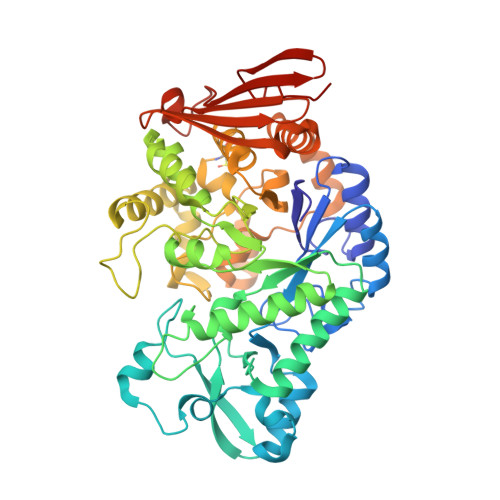
E232Q mutant of sucrose phosphorylase from BIFIDOBACTERIUM ADOLESCENTIS in complex with sucrose


Experimental Data Snapshot

  • Method: X-RAY DIFFRACTION
  • Resolution: 2.10 Å
  • R-Value Free: 
    0.217 (Depositor), 0.221 (DCC) 
  • R-Value Work: 
    0.182 (Depositor), 0.185 (DCC) 
  • R-Value Observed: 
    0.184 (Depositor) 

wwPDB Validation 3D Report Full Report

Validation slider image for 2GDU

This is version 2.1 of the entry. See complete history

Literature

Structural Rearrangements of Sucrose Phosphorylase from Bifidobacterium adolescentis during Sucrose Conversion

Mirza, O.Skov, L.K.Sprogoe, D.van den Broek, L.A.M.Beldman, G.Kastrup, J.S.Gajhede, M.

(2006) J Biological Chem 281: 35576-35584

  • DOI: https://doi.org/10.1074/jbc.M605611200
  • Primary Citation Related Structures: 
    2GDU

  • PubMed Abstract: 

    The reaction mechanism of sucrose phosphorylase from Bifidobacterium adolescentis (BiSP) was studied by site-directed mutagenesis and x-ray crystallography. An inactive mutant of BiSP (E232Q) was co-crystallized with sucrose. The structure revealed a substrate-binding mode comparable with that seen in other related sucrose-acting enzymes. Wild-type BiSP was also crystallized in the presence of sucrose. In the dimeric structure, a covalent glucosyl intermediate was formed in one molecule of the BiSP dimer, and after hydrolysis of the glucosyl intermediate, a beta-D-glucose product complex was formed in the other molecule. Although the overall structure of the BiSP-glucosyl intermediate complex is similar to that of the BiSP(E232Q)-sucrose complex, the glucose complex discloses major differences in loop conformations. Two loops (residues 336-344 and 132-137) in the proximity of the active site move up to 16 and 4 A, respectively. On the basis of these findings, we have suggested a reaction cycle that takes into account the large movements in the active-site entrance loops.


  • Organizational Affiliation
    • Biostructural Research Unit, Department of Medicinal Chemistry, Danish University of Pharmaceutical Sciences, Universitetsparken 2, DK-2100 Copenhagen, Denmark.

Macromolecule Content 

  • Total Structure Weight: 113.25 kDa 
  • Atom Count: 8,979 
  • Modeled Residue Count: 1,008 
  • Deposited Residue Count: 1,008 
  • Unique protein chains: 1

Macromolecules

Find similar proteins by:|  3D Structure
Entity ID: 1
MoleculeChains  Sequence LengthOrganismDetailsImage
sucrose phosphorylase
A, B
504Bifidobacterium adolescentisMutation(s): 1 
EC: 2.4.1.7
UniProt
Find proteins for A0ZZH6 (Bifidobacterium adolescentis (strain ATCC 15703 / DSM 20083 / NCTC 11814 / E194a))
Explore A0ZZH6 
Go to UniProtKB:  A0ZZH6
Entity Groups
Sequence Clusters30% Identity50% Identity70% Identity90% Identity95% Identity100% Identity
UniProt GroupA0ZZH6
Sequence Annotations
Expand
Reference Sequence

Oligosaccharides

Help  
Entity ID: 2
MoleculeChains Length2D Diagram GlycosylationD Interactions
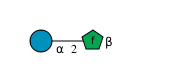
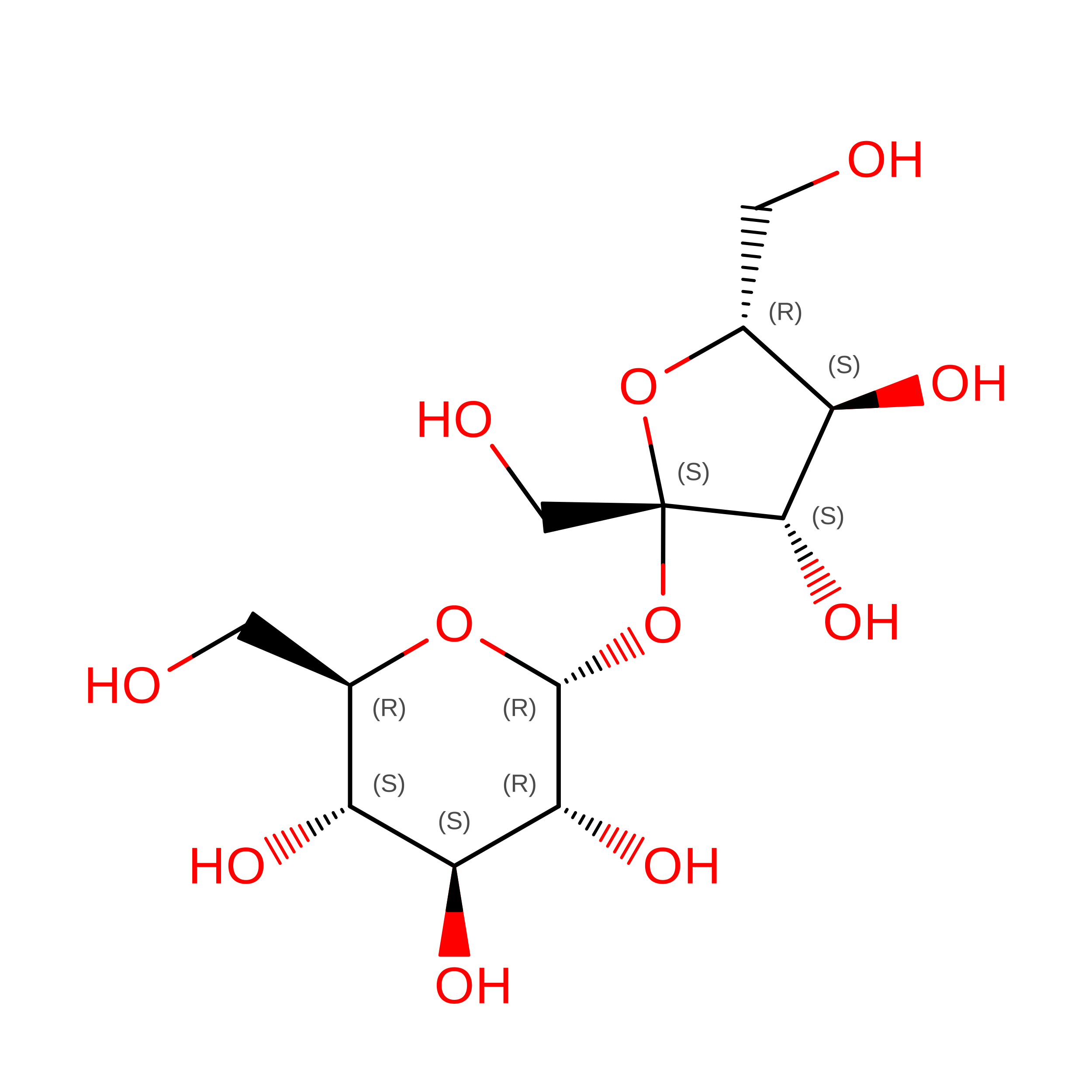
beta-D-fructofuranose-(2-1)-alpha-D-glucopyranose
C, D
2N/A
Glycosylation Resources
GlyTouCan: G05551OP
GlyCosmos: G05551OP

Small Molecules

Modified Residues  1 Unique
IDChains TypeFormula2D DiagramParent
CSD
Query on CSD
A, B
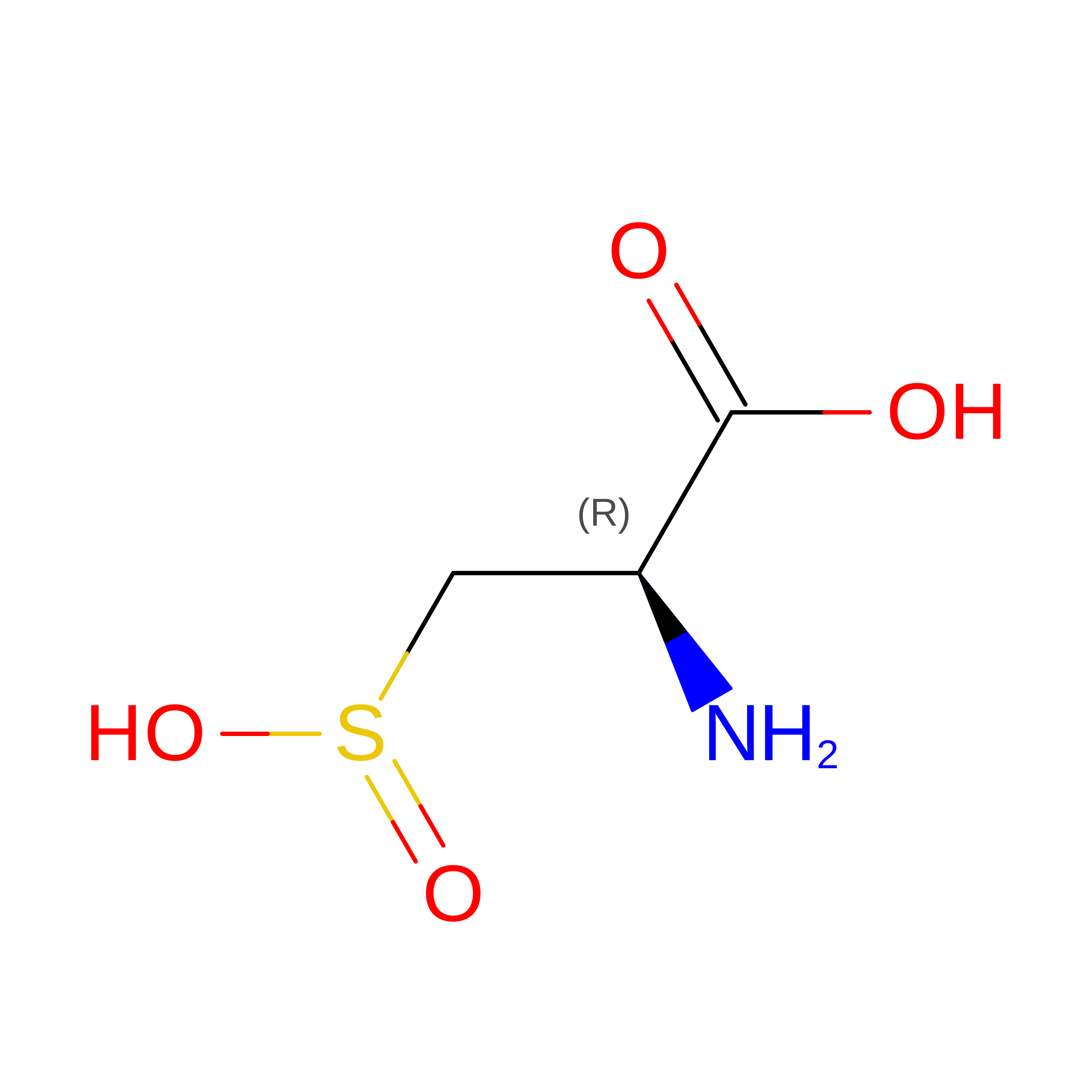
L-PEPTIDE LINKINGC3 H7 N O4 SCYS

Biologically Interesting Molecules (External Reference) 

1 Unique

Experimental Data & Validation

Experimental Data

  • Method: X-RAY DIFFRACTION
  • Resolution: 2.10 Å
  • R-Value Free:  0.217 (Depositor), 0.221 (DCC) 
  • R-Value Work:  0.182 (Depositor), 0.185 (DCC) 
  • R-Value Observed: 0.184 (Depositor) 
Space Group: P 21 21 21
Unit Cell:
Length ( Å )Angle ( ˚ )
a = 55.331α = 90
b = 124.157β = 90
c = 152.453γ = 90
Software Package:
Software NamePurpose
CNSrefinement
PDB_EXTRACTdata extraction
SCALEPACKdata scaling
CNSphasing

Structure Validation

View Full Validation Report


Entry History 

Deposition Data

Revision History  (Full details and data files)

  • Version 1.0: 2006-09-26
    Type: Initial release
  • Version 1.1: 2008-05-01
    Changes: Version format compliance
  • Version 1.2: 2011-07-13
    Changes: Version format compliance
  • Version 1.3: 2014-11-12
    Changes: Other
  • Version 2.0: 2020-07-29
    Type: Remediation
    Reason: Carbohydrate remediation
    Changes: Atomic model, Data collection, Database references, Derived calculations, Non-polymer description, Structure summary
  • Version 2.1: 2024-11-20
    Changes: Data collection, Database references, Structure summary