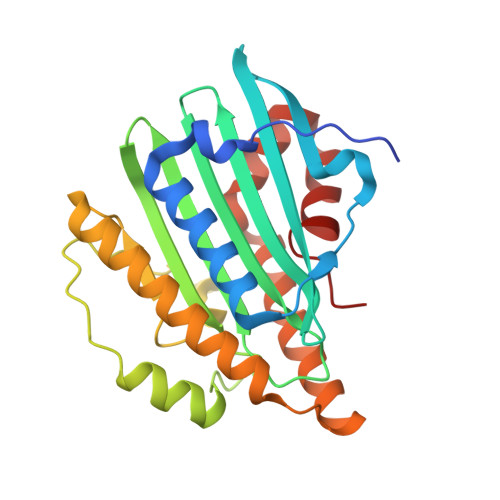
2G18 | pdb_00002g18

Crystal Structure of Nostoc sp. 7120 phycocyanobilin:ferredoxin oxidoreductase (PcyA) Apoprotein


Experimental Data Snapshot

  • Method: X-RAY DIFFRACTION
  • Resolution: 2.50 Å
  • R-Value Free: 
    0.257 (Depositor), 0.205 (DCC) 
  • R-Value Work: 
    0.211 (Depositor), 0.206 (DCC) 
  • R-Value Observed: 
    0.213 (Depositor) 

wwPDB Validation 3D Report Full Report

Validation slider image for 2G18

This is version 1.4 of the entry. See complete history

Literature

Insight into the radical mechanism of phycocyanobilin-ferredoxin oxidoreductase (PcyA) revealed by X-ray crystallography and biochemical measurements.

Tu, S.L.Rockwell, N.C.Lagarias, J.C.Fisher, A.J.

(2007) Biochemistry 46: 1484-1494

  • DOI: https://doi.org/10.1021/bi062038f
  • Primary Citation Related Structures: 
    2G18

  • PubMed Abstract: 

    The X-ray crystal structure of the substrate-free form of phycocyanobilin (PCB)-ferredoxin oxidoreductase (PcyA; EC 1.3.7.5) from the cyanobacterium Nostoc sp. PCC7120 has been solved at 2.5 A resolution. A comparative analysis of this structure with those recently reported for substrate-bound and substrate-free forms of PcyA from the cyanobacterium Synechocystis sp. PCC6803 (Hagiwara et al. (2006) Proc. Natl. Acad. Sci. U.S.A. 103, 27-32; Hagiwara et al. (2006) FEBS Lett. 580, 3823-3828) provides a compelling picture of substrate-induced changes in the PcyA enzyme and the chemical basis of PcyA's catalytic activity. On the basis of these structures and the biochemical analysis of site-directed mutants of Nostoc PcyA, including mutants reported in recent studies (Tu et al. (2006) J. Biol. Chem. 281, 3127-3136) as well as mutants described in this study, a revised mechanism for the PcyA-mediated four-electron reduction of biliverdin IXalpha to 3E/3Z-phycocyanobilin via enzyme-bound bilin radical intermediates is proposed. The mechanistic insight of these studies, along with homology modeling, have provided new insight into the catalytic mechanisms of other members of the ferredoxin-dependent bilin reductase family that are widespread in oxygenic photosynthetic organisms.


  • Organizational Affiliation
    • Institute of Plant and Microbial Biology, Academia Sinica, Nankang, Taipei 115, Taiwan.

Macromolecule Content 

  • Total Structure Weight: 345.11 kDa 
  • Atom Count: 23,613 
  • Modeled Residue Count: 2,918 
  • Deposited Residue Count: 3,036 
  • Unique protein chains: 1

Macromolecules

Find similar proteins by:|  3D Structure
Entity ID: 1
MoleculeChains  Sequence LengthOrganismDetailsImage
Phycocyanobilin:ferredoxin oxidoreductase
A, B, C, D, E
A, B, C, D, E, F, G, H, I, J, K, L
253Anabaena sp.Mutation(s): 0 
Gene Names: pcyA
EC: 1.3.7.5
UniProt
Find proteins for Q93TN0 (Nostoc sp. (strain PCC 7120 / SAG 25.82 / UTEX 2576))
Explore Q93TN0 
Go to UniProtKB:  Q93TN0
Entity Groups
Sequence Clusters30% Identity50% Identity70% Identity90% Identity95% Identity100% Identity
UniProt GroupQ93TN0
Sequence Annotations
Expand
Reference Sequence

Small Molecules

Ligands 1 Unique
IDChains Name / Formula / InChI Key2D Diagram3D Interactions
CA

Query on CA


Download:Ideal Coordinates CCD File
M [auth E]CALCIUM ION
Ca
BHPQYMZQTOCNFJ-UHFFFAOYSA-N

Experimental Data & Validation

Experimental Data

  • Method: X-RAY DIFFRACTION
  • Resolution: 2.50 Å
  • R-Value Free:  0.257 (Depositor), 0.205 (DCC) 
  • R-Value Work:  0.211 (Depositor), 0.206 (DCC) 
  • R-Value Observed: 0.213 (Depositor) 
Space Group: P 1 21 1
Unit Cell:
Length ( Å )Angle ( ˚ )
a = 78.501α = 90
b = 141.332β = 91.29
c = 121.842γ = 90
Software Package:
Software NamePurpose
REFMACrefinement
DENZOdata reduction
SCALEPACKdata scaling
PHASERphasing

Structure Validation

View Full Validation Report


Entry History 

Deposition Data

Revision History  (Full details and data files)

  • Version 1.0: 2006-12-26
    Type: Initial release
  • Version 1.1: 2008-05-01
    Changes: Version format compliance
  • Version 1.2: 2011-07-13
    Changes: Advisory, Version format compliance
  • Version 1.3: 2020-01-22
    Changes: Database references, Derived calculations
  • Version 1.4: 2024-02-14
    Changes: Data collection, Database references, Derived calculations, Refinement description