2FKE | pdb_00002fke

FK-506-BINDING PROTEIN: THREE-DIMENSIONAL STRUCTURE OF THE COMPLEX WITH THE ANTAGONIST L-685,818


Experimental Data Snapshot

  • Method: X-RAY DIFFRACTION
  • Resolution: 1.72 Å
  • R-Value Work: 
    0.180 (DCC) 
  • R-Value Observed: 
    0.180 (Depositor) 

wwPDB Validation 3D Report Full Report

Validation slider image for 2FKE

Ligand Structure Quality Assessment 


This is version 1.4 of the entry. See complete history

Literature

FK-506-binding protein: three-dimensional structure of the complex with the antagonist L-685,818.

Becker, J.W.Rotonda, J.McKeever, B.M.Chan, H.K.Marcy, A.I.Wiederrecht, G.Hermes, J.D.Springer, J.P.

(1993) J Biological Chem 268: 11335-11339

  • Primary Citation Related Structures: 
    1FKD, 2FKE

  • PubMed Abstract: 

    L-685,818 differs only slightly in structure from the immunosuppressive drug FK-506, and both compounds bind with comparable affinity to the 12-kDa FK-506-binding protein (FKBP12), the major intracellular receptor for the drug. Despite these similarities, L-685,818 is a potent antagonist of both the immunosuppressive and toxic effects of the drug. Here, we present a structural analysis of this problem. Although FK-506 and L-685,818 differ greatly in pharmacology, we have found that the three-dimensional structures of their complexes with FKBP12 are essentially identical. Approximately half of each ligand is in contact with the receptor protein, and half is exposed to solvent; the exposed region includes the two sites where the compounds differ. These results indicate that the profound differences in the pharmacology of these two compounds are not caused by any difference in their interaction with FKBP12. Rather, these effects arise because relatively minor changes in the exposed part of a bound ligand have a strong effect on how FKBP12-ligand complexes interact with calcineurin, their putative intracellular target. In addition, FK-506 complexes with FKBP12 proteins from several species all inhibit mammalian calcineurin. Analysis of the three-dimensional structure of the complex with respect to residues conserved among these proteins suggests a small number of surface residues near the bound ligands that may play a critical role in interactions between the protein-drug complex and calcineurin.


  • Organizational Affiliation
    • Department of Biophysical Chemistry, Merck Research Laboratories, Rahway, New Jersey 07065-0900.

Macromolecule Content 

  • Total Structure Weight: 12.64 kDa 
  • Atom Count: 960 
  • Modeled Residue Count: 107 
  • Deposited Residue Count: 107 
  • Unique protein chains: 1

Macromolecules

Find similar proteins by:|  3D Structure
Entity ID: 1
MoleculeChains  Sequence LengthOrganismDetailsImage
FK506 BINDING PROTEIN107Homo sapiensMutation(s): 0 
EC: 5.2.1.8
UniProt & NIH Common Fund Data Resources
Find proteins for P62942 (Homo sapiens)
Explore P62942 
Go to UniProtKB:  P62942
PHAROS:  P62942
GTEx:  ENSG00000088832 
Entity Groups
Sequence Clusters30% Identity50% Identity70% Identity90% Identity95% Identity100% Identity
UniProt GroupP62942
Sequence Annotations
Expand
Reference Sequence

Small Molecules

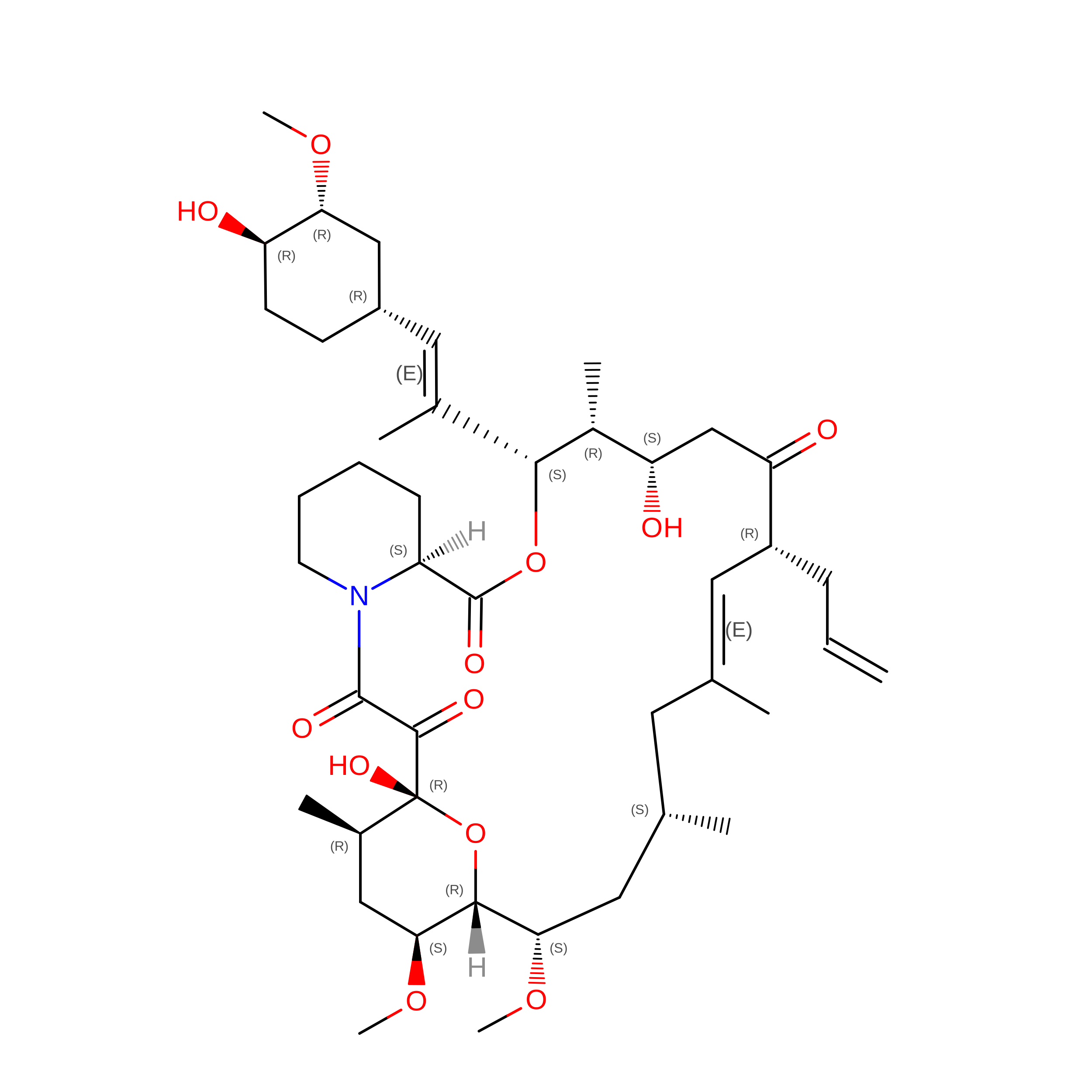
Ligands 1 Unique
IDChains Name / Formula / InChI Key2D Diagram3D Interactions
FK5

Query on FK5


Download:Ideal Coordinates CCD File
B [auth A]8-DEETHYL-8-[BUT-3-ENYL]-ASCOMYCIN
C44 H69 N O12
QJJXYPPXXYFBGM-LFZNUXCKSA-N

Experimental Data & Validation

Experimental Data

  • Method: X-RAY DIFFRACTION
  • Resolution: 1.72 Å
  • R-Value Work:  0.180 (DCC) 
  • R-Value Observed: 0.180 (Depositor) 
Space Group: P 42 21 2
Unit Cell:
Length ( Å )Angle ( ˚ )
a = 58.154α = 90
b = 58.154β = 90
c = 55.445γ = 90
Software Package:
Software NamePurpose
PROLSQrefinement

Structure Validation

View Full Validation Report


Ligand Structure Quality Assessment 


Entry History 

Deposition Data

Revision History  (Full details and data files)

  • Version 1.0: 1994-01-31
    Type: Initial release
  • Version 1.1: 2008-03-03
    Changes: Version format compliance
  • Version 1.2: 2011-07-13
    Changes: Derived calculations, Version format compliance
  • Version 1.3: 2017-11-29
    Changes: Derived calculations, Other
  • Version 1.4: 2024-02-14
    Changes: Data collection, Database references, Derived calculations