Download Mendeley
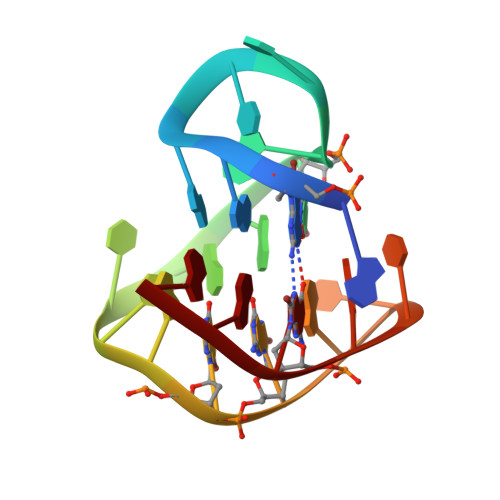
Structure of a human telomeric DNA sequence stabilized by 8-bromoguanosine substitutions, as determined by NMR in a K+ solution
Matsugami, A., Xu, Y., Noguchi, Y., Sugiyama, H., Katahira, M.(2007) FEBS J 274: 3545-3556
- PubMed: 17561958 Search on PubMed
- DOI: https://doi.org/10.1111/j.1742-4658.2007.05881.x
- Primary Citation Related Structures:
2E4I - PubMed Abstract:
The structure of human telomeric DNA is controversial; it depends upon the sequence contexts and the methodologies used to determine it. The solution structure in the presence of K(+) is particularly interesting, but the structure is yet to be elucidated, due to possible conformational heterogeneity. Here, a unique strategy is applied to stabilize one such structure in a K(+) solution by substituting guanosines with 8-bromoguanosines at proper positions. The resulting spectra are cleaner and led to determination of the structure at a high atomic resolution. This demonstrates that the application of 8-bromoguanosine is a powerful tool to overcome the difficulty of nucleic acid structure determination arising from conformational heterogeneity. The obtained structure is a mixed-parallel/antiparallel quadruplex. The structure of telomeric DNA was recently reported in another study, in which stabilization was brought about by mutation and resultant additional interactions [Luu KN, Phan AT, Kuryavyi V, Lacroix L & Patel DJ (2006) Structure of the human telomere in K(+) solution: an intramolecular (3+1) G-quadruplex scaffold. J Am Chem Soc 128, 9963-9970]. The structure of the guanine tracts was similar between the two. However, a difference was seen for loops connecting guanine tracts, which may play a role in the higher order arrangement of telomeres. Our structure can be utilized to design a small molecule which stabilizes the quadruplex. This type of molecule is supposed to inhibit a telomerase and thus is expected to be a candidate anticancer drug.
- Supramolecular Biology, International Graduate School of Arts and Sciences, Yokohama City University, JapanGraduate School of Sciences, Kyoto University, Japan,RIKEN, Yokohama, Japan,PRESTO, Yokohama, Japan.
Organizational Affiliation: