Download Mendeley
Apo and substrate-bound dihydropteroate synthase crystal structures from Thermus thermophilus HB8.
Ramakrishna, A., Kambaru, A., Gokulakrishnan, K., Bagautdinov, B., Padavattan, S.(2026) Eur Biophys J
- PubMed: 42507017 Search on PubMedSearch on PubMed Central
- DOI: https://doi.org/10.1007/s00249-026-01857-0
- Primary Citation Related Structures:
2DQW, 2DZA, 2DZB - PubMed Abstract:
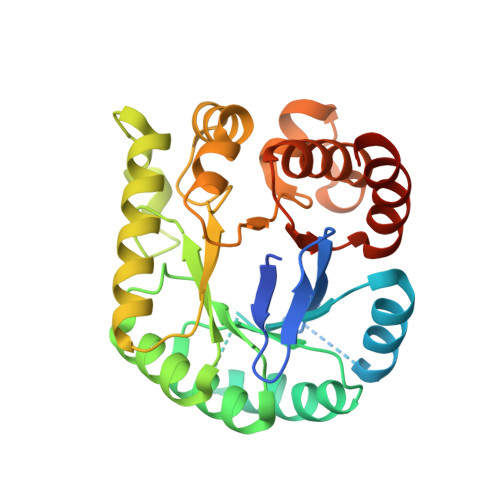
Folate biosynthesis is essential for the survival of bacteria and other lower organisms, yet absent in mammals, making its enzymes promising targets for selective antimicrobial therapy. Dihydropteroate synthase (DHPS) catalyzes a key step in this pathway by condensing para-aminobenzoate (pABA) with 6-hydroxymethyl-7,8-dihydropterin pyrophosphate (DHPPP) to generate dihydropteroate. DHPS is also the cellular target of sulfonamide antibiotics, and the emergence of sulfonamide resistance underscores the need for detailed structural insights into substrate recognition and inhibitor design. Here, we report high-resolution crystal structures of Thermus thermophilus HB8 DHPS (TtDHPS) in its apo form (at 1.65 Å resolution) and in complex with pABA (at 1.9 Å resolution) and the pterin substrate analogue 6-hydroxymethyl-7,8-dihydropterin pyrophosphate (6-HMPPP) (at 1.9 Å resolution). TtDHPS adopts a classical TIM-barrel fold and forms a biologically relevant dimer stabilized by C-terminal α-helices. Comparative analysis of the apo and ligand-bound forms reveals substrate-induced ordering of flexible loop regions that, together with residues from the barrel core, define the pterin- and pABA-binding pockets. Structural and sequence analyses with DHPS homologs from Escherichia coli and Mycobacterium tuberculosis highlight conserved catalytic features, as well as variable loop conformations and phosphate-binding residues that may contribute to differential sulfonamide sensitivity. Collectively, these structures shed light on DHPS catalysis and may prove helpful in the study of inhibitors associated with sulfonamide resistance.
- Department of Biophysics, National Institute of Mental Health and Neurosciences, Bangalore, 560029, India.
Organizational Affiliation: