Download Mendeley
Consequences of N-acylation on structure and membrane binding properties of dermaseptin derivative k4-s4-(1-13)
Shalev, D.E., Rotem, S., Fish, A., Mor, A.(2006) J Biol Chem 281: 9432-9438
- PubMed: 16407175 Search on PubMed
- DOI: https://doi.org/10.1074/jbc.M513051200
- Primary Citation Related Structures:
2DCX, 2DD6 - PubMed Abstract:
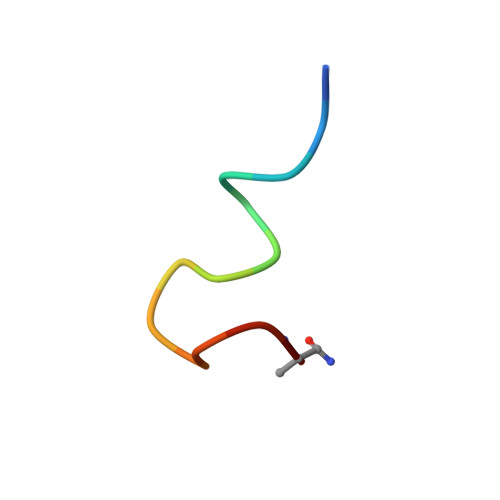
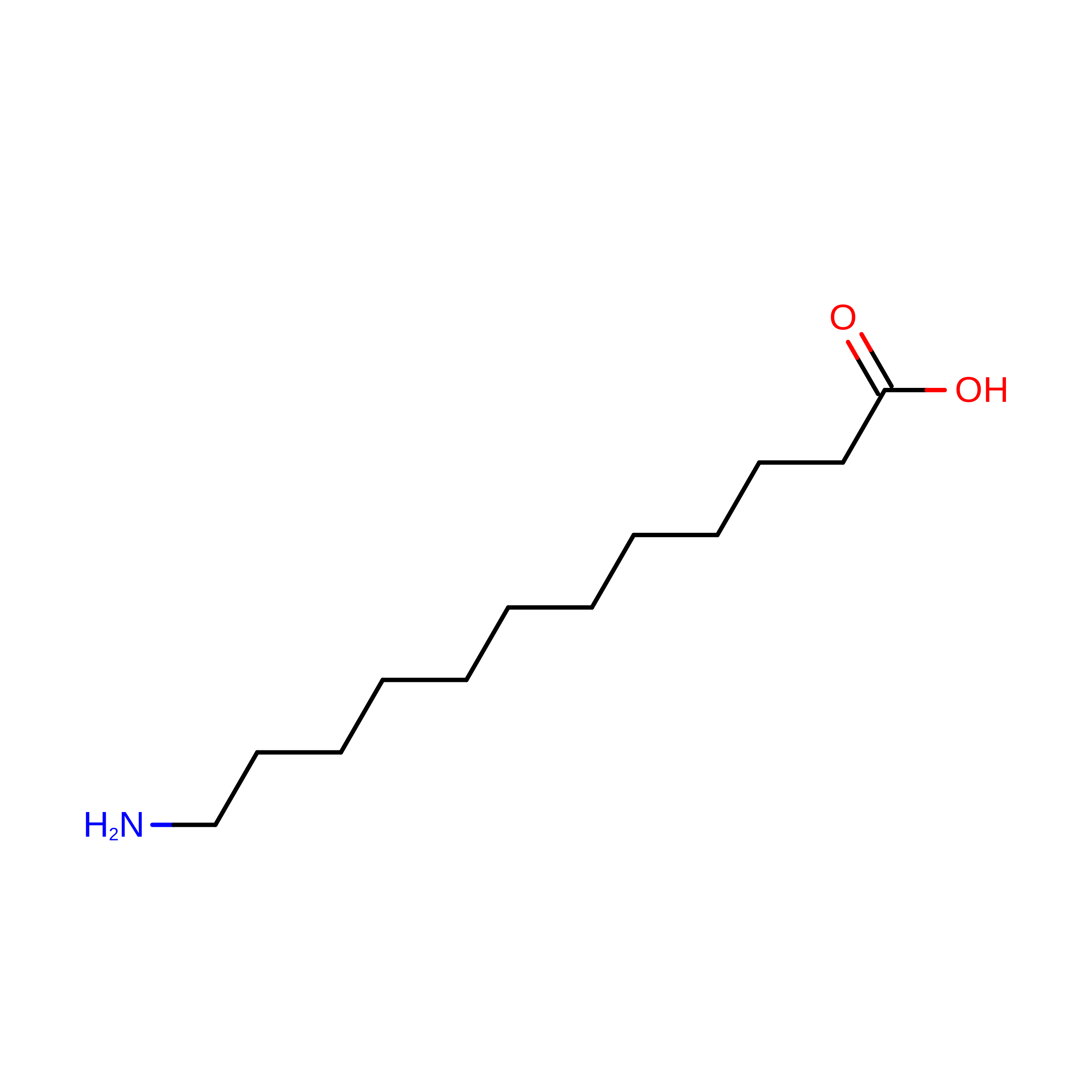
Acyl conjugation to antimicrobial peptides is known to enhance antimicrobial properties. Here, we investigated the consequences of aminolauryl (NC(12)) conjugation to the dermaseptin derivative K(4)-S4-(1-13) (P) on binding properties to bilayer models mimicking bacterial plasma membrane, which is often cited as the ultimate site of action. Isothermal titration calorimetry revealed that acylation was responsible for enhancing the binding affinity of NC(12)-P compared with P (K = 13 x 10(5) and 1.5 x 10(5) m(-1), respectively). Surface plasmon resonance measurements confirmed the isothermal titration calorimetry results (K(app) = 12.6 x 10(5) and 1.53 x 10(5) m(-1), respectively) and further indicated that enhanced adhesion affinity (K(adhesion) = 3 x 10(5) and 1 x 10(5) m(-1), respectively) was coupled to enhanced tendency to insert within the bilayer (K(insertion) = 4.5 and 1.5, respectively). To gain insight into the molecular basis for these observations, we investigated the three-dimensional structures in the presence of dodecylphosphocholine using NMR. The ensemble of NMR-calculated structures (backbone root mean square deviation <0.6 A) showed that the acyl moiety was responsible for a significant molecular reorganization, possibly affecting the electrostatic potential distribution in NC(12)-P relative to that of P. The combined data present compelling evidence in support of the hypothesis that N-acylation affects antimicrobial properties by modifying the secondary structure of the peptide in a manner that facilitates contact with the membrane and consequently increases its disruption.
- Wolfson Centre for Applied Structural Biology, Hebrew University of Jerusalem, Safra Campus, Givat Ram, 91904 Jerusalem, Israel.
Organizational Affiliation: