2D8L | pdb_00002d8l

Crystal Structure of Unsaturated Rhamnogalacturonyl Hydrolase in complex with dGlcA-GalNAc


Experimental Data Snapshot

  • Method: X-RAY DIFFRACTION
  • Resolution: 1.70 Å
  • R-Value Free: 
    0.219 (Depositor), 0.182 (DCC) 

wwPDB Validation 3D Report Full Report

Validation slider image for 2D8L

This is version 2.1 of the entry. See complete history

Literature

A novel glycoside hydrolase family 105: the structure of family 105 unsaturated rhamnogalacturonyl hydrolase complexed with a disaccharide in comparison with family 88 enzyme complexed with the disaccharide

Itoh, T.Ochiai, A.Mikami, B.Hashimoto, W.Murata, K.

(2006) J Mol Biology 360: 573-585

  • DOI: https://doi.org/10.1016/j.jmb.2006.04.047
  • Primary Citation Related Structures: 
    2D8L

  • PubMed Abstract: 

    YteR, a hypothetical protein with unknown functions, is derived from Bacillus subtilis strain 168 and has an overall structure similar to that of bacterial unsaturated glucuronyl hydrolase (UGL), although it exhibits little amino acid sequence identity with UGL. UGL releases unsaturated glucuronic acid from glycosaminoglycan treated with glycosaminoglycan lyases. The amino acid sequence of YteR shows a significant homology (26% identity) with the hypothetical protein YesR also from B. subtilis strain 168. To clarify the intrinsic functions of YteR and YesR, both proteins were overexpressed in Escherichia coli, purified, and characterized. Based on their gene arrangements in genome and enzyme properties, YteR and YesR were found to constitute a novel enzyme activity, "unsaturated rhamnogalacturonyl hydrolase," classified as new glycoside hydrolase family 105. This enzyme acts specifically on unsaturated rhamnogalacturonan (RG) obtained from RG type-I treated with RG lyases and releases an unsaturated galacturonic acid. The crystal structure of YteR complexed with unsaturated chondroitin disaccharide (UGL substrate) was obtained and compared to the structure of UGL complexed with the same disaccharide. The UGL substrate is sterically hindered with the active pocket of YteR. The protruding loop of YteR prevents the UGL substrate from being bound effectively. The most likely candidate catalytic residues for general acid/base are Asp143 in YteR and Asp135 in YesR. This is supported by three-dimensional structural and site-directed mutagenesis studies. These findings provide molecular insights into novel enzyme catalysis and sequential reaction mechanisms involved in RG-I depolymerization by bacteria.


  • Organizational Affiliation
    • Division of Agronomy and Horticultural Science, Graduate School of Agriculture, Kyoto University, Gokasho, Uji, Kyoto 611-0011, Japan.

Macromolecule Content 

  • Total Structure Weight: 43.4 kDa 
  • Atom Count: 3,651 
  • Modeled Residue Count: 363 
  • Deposited Residue Count: 373 
  • Unique protein chains: 1

Macromolecules

Find similar proteins by:|  3D Structure
Entity ID: 1
MoleculeChains  Sequence LengthOrganismDetailsImage
Putative glycosyl hydrolase yteR373Bacillus subtilisMutation(s): 0 
EC: 3.2.1 (PDB Primary Data), 3.2.1.172 (UniProt)
UniProt
Find proteins for O34559 (Bacillus subtilis (strain 168))
Explore O34559 
Go to UniProtKB:  O34559
Entity Groups
Sequence Clusters30% Identity50% Identity70% Identity90% Identity95% Identity100% Identity
UniProt GroupO34559
Sequence Annotations
Expand
Reference Sequence

Oligosaccharides

Help  
Entity ID: 2
MoleculeChains Length2D Diagram GlycosylationD Interactions
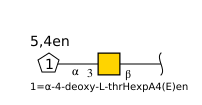
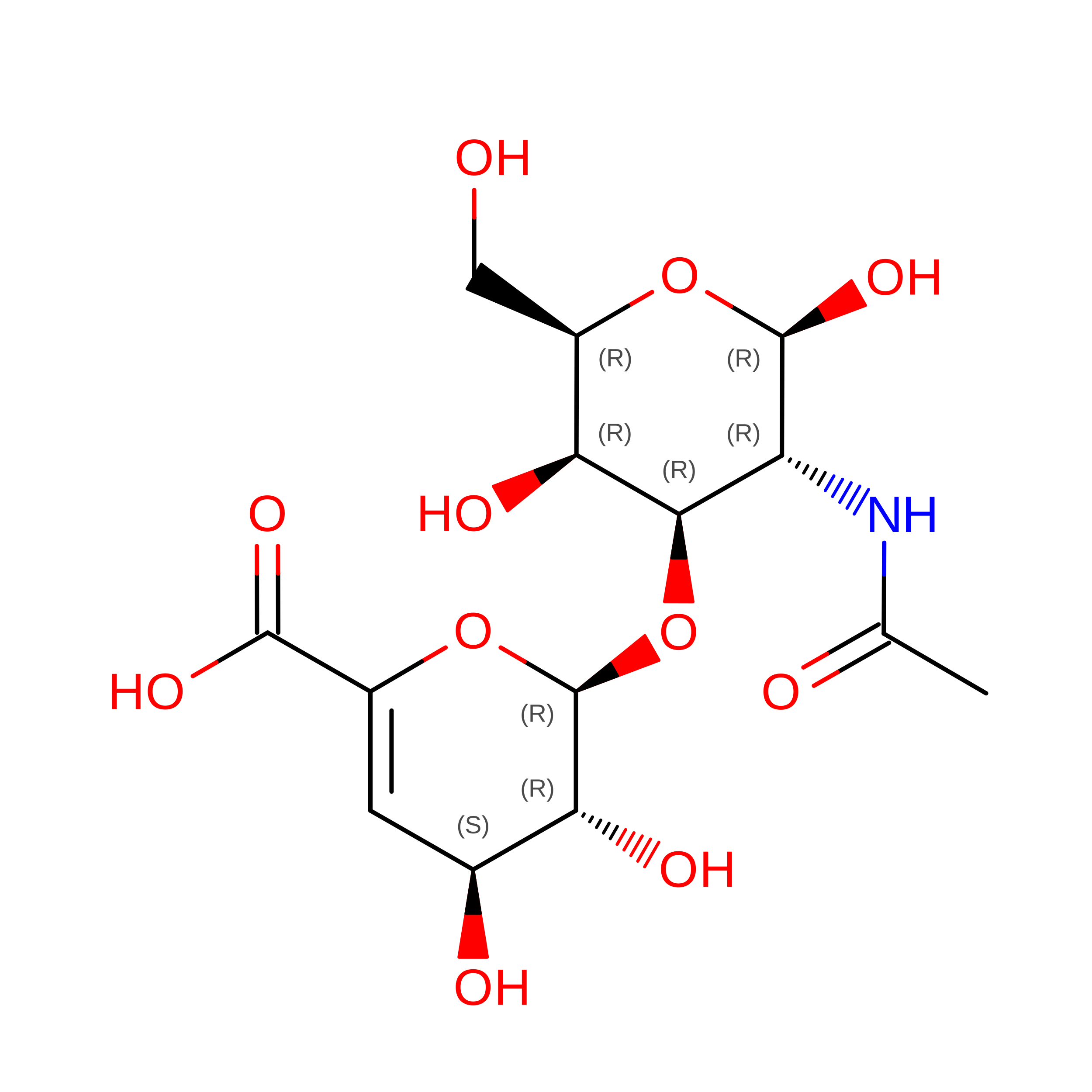
4-deoxy-alpha-L-threo-hex-4-enopyranuronic acid-(1-3)-2-acetamido-2-deoxy-beta-D-galactopyranose
B
2N/A
Glycosylation Resources
GlyTouCan: G90884WY
GlyCosmos: G90884WY

Biologically Interesting Molecules (External Reference) 

1 Unique

Experimental Data & Validation

Experimental Data

  • Method: X-RAY DIFFRACTION
  • Resolution: 1.70 Å
  • R-Value Free:  0.219 (Depositor), 0.182 (DCC) 
Space Group: P 61 2 2
Unit Cell:
Length ( Å )Angle ( ˚ )
a = 91.831α = 90
b = 91.831β = 90
c = 178.865γ = 120
Software Package:
Software NamePurpose
SHELXmodel building
SHELXL-97refinement
HKL-2000data reduction
SCALEPACKdata scaling
CNSphasing

Structure Validation

View Full Validation Report


Entry History 

Deposition Data

Revision History  (Full details and data files)

  • Version 1.0: 2006-11-14
    Type: Initial release
  • Version 1.1: 2008-04-30
    Changes: Version format compliance
  • Version 1.2: 2011-07-13
    Changes: Version format compliance
  • Version 2.0: 2020-07-29
    Type: Remediation
    Reason: Carbohydrate remediation
    Changes: Atomic model, Data collection, Derived calculations, Non-polymer description, Structure summary
  • Version 2.1: 2024-03-13
    Changes: Data collection, Database references, Structure summary