Download Mendeley
A Partial Atomic Structure for the Flagellar Hook of Salmonella Typhimurium.
Shaikh, T.R., Thomas, D.R., Chen, J.Z., Samatey, F.A., Matsunami, H., Imada, K., Namba, K., Derosier, D.J.(2005) Proc Natl Acad Sci U S A 102: 1023
- PubMed: 15657146 Search on PubMedSearch on PubMed Central
- DOI: https://doi.org/10.1073/pnas.0409020102
- Primary Citation Related Structures:
2BGY, 2BGZ - PubMed Abstract:
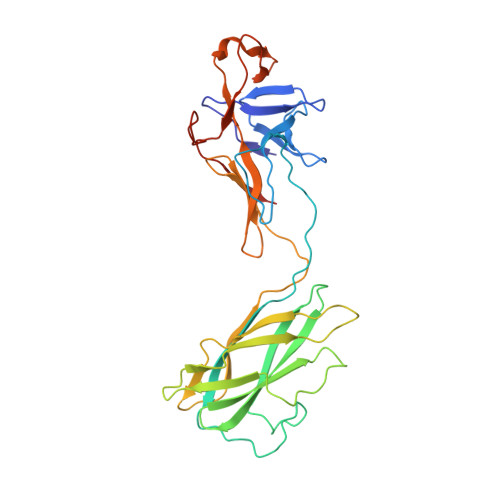
The axial proteins of the bacterial flagellum function as a drive shaft, universal joint, and propeller driven by the flagellar rotary motor; they also form the putative protein export channel. The N- and C-terminal sequences of the eight axial proteins were predicted to form interlocking alpha-domains generating an axial tube. We report on an approximately 1-nm resolution map of the hook from Salmonella typhimurium, which reveals such a tube made from interdigitated, 1-nm rod-like densities similar to those seen in maps of the filament. Atomic models for the two outer domains of the hook subunit were docked into the corresponding outermost features of the map. The N and C termini of the hook subunit fragment are positioned next to each other and face toward the axis of the hook. The placement of these termini would permit the residues missing in the fragment to form the rod-like features that form the core domain of the hook. We also fit the hook atomic model to an approximately 2-nm resolution map of the hook from Caulobacter crescentus. The hook protein sequence from C. crescentus is largely homologous to that of S. typhimurium except for a large insertion (20 kDa). According to difference maps and our fitting, this insertion is found on the outer surface of the hook, consistent with our modeling of the hook.
- Dynamic NanoMachine Project, International Cooperative Research Project, Japan Science and Technology Agency, 1-3 Yamadaoka, Suita, Osaka 565-0871, Japan.
Organizational Affiliation: