2B14 | pdb_00002b14

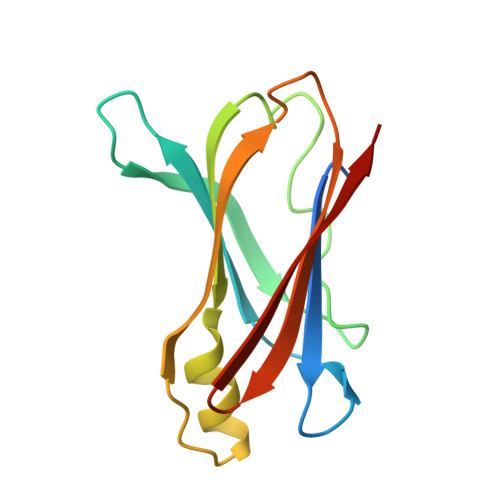
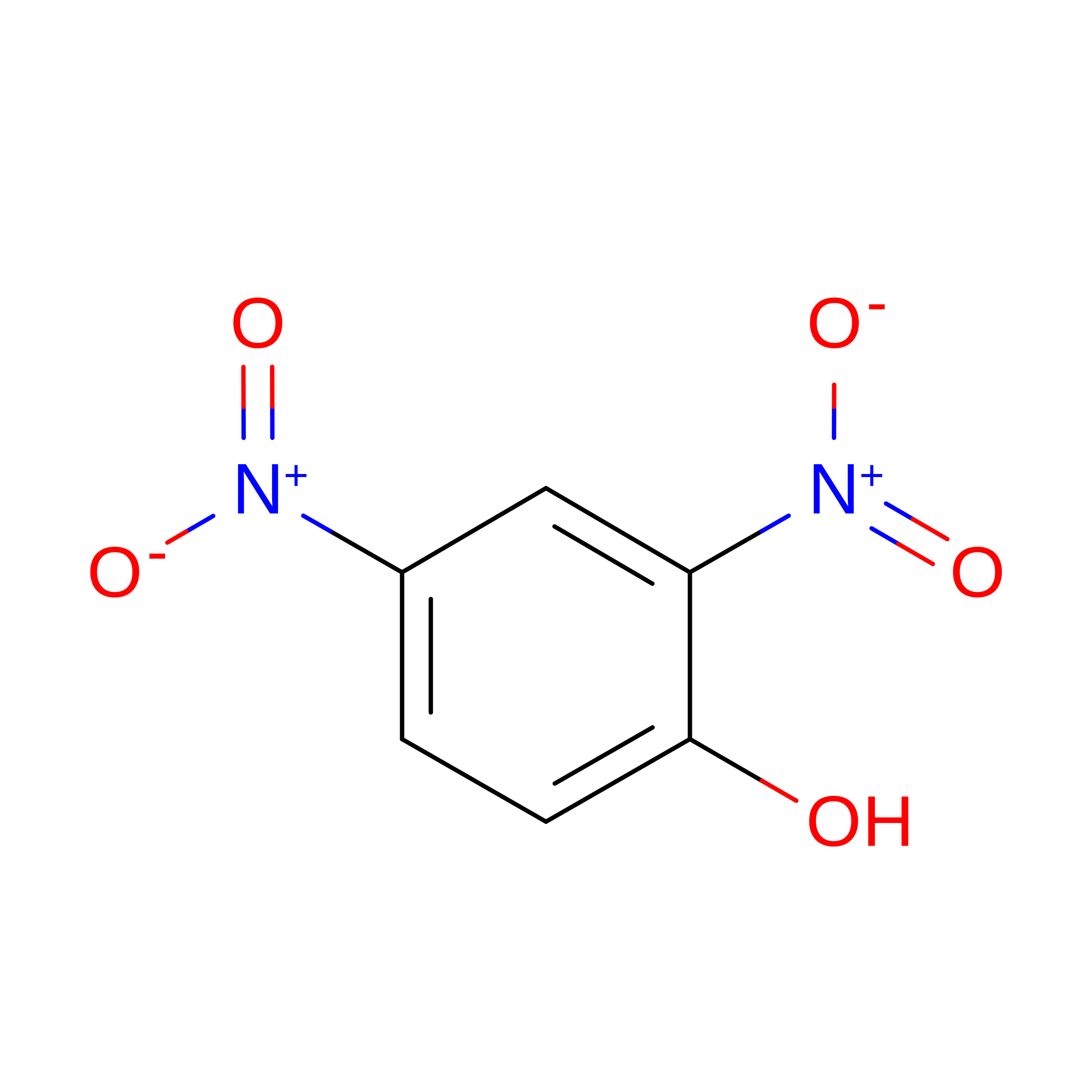
The crystal structure of 2,4-dinitrophenol in complex with the amyloidogenic variant Transthyretin Leu 55 Pro


Experimental Data Snapshot

  • Method: X-RAY DIFFRACTION
  • Resolution: 2.00 Å
  • R-Value Free: 
    0.239 (Depositor), 0.206 (DCC) 
  • R-Value Work: 
    0.203 (Depositor), 0.208 (DCC) 
  • R-Value Observed: 
    0.204 (Depositor) 

Starting Model: experimental
View more details

wwPDB Validation 3D Report Full Report

Validation slider image for 2B14

Ligand Structure Quality Assessment 


This is version 1.4 of the entry. See complete history

Literature

The binding of 2,4-dinitrophenol to wild-type and amyloidogenic transthyretin

Morais-de-Sa, E.Neto-Silva, R.M.Pereira, P.J.Saraiva, M.J.Damas, A.M.

(2006) Acta Crystallogr D Biol Crystallogr 62: 512-519

  • DOI: https://doi.org/10.1107/S0907444906006962
  • Primary Citation Related Structures: 
    2B14, 2B15, 2B16

  • PubMed Abstract: 

    Systemic deposition of transthyretin (TTR) amyloid fibrils is always observed in familial amyloidotic polyneuropathy, senile systemic amyloidosis and familial amyloidotic cardiomyopathy patients. Destabilization of the molecule leads to a cascade of events which result in fibril formation. The destabilization of a native protein with consequent conformational changes appears to be a common link in several human amyloid diseases. Intensive research has been directed towards finding small molecules that could work as therapeutic agents for the prevention/inhibition of amyloid diseases through stabilization of the native fold of the potentially amyloidogenic protein. This work provides insight into the structural determinants of the highly stabilizing effects of 2,4-dinitrophenol on wild-type TTR. It is also shown that similar interactions are established between this molecule and two highly amyloidogenic TTR variants: TTR L55P and TTR Y78F. In the three crystal complexes, 2,4-dinitrophenol occupies the two hormone-binding sites of the TTR tetramer. As a result of 2,4-dinitrophenol binding, the two dimers in the TTR tetramer become closer, increasing the stability of the protein. The three-dimensional structures now determined allow a comprehensive description of key interactions between transthyretin and 2,4-dinitrophenol, a small compound that holds promise as a template for the design of a therapeutical drug for amyloid diseases.


  • Organizational Affiliation
    • Instituto de Biologia Molecular e Celular-IBMC, Rua do Campo Alegre 823, 4150-180 Porto, Portugal.

Macromolecule Content 

  • Total Structure Weight: 27.89 kDa 
  • Atom Count: 1,782 
  • Modeled Residue Count: 229 
  • Deposited Residue Count: 254 
  • Unique protein chains: 1

Macromolecules

Find similar proteins by:|  3D Structure
Entity ID: 1
MoleculeChains  Sequence LengthOrganismDetailsImage
Transthyretin
A, B
127Homo sapiensMutation(s): 1 
UniProt & NIH Common Fund Data Resources
Find proteins for P02766 (Homo sapiens)
Explore P02766 
Go to UniProtKB:  P02766
PHAROS:  P02766
GTEx:  ENSG00000118271 
Entity Groups
Sequence Clusters30% Identity50% Identity70% Identity90% Identity95% Identity100% Identity
UniProt GroupP02766
Sequence Annotations
Expand
Reference Sequence

Experimental Data & Validation

Experimental Data

  • Method: X-RAY DIFFRACTION
  • Resolution: 2.00 Å
  • R-Value Free:  0.239 (Depositor), 0.206 (DCC) 
  • R-Value Work:  0.203 (Depositor), 0.208 (DCC) 
  • R-Value Observed: 0.204 (Depositor) 
Space Group: P 21 21 2
Unit Cell:
Length ( Å )Angle ( ˚ )
a = 42.55α = 90
b = 84.247β = 90
c = 63.397γ = 90
Software Package:
Software NamePurpose
MOSFLMdata reduction
SCALAdata scaling
AMoREphasing
ARP/wARPmodel building
CCP4data scaling

Structure Validation

View Full Validation Report


Ligand Structure Quality Assessment 


Entry History 

Deposition Data

Revision History  (Full details and data files)

  • Version 1.0: 2006-07-18
    Type: Initial release
  • Version 1.1: 2008-05-01
    Changes: Version format compliance
  • Version 1.2: 2011-07-13
    Changes: Derived calculations, Version format compliance
  • Version 1.3: 2021-11-10
    Changes: Database references, Derived calculations
  • Version 1.4: 2023-10-25
    Changes: Data collection, Refinement description