Download Mendeley
Structure of Cytochrome c552 from a Moderate Thermophilic Bacterium, Hydrogenophilus thermoluteolus: Comparative Study on the Thermostability of Cytochrome c
Nakamura, S., Ichiki, S.I., Takashima, H., Uchiyama, S., Hasegawa, J., Kobayashi, Y., Sambongi, Y., Ohkubo, T.(2006) Biochemistry 45: 6115-6123
- PubMed: 16681384 Search on PubMed
- DOI: https://doi.org/10.1021/bi0520131
- Primary Citation Related Structures:
2AI5, 2D0S - PubMed Abstract:
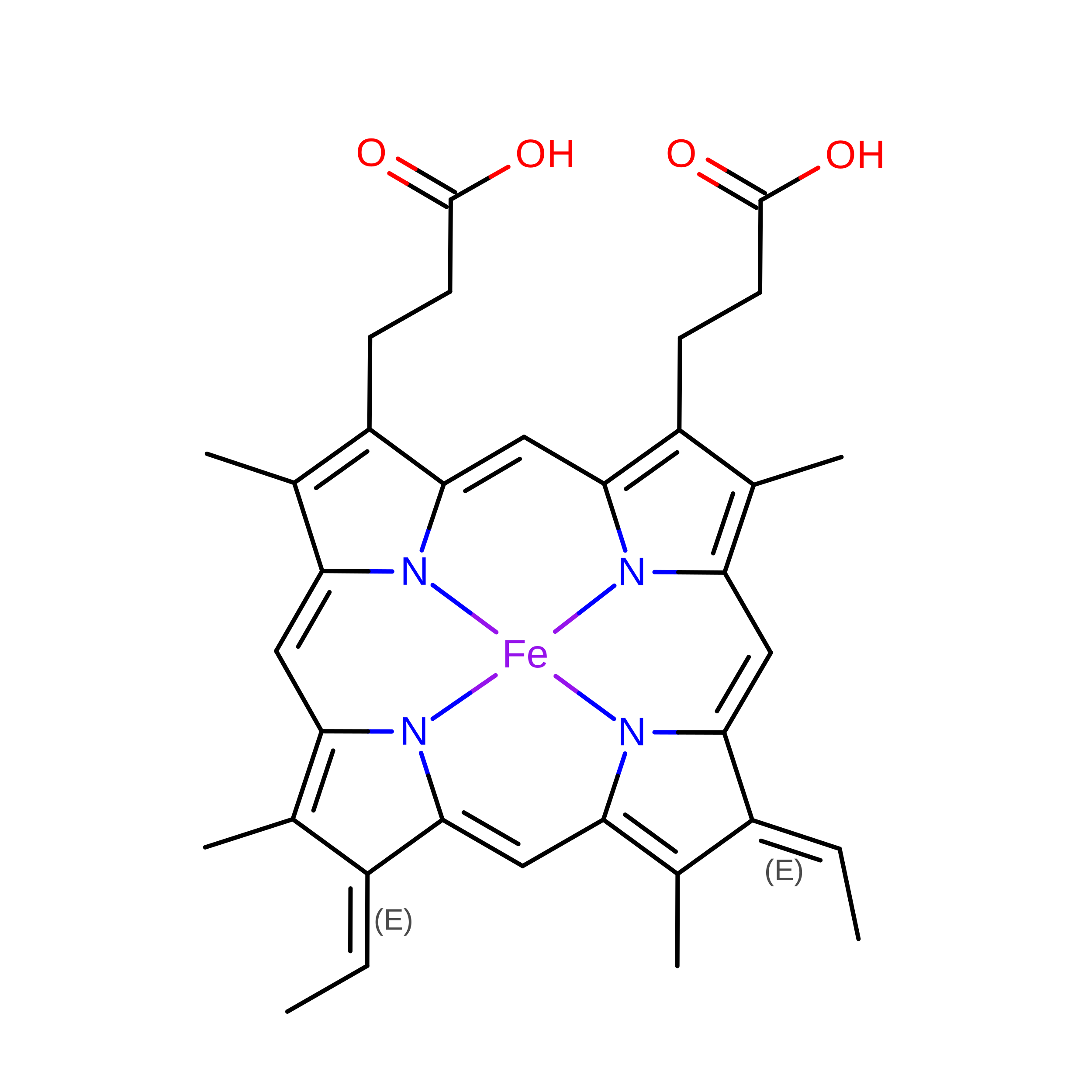
We have studied the structure-thermostability relationship using cytochromes c from mesophilic and thermophilic bacteria; Pseudomonas aeruginosa (PAc(551)) growing at 37 degrees C and Hydrogenobacter thermophilus (HTc(552)) at 72 degrees C and showed that only five residues primarily differentiate their stabilities. For a more comprehensive study, we found Hydrogenophilus thermoluteolus (Pseudomonas hydrogenothermophila) growing at 52 degrees C and showed the moderate stability of the cytochrome c from this bacterium (PHc(552)). To explore the stabilization mechanisms, the crystal structure of PHc(552) was determined by X-ray analysis. The solution structure of HTc(552) elucidated previously by NMR was refined using distributed computational implementation. Furthermore, the recently reported crystal structure of HTc(552) has become available [Travaglini-Allocatelli, C. et al. (2005) J. Biol. Chem. 280, 25729-25734]. When the structures of these three cytochromes c were combined, this revealed that the five residues, corresponding to those mentioned above, determine the difference of stabilities among them as well. These facts suggested the stabilization mechanisms as follows: (1) improved van der Waals interactions by packing optimization at the N-terminal helix, (2) attractive electrostatic interactions with the heme propionate group, and (3) favorable van der Waals interaction with the heme. This comparative study, by supplementing the structural information of PHc(552) with its complementary feature, demonstrates that just a small number of amino acid residues determine the overall molecular stability by means of additivity of the effects of their substitutions. It is interesting that, in naturally occurring proteins, these adaptation strategies are accommodated by these bacteria to survive in the wide range of thermal conditions.
- Graduate School of Pharmaceutical Sciences, Osaka University, Suita, Osaka 565-0871, Japan.
Organizational Affiliation: