2AHG | pdb_00002ahg

Unsaturated glucuronyl hydrolase mutant D88N with dGlcA-GalNAc


Experimental Data Snapshot

  • Method: X-RAY DIFFRACTION
  • Resolution: 1.90 Å
  • R-Value Free: 
    0.235 (Depositor), 0.235 (DCC) 
  • R-Value Work: 
    0.184 (Depositor), 0.186 (DCC) 
  • R-Value Observed: 
    0.184 (Depositor) 

wwPDB Validation 3D Report Full Report

Validation slider image for 2AHG

This is version 2.2 of the entry. See complete history

Literature

Crystal Structure of Unsaturated Glucuronyl Hydrolase Complexed with Substrate: MOLECULAR INSIGHTS INTO ITS CATALYTIC REACTION MECHANISM

Itoh, T.Hashimoto, W.Mikami, B.Murata, K.

(2006) J Biological Chem 281: 29807-29816

  • DOI: https://doi.org/10.1074/jbc.M604975200
  • Primary Citation Related Structures: 
    2AHF, 2AHG, 2D5J

  • PubMed Abstract: 

    Unsaturated glucuronyl hydrolase (UGL), which is a member of glycoside hydrolase family GH-88, is a bacterial enzyme that degrades mammalian glycosaminoglycans and bacterial biofilms. The enzyme, which acts on unsaturated oligosaccharides with an alpha-glycoside bond produced by microbial polysaccharide lyases responsible for bacterial invasion of host cells, was believed to release 4-deoxy-l-threo-5-hexosulose-uronate (unsaturated glucuronic acid, or DeltaGlcA) and saccharide with a new nonreducing terminus by hydrolyzing the glycosidic bond. We detail the crystal structures of wild-type inactive mutant UGL of Bacillus sp. GL1 and its complex with a substrate (unsaturated chondroitin disaccharide), identify active site residues, and postulate a reaction mechanism catalyzed by UGL that triggers the hydration of the vinyl ether group in DeltaGlcA, based on the structural analysis of the enzyme-substrate complex and biochemical analysis. The proposed catalytic mechanism of UGL is a novel case among known glycosidases. Under the proposed mechanism, Asp-149 acts as a general acid and base catalyst to protonate the DeltaGlcA C4 atom and to deprotonate the water molecule. The deprotonated water molecule attacks the DeltaGlcA C5 atom to yield unstable hemiketal; this is followed by spontaneous conversion to an aldehyde (4-deoxy-l-threo-5-hexosulose-uronate) and saccharide through hemiacetal formation and cleavage of the glycosidic bond. UGL is the first clarified alpha(6)/alpha(6)-barrel enzyme using aspartic acid as the general acid/base catalyst.


  • Organizational Affiliation
    • Division of Applied Life Sciences and Division of Food Science and Biotechnology, Graduate School of Agriculture, Kyoto University, Gokasho, Uji, Kyoto 611-0011, Japan.

Macromolecule Content 

  • Total Structure Weight: 86.59 kDa 
  • Atom Count: 6,938 
  • Modeled Residue Count: 754 
  • Deposited Residue Count: 754 
  • Unique protein chains: 1

Macromolecules

Find similar proteins by:|  3D Structure
Entity ID: 1
MoleculeChains  Sequence LengthOrganismDetailsImage
unsaturated glucuronyl hydrolase
A, B
377Bacillus sp. GL1Mutation(s): 1 
EC: 3.2.1 (PDB Primary Data), 3.2.1.179 (UniProt)
UniProt
Find proteins for Q9RC92 (Bacillus sp. (strain GL1))
Explore Q9RC92 
Go to UniProtKB:  Q9RC92
Entity Groups
Sequence Clusters30% Identity50% Identity70% Identity90% Identity95% Identity100% Identity
UniProt GroupQ9RC92
Sequence Annotations
Expand
Reference Sequence

Oligosaccharides

Help  
Entity ID: 2
MoleculeChains Length2D Diagram GlycosylationD Interactions
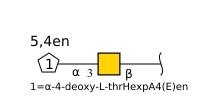
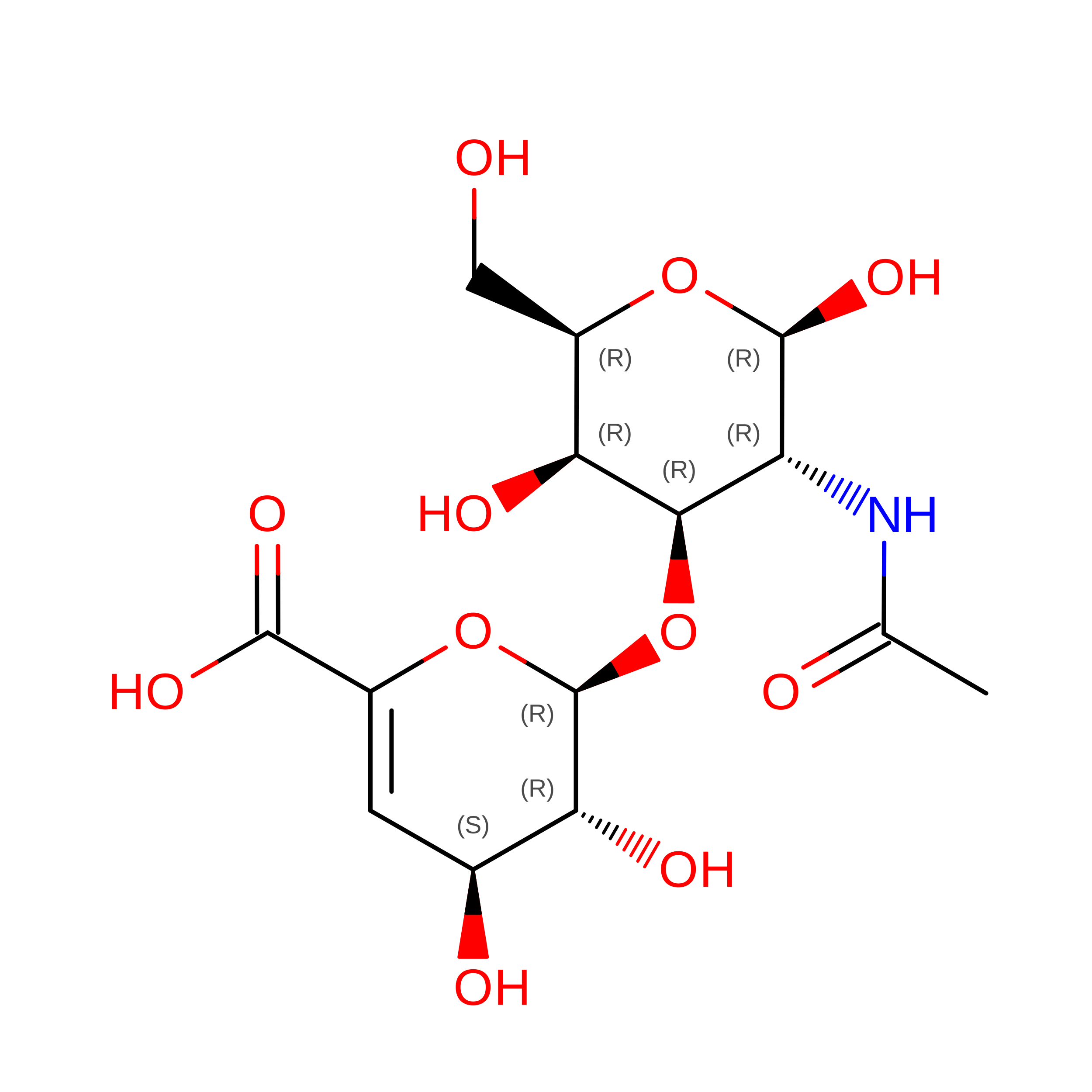
4-deoxy-alpha-L-threo-hex-4-enopyranuronic acid-(1-3)-2-acetamido-2-deoxy-beta-D-galactopyranose
C, D
2N/A
Glycosylation Resources
GlyTouCan: G90884WY
GlyCosmos: G90884WY

Biologically Interesting Molecules (External Reference) 

1 Unique

Experimental Data & Validation

Experimental Data

  • Method: X-RAY DIFFRACTION
  • Resolution: 1.90 Å
  • R-Value Free:  0.235 (Depositor), 0.235 (DCC) 
  • R-Value Work:  0.184 (Depositor), 0.186 (DCC) 
  • R-Value Observed: 0.184 (Depositor) 
Space Group: P 21 21 21
Unit Cell:
Length ( Å )Angle ( ˚ )
a = 87.855α = 90
b = 95.041β = 90
c = 95.433γ = 90
Software Package:
Software NamePurpose
CNSrefinement
HKL-2000data reduction
SCALEPACKdata scaling
CNSphasing

Structure Validation

View Full Validation Report


Entry History 

Deposition Data

Revision History  (Full details and data files)

  • Version 1.0: 2006-08-15
    Type: Initial release
  • Version 1.1: 2008-04-30
    Changes: Version format compliance
  • Version 1.2: 2011-07-13
    Changes: Source and taxonomy, Version format compliance
  • Version 2.0: 2020-07-29
    Type: Remediation
    Reason: Carbohydrate remediation
    Changes: Atomic model, Data collection, Derived calculations, Non-polymer description, Structure summary
  • Version 2.1: 2021-11-10
    Changes: Database references, Structure summary
  • Version 2.2: 2024-05-29
    Changes: Data collection