1Y3A | pdb_00001y3a

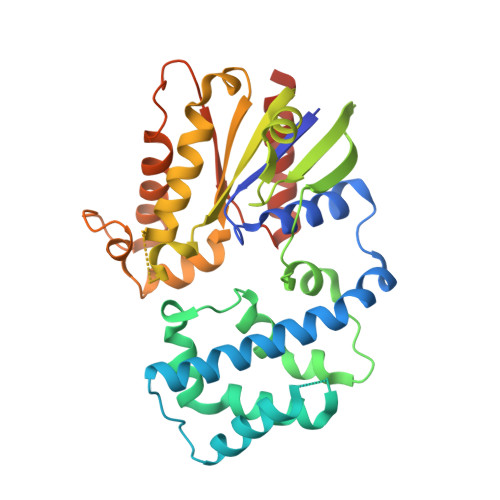
Structure of G-Alpha-I1 bound to a GDP-selective peptide provides insight into guanine nucleotide exchange


Experimental Data Snapshot

  • Method: X-RAY DIFFRACTION
  • Resolution: 2.50 Å
  • R-Value Free: 
    0.280 (Depositor), 0.250 (DCC) 
  • R-Value Work: 
    0.240 (Depositor), 0.245 (DCC) 
  • R-Value Observed: 
    0.255 (Depositor) 

Starting Model: experimental
View more details

wwPDB Validation 3D Report Full Report

Validation slider image for 1Y3A

Ligand Structure Quality Assessment 


This is version 1.4 of the entry. See complete history

Literature

Structure of G-Alpha-I1 bound to a GDP-selective peptide provides insight into guanine nucleotide exchange

Johnston, C.A.Willard, F.S.Jezyk, M.R.Fredericks, Z.Bodor, E.T.Jones, M.B.Blaesius, R.Watts, V.J.Harden, T.K.Sondek, J.Ramer, J.K.Siderovski, D.P.

(2005) Structure 7: 1069-1080

  • DOI: https://doi.org/10.1016/j.str.2005.04.007
  • Primary Citation Related Structures: 
    1Y3A

  • PubMed Abstract: 

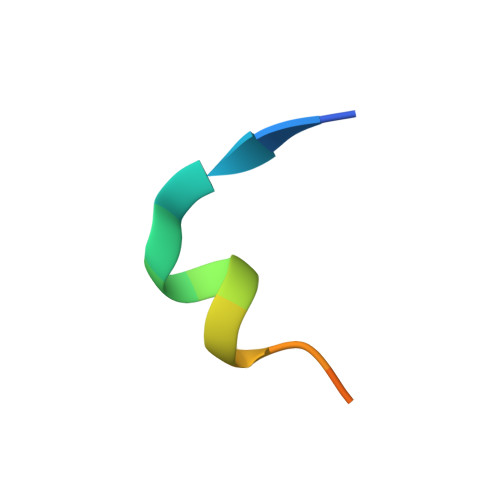
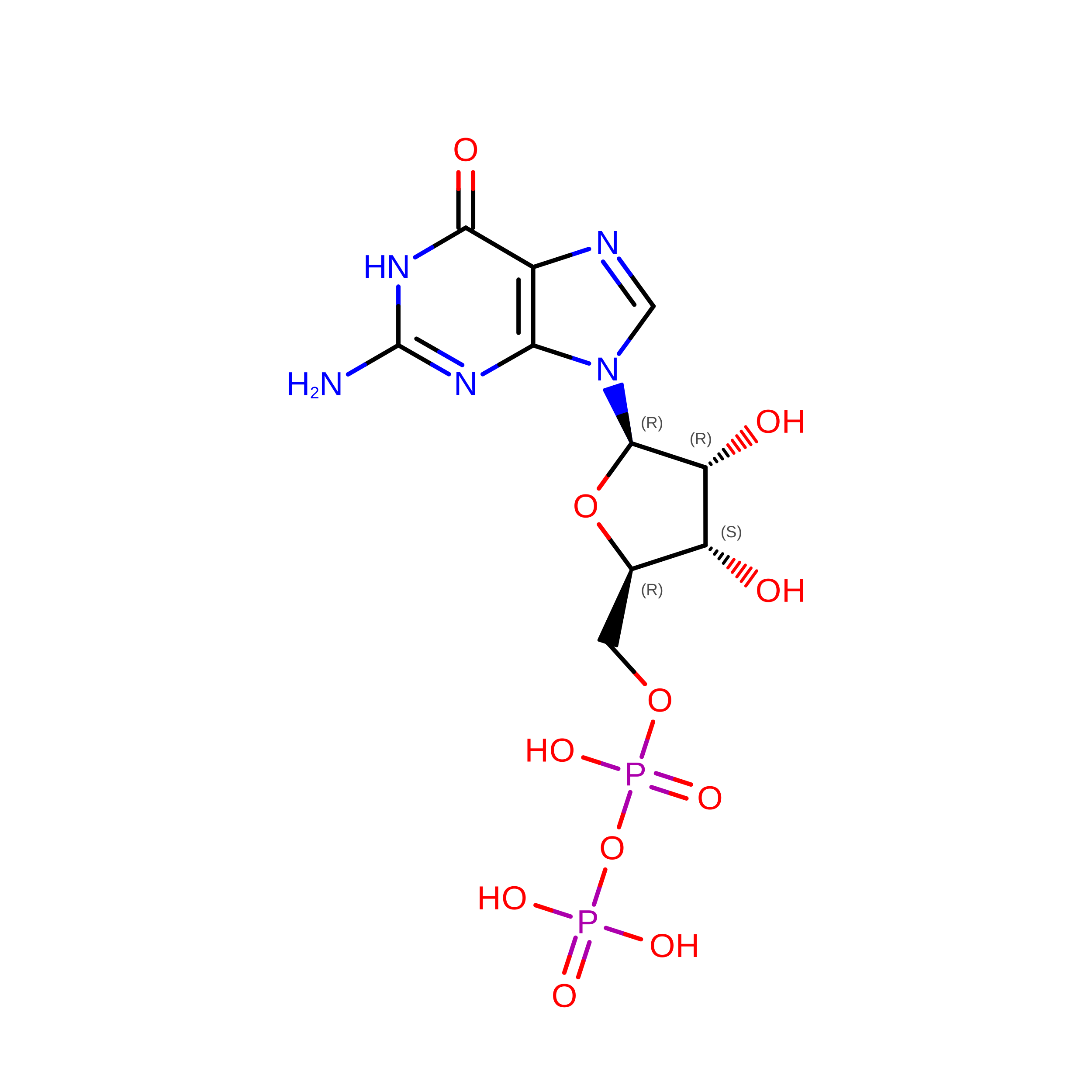
    Heterotrimeric G proteins are molecular switches that regulate numerous signaling pathways involved in cellular physiology. This characteristic is achieved by the adoption of two principal states: an inactive, GDP bound state and an active, GTP bound state. Under basal conditions, G proteins exist in the inactive, GDP bound state; thus, nucleotide exchange is crucial to the onset of signaling. Despite our understanding of G protein signaling pathways, the mechanism of nucleotide exchange remains elusive. We employed phage display technology to identify nucleotide state-dependent Galpha binding peptides. Herein, we report a GDP-selective Galpha binding peptide, KB-752, that enhances spontaneous nucleotide exchange of Galpha(i) subunits. Structural determination of the Galpha(i1)/peptide complex reveals unique changes in the Galpha switch regions predicted to enhance nucleotide exchange by creating a GDP dissociation route. Our results cast light onto a potential mechanism by which Galpha subunits adopt a conformation suitable for nucleotide exchange.


  • Organizational Affiliation
    • Department of Pharmacology, The University of North Carolina at Chapel Hill, Chapel Hill, NC 27599, USA.

Macromolecule Content 

  • Total Structure Weight: 160.34 kDa 
  • Atom Count: 10,424 
  • Modeled Residue Count: 1,256 
  • Deposited Residue Count: 1,380 
  • Unique protein chains: 2

Macromolecules

Find similar proteins by:|  3D Structure
Entity ID: 1
MoleculeChains  Sequence LengthOrganismDetailsImage
Guanine nucleotide-binding protein G(i), alpha-1 subunit
A, B, C, D
329Homo sapiensMutation(s): 0 
Gene Names: GNAI1
EC: 3.6.5
UniProt & NIH Common Fund Data Resources
Find proteins for P63096 (Homo sapiens)
Explore P63096 
Go to UniProtKB:  P63096
PHAROS:  P63096
GTEx:  ENSG00000127955 
Entity Groups
Sequence Clusters30% Identity50% Identity70% Identity90% Identity95% Identity100% Identity
UniProt GroupP63096
Sequence Annotations
Expand
Reference Sequence
Find similar proteins by:  Sequence   |   3D Structure  
Entity ID: 2
MoleculeChains  Sequence LengthOrganismDetailsImage
KB752 peptide
E, F, G, H
16Homo sapiensMutation(s): 0 

Experimental Data & Validation

Experimental Data

  • Method: X-RAY DIFFRACTION
  • Resolution: 2.50 Å
  • R-Value Free:  0.280 (Depositor), 0.250 (DCC) 
  • R-Value Work:  0.240 (Depositor), 0.245 (DCC) 
  • R-Value Observed: 0.255 (Depositor) 
Space Group: P 1 21 1
Unit Cell:
Length ( Å )Angle ( ˚ )
a = 72.943α = 90
b = 112.785β = 93.75
c = 109.49γ = 90
Software Package:
Software NamePurpose
HKL-2000data collection
SCALEPACKdata scaling
AMoREphasing
CNSrefinement
HKL-2000data reduction

Structure Validation

View Full Validation Report


Ligand Structure Quality Assessment 


Entry History 

Revision History  (Full details and data files)

  • Version 1.0: 2005-07-12
    Type: Initial release
  • Version 1.1: 2008-04-30
    Changes: Version format compliance
  • Version 1.2: 2011-07-13
    Changes: Version format compliance
  • Version 1.3: 2019-03-27
    Changes: Data collection, Derived calculations
  • Version 1.4: 2023-08-23
    Changes: Data collection, Database references, Derived calculations, Refinement description