1VB9 | pdb_00001vb9

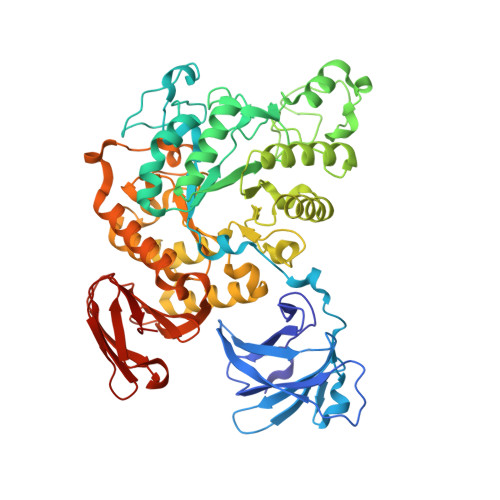
Crystal structure of Thermoactinomyces vulgaris R-47 alpha-amylase II (TVA II) complexed with transglycosylated product


Experimental Data Snapshot

  • Method: X-RAY DIFFRACTION
  • Resolution: 2.20 Å
  • R-Value Free: 
    0.233 (Depositor), 0.240 (DCC) 
  • R-Value Work: 
    0.194 (Depositor), 0.202 (DCC) 
  • R-Value Observed: 
    0.194 (Depositor) 

Starting Model: experimental
View more details

wwPDB Validation 3D Report Full Report

Validation slider image for 1VB9

This is version 2.2 of the entry. See complete history

Literature

The crystal structure of Thermoactinomyces vulgaris R-47 alpha-amylase II (TVA II) complexed with transglycosylated product

Mizuno, M.Tonozuka, T.Uechi, A.Ohtaki, A.Ichikawa, K.Kamitori, S.Nishikawa, A.Sakano, Y.

(2004) Eur J Biochem 271: 2530-2538

  • DOI: https://doi.org/10.1111/j.1432-1033.2004.04183.x
  • Primary Citation Related Structures: 
    1VB9

  • PubMed Abstract: 

    Alphan alpha-amylase (TVA II) from Thermoactinomyces vulgaris R-47 efficiently hydrolyzes alpha-1,4-glucosidic linkages of pullulan to produce panose in addition to hydrolyzing starch. TVA II also hydrolyzes alpha-1,4-glucosidic linkages of cyclodextrins and alpha-1,6-glucosidic linkages of isopanose. To clarify the basis for this wide substrate specificity of TVA II, we soaked 4(3)-alpha-panosylpanose (4(3)-P2) (a pullulan hydrolysate composed of two panosyl units) into crystals of D325N inactive mutated TVA II. We then determined the crystal structure of TVA II complexed with 4(2)-alpha-panosylpanose (4(2)-P2), which was produced by transglycosylation from 4(3)-P2, at 2.2-A resolution. The shape of the active cleft of TVA II is unique among those of alpha-amylase family enzymes due to a loop (residues 193-218) that is located at the end of the cleft around the nonreducing region and forms a 'dam'-like bank. Because this loop is short in TVA II, the active cleft is wide and shallow around the nonreducing region. It is assumed that this short loop is one of the reasons for the wide substrate specificity of TVA II. While Trp356 is involved in the binding of Glc +2 of the substrate, it appears that Tyr374 in proximity to Trp356 plays two roles: one is fixing the orientation of Trp356 in the substrate-liganded state and the other is supplying the water that is necessary for substrate hydrolysis.


  • Organizational Affiliation
    • Department of Applied Biological Science, Tokyo Univrsity of Agriculture and Technology, Tokyo, Japan.

Macromolecule Content 

  • Total Structure Weight: 137.17 kDa 
  • Atom Count: 10,196 
  • Modeled Residue Count: 1,170 
  • Deposited Residue Count: 1,170 
  • Unique protein chains: 1

Macromolecules

Find similar proteins by:|  3D Structure
Entity ID: 1
MoleculeChains  Sequence LengthOrganismDetailsImage
alpha-amylase II
A, B
585Thermoactinomyces vulgarisMutation(s): 1 
EC: 3.2.1.1 (PDB Primary Data), 3.2.1.135 (UniProt)
UniProt
Find proteins for Q08751 (Thermoactinomyces vulgaris)
Explore Q08751 
Go to UniProtKB:  Q08751
Entity Groups
Sequence Clusters30% Identity50% Identity70% Identity90% Identity95% Identity100% Identity
UniProt GroupQ08751
Sequence Annotations
Expand
Reference Sequence

Oligosaccharides

Help  
Entity ID: 2
MoleculeChains Length2D Diagram GlycosylationD Interactions
alpha-D-glucopyranose-(1-6)-alpha-D-glucopyranose-(1-4)-alpha-D-glucopyranose-(1-4)-[alpha-D-glucopyranose-(1-6)]alpha-D-glucopyranose-(1-4)-alpha-D-glucopyranose
C, D
6N/A
Glycosylation Resources
GlyTouCan: G33695HX
GlyCosmos: G33695HX
GlyGen: G33695HX

Experimental Data & Validation

Experimental Data

  • Method: X-RAY DIFFRACTION
  • Resolution: 2.20 Å
  • R-Value Free:  0.233 (Depositor), 0.240 (DCC) 
  • R-Value Work:  0.194 (Depositor), 0.202 (DCC) 
  • R-Value Observed: 0.194 (Depositor) 
Space Group: P 21 21 21
Unit Cell:
Length ( Å )Angle ( ˚ )
a = 113.049α = 90
b = 118.274β = 90
c = 112.107γ = 90
Software Package:
Software NamePurpose
CNSrefinement
MOSFLMdata reduction
CCP4data scaling
CNSphasing

Structure Validation

View Full Validation Report


Entry History 

Deposition Data

Revision History  (Full details and data files)

  • Version 1.0: 2005-03-08
    Type: Initial release
  • Version 1.1: 2008-04-27
    Changes: Version format compliance
  • Version 1.2: 2011-07-13
    Changes: Version format compliance
  • Version 2.0: 2020-07-29
    Type: Remediation
    Reason: Carbohydrate remediation
    Changes: Atomic model, Data collection, Derived calculations, Structure summary
  • Version 2.1: 2021-11-10
    Changes: Database references, Structure summary
  • Version 2.2: 2023-10-25
    Changes: Data collection, Refinement description