1SGH | pdb_00001sgh

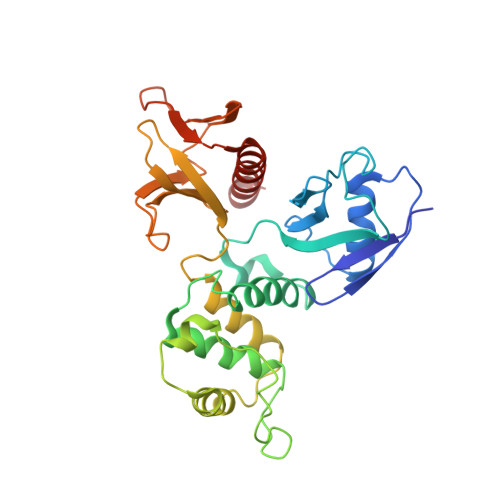
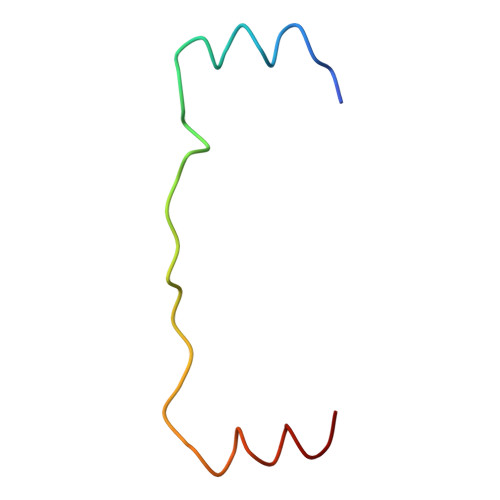
Moesin FERM domain bound to EBP50 C-terminal peptide


Experimental Data Snapshot

  • Method: X-RAY DIFFRACTION
  • Resolution: 3.50 Å
  • R-Value Free: 
    0.401 (Depositor), 0.382 (DCC) 
  • R-Value Work: 
    0.338 (Depositor), 0.314 (DCC) 

Starting Model: experimental
View more details

wwPDB Validation 3D Report Full Report

Validation slider image for 1SGH

This is version 1.3 of the entry. See complete history

Literature

The EBP50-moesin interaction involves a binding site regulated by direct masking on the FERM domain

Finnerty, C.M.Chambers, D.Ingraffea, J.Faber, H.R.Karplus, P.A.Bretscher, A.

(2004) J Cell Sci 117: 1547-1552

  • DOI: https://doi.org/10.1242/jcs.01038
  • Primary Citation Related Structures: 
    1SGH

  • PubMed Abstract: 

    Members of the ezrin-radixin-moesin (ERM) protein family serve as regulated microfilament-membrane crosslinking proteins that, upon activation, bind the scaffolding protein ERM-phosphoprotein of 50 kDa (EBP50). Here we report a 3.5 A resolution diffraction analysis of a complex between the active moesin N-terminal FERM domain and a 38 residue peptide from the C terminus of EBP50. This crystallographic result, combined with sequence and structural comparisons, suggests that the C-terminal 11 residues of EBP50 binds as an alpha-helix at the same site occupied in the dormant monomer by the last 11 residues of the inhibitory moesin C-terminal tail. Biochemical support for this interpretation derives from in vitro studies showing that appropriate mutations in both the EBP50 tail peptide and the FERM domain reduce binding, and that a peptide representing just the C-terminal 14 residues of EBP50 also binds to moesin. Combined with the recent identification of the I-CAM-2 binding site on the ERM FERM domain (Hamada, K., Shimizu, T., Yonemura, S., Tsukita, S., and Hakoshima, T. (2003) EMBO J. 22, 502-514), this study reveals that the FERM domain contains two distinct binding sites for membrane-associated proteins. The contribution of each ligand to ERM function can now be dissected by making structure-based mutations that specifically affect the binding of each ligand.


  • Organizational Affiliation
    • Department of Molecular Biology and Genetics, Biotechnology Building, Cornell University, Ithaca, NY 14853, USA.

Macromolecule Content 

  • Total Structure Weight: 39.56 kDa 
  • Atom Count: 2,482 
  • Modeled Residue Count: 332 
  • Deposited Residue Count: 336 
  • Unique protein chains: 2

Macromolecules

Find similar proteins by:|  3D Structure
Entity ID: 1
MoleculeChains  Sequence LengthOrganismDetailsImage
Moesin297Homo sapiensMutation(s): 0 
Gene Names: MSN
UniProt & NIH Common Fund Data Resources
Find proteins for P26038 (Homo sapiens)
Explore P26038 
Go to UniProtKB:  P26038
PHAROS:  P26038
GTEx:  ENSG00000147065 
Entity Groups
Sequence Clusters30% Identity50% Identity70% Identity90% Identity95% Identity100% Identity
UniProt GroupP26038
Sequence Annotations
Expand
Reference Sequence
Find similar proteins by:|  3D Structure
Entity ID: 2
MoleculeChains  Sequence LengthOrganismDetailsImage
Ezrin-radixin-moesin binding phosphoprotein 5039N/AMutation(s): 0 
UniProt & NIH Common Fund Data Resources
Find proteins for O14745 (Homo sapiens)
Explore O14745 
Go to UniProtKB:  O14745
PHAROS:  O14745
GTEx:  ENSG00000109062 
Entity Groups
Sequence Clusters30% Identity50% Identity70% Identity90% Identity95% Identity100% Identity
UniProt GroupO14745
Sequence Annotations
Expand
Reference Sequence

Experimental Data & Validation

Experimental Data

  • Method: X-RAY DIFFRACTION
  • Resolution: 3.50 Å
  • R-Value Free:  0.401 (Depositor), 0.382 (DCC) 
  • R-Value Work:  0.338 (Depositor), 0.314 (DCC) 
Space Group: C 1 2 1
Unit Cell:
Length ( Å )Angle ( ˚ )
a = 127.6α = 90
b = 70.5β = 106.1
c = 62.8γ = 90
Software Package:
Software NamePurpose
MOSFLMdata reduction
SCALAdata scaling
CNSrefinement
CCP4data scaling
CNSphasing

Structure Validation

View Full Validation Report


Entry History 

Deposition Data

Revision History  (Full details and data files)

  • Version 1.0: 2004-06-29
    Type: Initial release
  • Version 1.1: 2008-04-29
    Changes: Version format compliance
  • Version 1.2: 2011-07-13
    Changes: Version format compliance
  • Version 1.3: 2023-08-23
    Changes: Data collection, Database references, Refinement description