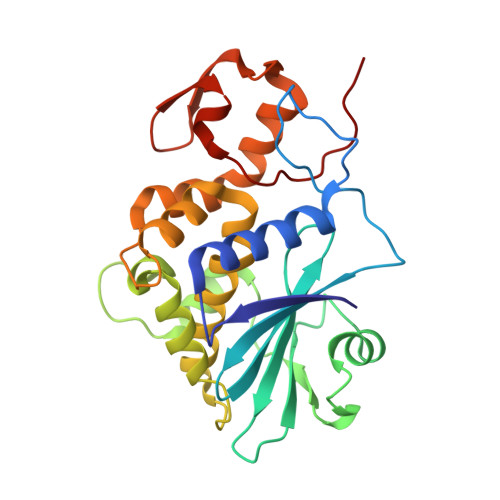
1RL0 | pdb_00001rl0

Crystal structure of a new ribosome-inactivating protein (RIP): dianthin 30


Experimental Data Snapshot

  • Method: X-RAY DIFFRACTION
  • Resolution: 1.40 Å
  • R-Value Free: 
    0.206 (Depositor), 0.210 (DCC) 
  • R-Value Work: 
    0.184 (Depositor), 0.188 (DCC) 
  • R-Value Observed: 
    0.184 (Depositor) 

Starting Model: experimental
View more details

wwPDB Validation 3D Report Full Report

Validation slider image for 1RL0

This is version 1.3 of the entry. See complete history

Literature

The 1.4A structure of dianthin 30 indicates a role of surface potential at the active site of type 1 ribosome inactivating proteins

Fermani, S.Falini, G.Ripamonti, A.Polito, L.Stirpe, F.Bolognesi, A.

(2005) J Struct Biol 149: 204-212

  • DOI: https://doi.org/10.1016/j.jsb.2004.11.007
  • Primary Citation Related Structures: 
    1RL0

  • PubMed Abstract: 

    Ribosome inactivating proteins (RIPs) are plant proteins with enzymatic activity identified as rRNA N-glycosidase (EC 3.2.2.22), which cleaves the N-glycosidic bond of a specific adenine on the ricin/sarcin region of rRNA, thus causing inhibition of protein synthesis. They also depurinate extensively DNA and other polynucleotides. The three-dimensional structure of dianthin 30, a type 1 (single-chain) RIP of Dianthus caryophyllus (leaves), is now described at 1.4 angstroms, a resolution never achieved before for any RIP. The fold typical of RIPs is conserved, despite some differences in the loop regions. The general structure comparison by superimposed alpha-carbon (249 atoms) and the sequence alignment by structure for dianthin 30 and saporin-S6 give a root mean square deviation of 0.625 angstroms. Despite the differences reported for the biological activities of the two RIPs, their structures fit quite well and both show a protein segment containing strands beta7, beta8, and beta9 shorter than other RIPs. However, the surface electrostatic potential in the active site region neatly distinguishes dianthin 30 from saporin-S6. The possible relationship between the charge distribution and the behavior of the proteins toward different substrates is discussed.


  • Organizational Affiliation
    • Dipartimento di Chimica G. Ciamician, Alma Mater Studiorum Universita' di Bologna, via Selmi 2, I-40126 Bologna, Italy.

Macromolecule Content 

  • Total Structure Weight: 28.63 kDa 
  • Atom Count: 2,550 
  • Modeled Residue Count: 255 
  • Deposited Residue Count: 255 
  • Unique protein chains: 1

Macromolecules

Find similar proteins by:|  3D Structure
Entity ID: 1
MoleculeChains  Sequence LengthOrganismDetailsImage
Antiviral protein DAP-30255Dianthus caryophyllusMutation(s): 0 
EC: 3.2.2.22
UniProt
Find proteins for P24476 (Dianthus caryophyllus)
Explore P24476 
Go to UniProtKB:  P24476
Entity Groups
Sequence Clusters30% Identity50% Identity70% Identity90% Identity95% Identity100% Identity
UniProt GroupP24476
Sequence Annotations
Expand
Reference Sequence

Experimental Data & Validation

Experimental Data

  • Method: X-RAY DIFFRACTION
  • Resolution: 1.40 Å
  • R-Value Free:  0.206 (Depositor), 0.210 (DCC) 
  • R-Value Work:  0.184 (Depositor), 0.188 (DCC) 
  • R-Value Observed: 0.184 (Depositor) 
Space Group: P 1 21 1
Unit Cell:
Length ( Å )Angle ( ˚ )
a = 37.568α = 90
b = 78.654β = 105.39
c = 43.136γ = 90
Software Package:
Software NamePurpose
DENZOdata reduction
SCALEPACKdata scaling
AMoREphasing
CNSrefinement

Structure Validation

View Full Validation Report


Entry History 

Deposition Data

Revision History  (Full details and data files)

  • Version 1.0: 2004-12-07
    Type: Initial release
  • Version 1.1: 2008-04-29
    Changes: Version format compliance
  • Version 1.2: 2011-07-13
    Changes: Version format compliance
  • Version 1.3: 2023-08-23
    Changes: Data collection, Database references, Refinement description