1PQF | pdb_00001pqf

Glycine 24 to Serine mutation of aspartate decarboxylase


Experimental Data Snapshot

  • Method: X-RAY DIFFRACTION
  • Resolution: 2.00 Å
  • R-Value Free: 
    0.185 (Depositor), 0.197 (DCC) 
  • R-Value Work: 
    0.165 (Depositor), 0.179 (DCC) 
  • R-Value Observed: 
    0.166 (Depositor) 

Starting Model: experimental
View more details

wwPDB Validation 3D Report Full Report

Validation slider image for 1PQF

This is version 1.4 of the entry. See complete history

Literature

Structural constraints on protein self-processing in L-aspartate-alpha-decarboxylase

Schmitzberger, F.Kilkenny, M.L.Lobley, C.M.C.Webb, M.E.Vinkovic, M.Matak-Vinkovic, D.Witty, M.Chirgadze, D.Y.Smith, A.G.Abell, C.Blundell, T.L.

(2003) EMBO J 22: 6193-6204

  • DOI: https://doi.org/10.1093/emboj/cdg575
  • Primary Citation Related Structures: 
    1PPY, 1PQE, 1PQF, 1PQH, 1PT0, 1PT1, 1PYQ, 1PYU

  • PubMed Abstract: 

    Aspartate decarboxylase, which is translated as a pro-protein, undergoes intramolecular self-cleavage at Gly24-Ser25. We have determined the crystal structures of an unprocessed native precursor, in addition to Ala24 insertion, Ala26 insertion and Gly24-->Ser, His11-->Ala, Ser25-->Ala, Ser25-->Cys and Ser25-->Thr mutants. Comparative analyses of the cleavage site reveal specific conformational constraints that govern self-processing and demonstrate that considerable rearrangement must occur. We suggest that Thr57 Ogamma and a water molecule form an 'oxyanion hole' that likely stabilizes the proposed oxyoxazolidine intermediate. Thr57 and this water molecule are probable catalytic residues able to support acid-base catalysis. The conformational freedom in the loop preceding the cleavage site appears to play a determining role in the reaction. The molecular mechanism of self-processing, presented here, emphasizes the importance of stabilization of the oxyoxazolidine intermediate. Comparison of the structural features shows significant similarity to those in other self-processing systems, and suggests that models of the cleavage site of such enzymes based on Ser-->Ala or Ser-->Thr mutants alone may lead to erroneous interpretations of the mechanism.


  • Organizational Affiliation
    • Department of Biochemistry, 80 Tennis Court Road, Cambridge CB2 1GA, UK. florian@cryst.bioc.cam.ac.uk

Macromolecule Content 

  • Total Structure Weight: 31.84 kDa 
  • Atom Count: 2,106 
  • Modeled Residue Count: 243 
  • Deposited Residue Count: 286 
  • Unique protein chains: 1

Macromolecules

Find similar proteins by:|  3D Structure
Entity ID: 1
MoleculeChains  Sequence LengthOrganismDetailsImage
Aspartate 1-decarboxylase
A, B
143Escherichia coliMutation(s): 2 
Gene Names: PAND
EC: 4.1.1.11
UniProt
Find proteins for P0A790 (Escherichia coli (strain K12))
Explore P0A790 
Go to UniProtKB:  P0A790
Entity Groups
Sequence Clusters30% Identity50% Identity70% Identity90% Identity95% Identity100% Identity
UniProt GroupP0A790
Sequence Annotations
Expand
Reference Sequence

Small Molecules

Modified Residues  1 Unique
IDChains TypeFormula2D DiagramParent
CSX
Query on CSX
A, B
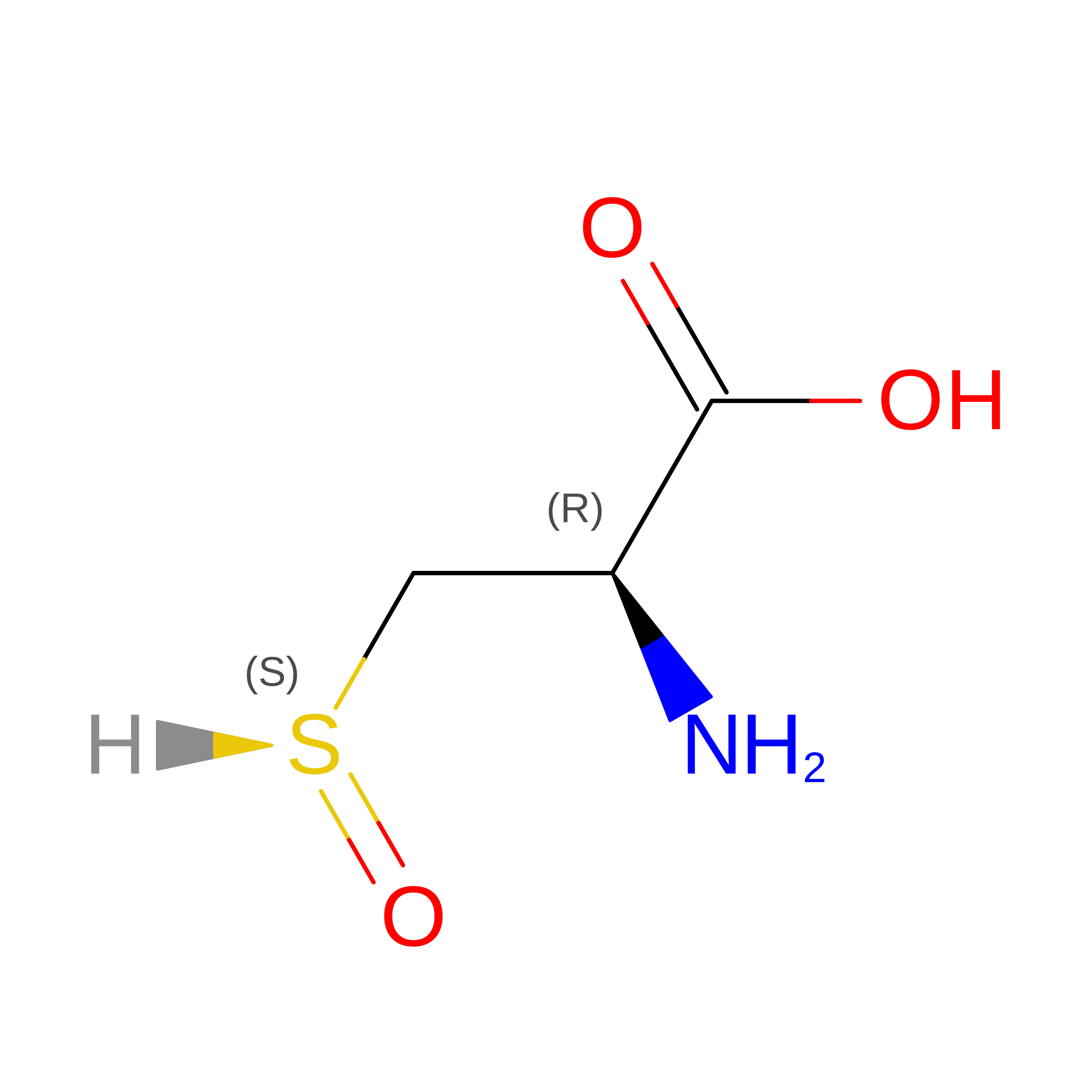
L-PEPTIDE LINKINGC3 H7 N O3 SCYS

Experimental Data & Validation

Experimental Data

  • Method: X-RAY DIFFRACTION
  • Resolution: 2.00 Å
  • R-Value Free:  0.185 (Depositor), 0.197 (DCC) 
  • R-Value Work:  0.165 (Depositor), 0.179 (DCC) 
  • R-Value Observed: 0.166 (Depositor) 
Space Group: P 61 2 2
Unit Cell:
Length ( Å )Angle ( ˚ )
a = 71.436α = 90
b = 71.436β = 90
c = 219.157γ = 120
Software Package:
Software NamePurpose
REFMACrefinement
DENZOdata reduction
SCALEPACKdata scaling
CNSphasing

Structure Validation

View Full Validation Report


Entry History 

Revision History  (Full details and data files)

  • Version 1.0: 2003-11-18
    Type: Initial release
  • Version 1.1: 2008-04-29
    Changes: Version format compliance
  • Version 1.2: 2011-07-13
    Changes: Derived calculations, Version format compliance
  • Version 1.3: 2021-10-27
    Changes: Database references, Derived calculations
  • Version 1.4: 2023-08-16
    Changes: Data collection, Refinement description