1M61 | pdb_00001m61

Crystal structure of the apo SH2 domains of ZAP-70


Experimental Data Snapshot

  • Method: X-RAY DIFFRACTION
  • Resolution: 2.50 Å
  • R-Value Free: 
    0.286 (Depositor) 
  • R-Value Work: 
    0.245 (Depositor) 

Starting Model: experimental
View more details

wwPDB Validation 3D Report Full Report

Validation slider image for 1M61

This is version 1.4 of the entry. See complete history

Literature

Crystal structure and NMR studies of the apo SH2 domains of ZAP-70: two bikes rather than a tandem

Folmer, R.H.A.Geschwindner, S.Xue, Y.

(2002) Biochemistry 41: 14176-14184

  • DOI: https://doi.org/10.1021/bi026465e
  • Primary Citation Related Structures: 
    1M61

  • PubMed Abstract: 

    The protein kinase ZAP-70 is involved in T-cell activation, and interacts with tyrosine-phosphorylated peptide sequences known as immunoreceptor tyrosine activation motifs (ITAMs), which are present in three of the subunits of the T-cell receptor. We have studied the tandem SH2 (tSH2) domains of ZAP-70, by both X-ray and NMR. Here, we present the crystal structure of the apoprotein, i.e., the tSH2 domain in the absence of ITAM. Comparison with the previously reported complex structure reveals that binding to the ITAM peptide induces surprisingly large movements between the two SH2 domains and within the actual binding sites. The conformation of the ITAM-free protein is partly governed by a hydrophobic cluster between the linker region and the C-terminal SH2 domain. Our data suggest that the two SH2 domains are able to undergo large interdomain movements. The proposed relative flexibility of the SH2 domains is further supported by the finding that no NMR signals could be detected for the two helices connecting the SH2 domains; these are likely to be broadened beyond detection due to conformational exchange. It is likely that this conformational reorientation induced by ITAM binding is the main signaling event activating the kinase domain in ZAP-70. Another NMR observation was that the N-terminal SH2 domain could bind tetrapeptides derived from the ITAM sequence, apparently without the need to interact with the C-terminal domain. In contrast, the C-terminal domain has little affinity for tetrapeptides. The opposite situation is true for binding to plain phosphotyrosine, where the C-terminal domain has a higher affinity. Distinct features in the crystal structure, showing the interdependence of both domains, explain these binding data.


  • Organizational Affiliation
    • Structural Chemistry Laboratory, AstraZeneca R&D Mölndal, S-431 83 Mölndal, Sweden.

Macromolecule Content 

  • Total Structure Weight: 29.37 kDa 
  • Atom Count: 2,099 
  • Modeled Residue Count: 259 
  • Deposited Residue Count: 259 
  • Unique protein chains: 1

Macromolecules

Find similar proteins by:|  3D Structure
Entity ID: 1
MoleculeChains  Sequence LengthOrganismDetailsImage
TYROSINE-PROTEIN KINASE ZAP-70259Homo sapiensMutation(s): 0 
EC: 2.7.1.112 (PDB Primary Data), 2.7.10.2 (UniProt)
UniProt & NIH Common Fund Data Resources
Find proteins for P43403 (Homo sapiens)
Explore P43403 
Go to UniProtKB:  P43403
PHAROS:  P43403
GTEx:  ENSG00000115085 
Entity Groups
Sequence Clusters30% Identity50% Identity70% Identity90% Identity95% Identity100% Identity
UniProt GroupP43403
Sequence Annotations
Expand
Reference Sequence

Small Molecules

Ligands 1 Unique
IDChains Name / Formula / InChI Key2D Diagram3D Interactions
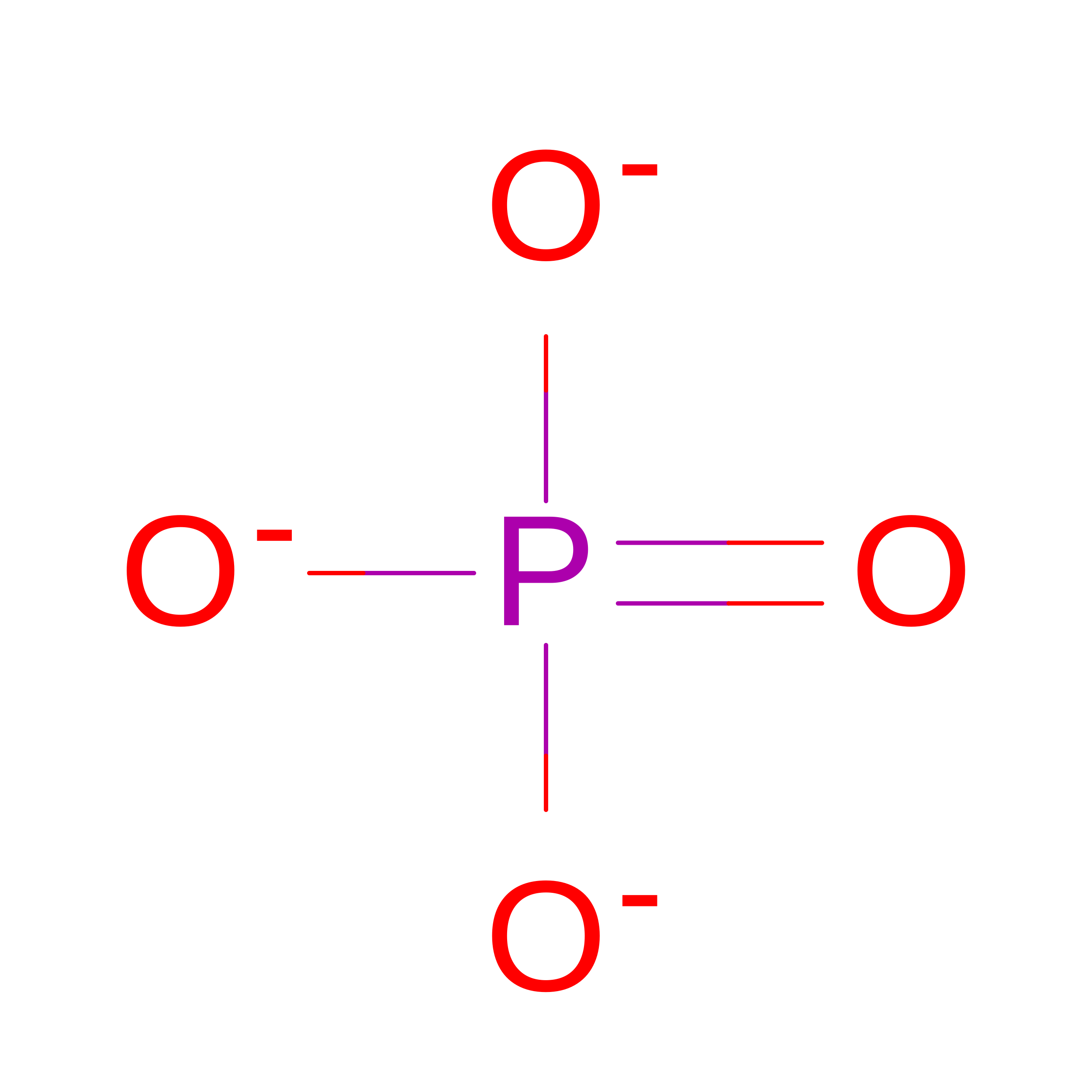
PO4

Query on PO4


Download:Ideal Coordinates CCD File
B [auth A]PHOSPHATE ION
O4 P
NBIIXXVUZAFLBC-UHFFFAOYSA-K

Experimental Data & Validation

Experimental Data

  • Method: X-RAY DIFFRACTION
  • Resolution: 2.50 Å
  • R-Value Free:  0.286 (Depositor) 
  • R-Value Work:  0.245 (Depositor) 
Space Group: P 1 21 1
Unit Cell:
Length ( Å )Angle ( ˚ )
a = 48.851α = 90
b = 52.227β = 89.91
c = 54.455γ = 90
Software Package:
Software NamePurpose
MOSFLMdata reduction
SCALAdata scaling
AMoREphasing
CNXrefinement
CCP4data scaling

Structure Validation

View Full Validation Report


Entry History 

Deposition Data

Revision History  (Full details and data files)

  • Version 1.0: 2003-07-15
    Type: Initial release
  • Version 1.1: 2008-04-28
    Changes: Version format compliance
  • Version 1.2: 2011-07-13
    Changes: Version format compliance
  • Version 1.3: 2018-03-07
    Changes: Data collection
  • Version 1.4: 2024-02-14
    Changes: Data collection, Database references, Derived calculations, Refinement description