1LOH | pdb_00001loh

Streptococcus pneumoniae Hyaluronate Lyase in Complex with Hexasaccharide Hyaluronan Substrate


Experimental Data Snapshot

  • Method: X-RAY DIFFRACTION
  • Resolution: 2.00 Å
  • R-Value Free: 
    0.324 (Depositor), 0.231 (DCC) 
  • R-Value Work: 
    0.224 (Depositor), 0.212 (DCC) 
  • R-Value Observed: 
    0.224 (Depositor) 

wwPDB Validation 3D Report Full Report

Validation slider image for 1LOH

This is version 2.2 of the entry. See complete history

Literature

Mechanism of hyaluronan degradation by Streptococcus pneumoniae hyaluronate lyase. Structures of complexes with the substrate.

Jedrzejas, M.J.Mello, L.V.de Groot, B.L.Li, S.

(2002) J Biological Chem 277: 28287-28297

  • DOI: https://doi.org/10.1074/jbc.M112009200
  • Primary Citation Related Structures: 
    1LOH, 1LXK

  • PubMed Abstract: 

    Hyaluronate lyase enzymes degrade hyaluronan, the main polysaccharide component of the host connective tissues, predominantly into unsaturated disaccharide units, thereby destroying the normal connective tissue structure and exposing the tissue cells to various endo- and exogenous factors, including bacterial toxins. The crystal structures of Streptococcus pneumoniae hyaluronate lyase with tetra- and hexasaccharide hyaluronan substrates bound in the active site were determined at 1.52- and 2.0-A resolution, respectively. Hexasaccharide is the longest substrate segment that binds entirely within the active site of these enzymes. The enzyme residues responsible for substrate binding, positioning, catalysis, and product release were thereby identified and their specific roles characterized. The involvement of three residues in catalysis, Asn(349), His(399), and Tyr(408), is confirmed, and the details of proton acceptance and donation within the catalytic machinery are described. The mechanism of processivity of the enzyme is analyzed. The flexibility (allosteric) behavior of the enzyme may be understood in terms of the results of flexibility analysis of this protein, which identified two modes of motion that are also proposed to be involved in the hyaluronan degradation process. The first motion describes an opening and closing of the catalytic cleft located between the alpha- and beta-domains. The second motion demonstrates the mobility of a binding cleft, which may facilitate the binding of the negatively charged hyaluronan to the enzyme.


  • Organizational Affiliation
    • Children's Hospital Oakland Research Institute, Oakland, California 94609, USA. mjedrzejas@chori.org

Macromolecule Content 

  • Total Structure Weight: 83.46 kDa 
  • Atom Count: 6,379 
  • Modeled Residue Count: 721 
  • Deposited Residue Count: 721 
  • Unique protein chains: 1

Macromolecules

Find similar proteins by:|  3D Structure
Entity ID: 1
MoleculeChains  Sequence LengthOrganismDetailsImage
Hyaluronate Lyase721Streptococcus pneumoniaeMutation(s): 1 
EC: 4.2.2.1
UniProt
Find proteins for Q54873 (Streptococcus pneumoniae serotype 4 (strain ATCC BAA-334 / TIGR4))
Explore Q54873 
Go to UniProtKB:  Q54873
Entity Groups
Sequence Clusters30% Identity50% Identity70% Identity90% Identity95% Identity100% Identity
UniProt GroupQ54873
Sequence Annotations
Expand
Reference Sequence

Oligosaccharides

Help  
Entity ID: 2
MoleculeChains Length2D Diagram GlycosylationD Interactions
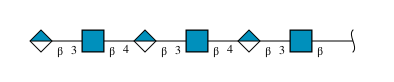
beta-D-glucopyranuronic acid-(1-3)-2-acetamido-2-deoxy-beta-D-glucopyranose-(1-4)-beta-D-glucopyranuronic acid-(1-3)-2-acetamido-2-deoxy-beta-D-glucopyranose-(1-4)-beta-D-glucopyranuronic acid-(1-3)-2-acetamido-2-deoxy-beta-D-glucopyranose
B
6N/A
Glycosylation Resources
GlyTouCan: G01866TT
GlyCosmos: G01866TT
GlyGen: G01866TT

Experimental Data & Validation

Experimental Data

  • Method: X-RAY DIFFRACTION
  • Resolution: 2.00 Å
  • R-Value Free:  0.324 (Depositor), 0.231 (DCC) 
  • R-Value Work:  0.224 (Depositor), 0.212 (DCC) 
  • R-Value Observed: 0.224 (Depositor) 
Space Group: P 21 21 21
Unit Cell:
Length ( Å )Angle ( ˚ )
a = 83.7α = 90
b = 103.57β = 90
c = 101.269γ = 90
Software Package:
Software NamePurpose
X-PLORmodel building
X-PLORrefinement
HKL-2000data reduction
SCALEPACKdata scaling
X-PLORphasing

Structure Validation

View Full Validation Report


Entry History 

Deposition Data

Revision History  (Full details and data files)

  • Version 1.0: 2002-08-07
    Type: Initial release
  • Version 1.1: 2008-04-28
    Changes: Version format compliance
  • Version 1.2: 2011-07-13
    Changes: Non-polymer description, Version format compliance
  • Version 2.0: 2020-07-29
    Type: Remediation
    Reason: Carbohydrate remediation
    Changes: Advisory, Atomic model, Data collection, Derived calculations, Structure summary
  • Version 2.1: 2021-10-27
    Changes: Database references, Structure summary
  • Version 2.2: 2024-02-14
    Changes: Data collection