1I9P | pdb_00001i9p

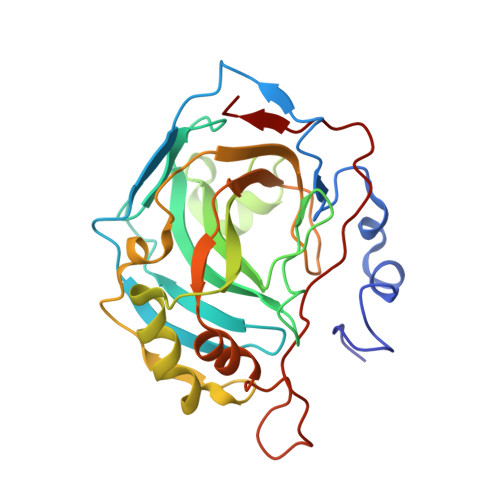
CARBONIC ANHYDRASE II (F131V) COMPLEXED WITH 4-(AMINOSULFONYL)-N-[(2,4,6-TRIFLUOROPHENYL)METHYL]-BENZAMIDE


Experimental Data Snapshot

  • Method: X-RAY DIFFRACTION
  • Resolution: 1.92 Å
  • R-Value Free: 
    0.290 (Depositor) 
  • R-Value Work: 
    0.217 (Depositor) 

wwPDB Validation 3D Report Full Report

Validation slider image for 1I9P

This is version 1.5 of the entry. See complete history

Literature

Fluoroaromatic-fluoroaromatic interactions between inhibitors bound in the crystal lattice of human carbonic anhydrase II.

Kim, C.Y.Chandra, P.P.Jain, A.Christianson, D.W.

(2001) J Am Chem Soc 123: 9620-9627

  • DOI: https://doi.org/10.1021/ja011034p
  • Primary Citation Related Structures: 
    1I9L, 1I9M, 1I9N, 1I9O, 1I9P, 1I9Q

  • PubMed Abstract: 

    Intermolecular interactions of eleven different fluoroaromatic inhibitors are probed within the scaffolding of the crystal lattice of Phe-131-->Val carbonic anhydrase II. The degree and pattern of fluorine substitution on the inhibitor benzyl ring modulate its size, shape, and electronic character. In turn, these properties affect the geometry of intermolecular interactions between the fluoroaromatic rings of two different inhibitor molecules bound in the crystal lattice, as determined by X-ray crystallography. Depending on the degree and pattern of fluorine substitution, we observe a face-to-face (aromatic-aromatic) interaction, an atom-to-face (carbonyl-aromatic) interaction, or no interaction at all. These interaction geometries are analyzed with regard to van der Waals, electrostatic, and possible charge-transfer effects. For the aromatic-aromatic interactions investigated in this study, with aromatic ring quadrupoles specifically "tuned" by the degree and pattern of fluorination, the structural results suggest that London forces and charge-transfer complexation dominate over weakly polar electrostatic interactions in the association of aromatic ring pairs.


  • Organizational Affiliation
    • Roy and Diana Vagelos Laboratories, Department of Chemistry, University of Pennsylvania, Philadelphia, Pennsylvania 19104-6323, USA.

Macromolecule Content 

  • Total Structure Weight: 29.72 kDa 
  • Atom Count: 2,180 
  • Modeled Residue Count: 258 
  • Deposited Residue Count: 259 
  • Unique protein chains: 1

Macromolecules

Find similar proteins by:|  3D Structure
Entity ID: 1
MoleculeChains  Sequence LengthOrganismDetailsImage
CARBONIC ANHYDRASE II259Homo sapiensMutation(s): 1 
EC: 4.2.1.1 (PDB Primary Data), 4.2.1.69 (UniProt)
UniProt & NIH Common Fund Data Resources
Find proteins for P00918 (Homo sapiens)
Explore P00918 
Go to UniProtKB:  P00918
PHAROS:  P00918
GTEx:  ENSG00000104267 
Entity Groups
Sequence Clusters30% Identity50% Identity70% Identity90% Identity95% Identity100% Identity
UniProt GroupP00918
Sequence Annotations
Expand
Reference Sequence

Small Molecules

Ligands 3 Unique
IDChains Name / Formula / InChI Key2D Diagram3D Interactions
IOE

Query on IOE


Download:Ideal Coordinates CCD File
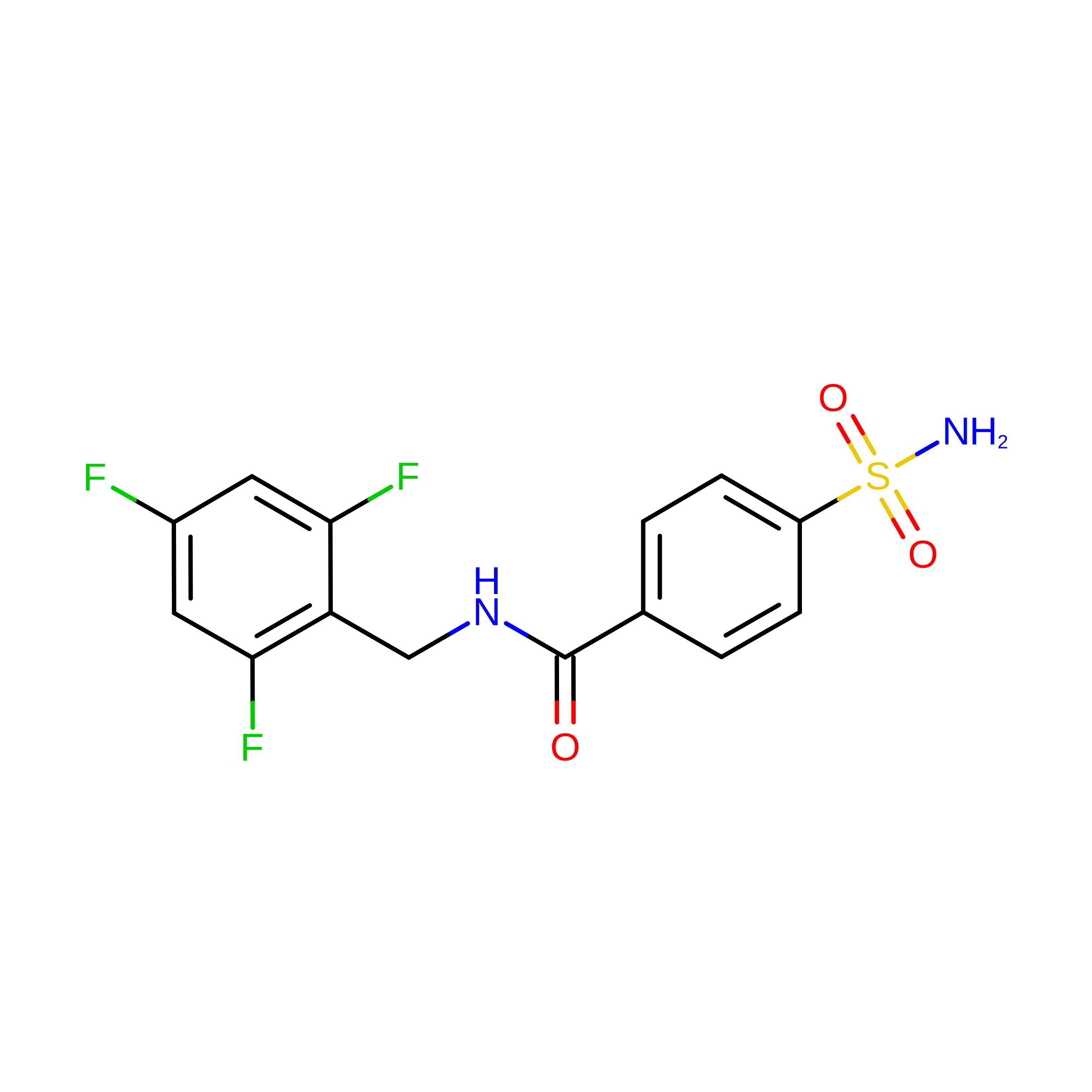
D [auth A]4-(AMINOSULFONYL)-N-[(2,4,6-TRIFLUOROPHENYL)METHYL]-BENZAMIDE
C14 H11 F3 N2 O3 S
DVTYOTODFLDHRL-UHFFFAOYSA-N
HG

Query on HG


Download:Ideal Coordinates CCD File
C [auth A]MERCURY (II) ION
Hg
BQPIGGFYSBELGY-UHFFFAOYSA-N
ZN

Query on ZN


Download:Ideal Coordinates CCD File
B [auth A]ZINC ION
Zn
PTFCDOFLOPIGGS-UHFFFAOYSA-N

Experimental Data & Validation

Experimental Data

  • Method: X-RAY DIFFRACTION
  • Resolution: 1.92 Å
  • R-Value Free:  0.290 (Depositor) 
  • R-Value Work:  0.217 (Depositor) 
Space Group: P 1 21 1
Unit Cell:
Length ( Å )Angle ( ˚ )
a = 43.105α = 90
b = 42.111β = 104.603
c = 73.356γ = 90
Software Package:
Software NamePurpose
X-PLORmodel building
X-PLORrefinement
DENZOdata reduction
SCALEPACKdata scaling
X-PLORphasing

Structure Validation

View Full Validation Report


Entry History 

Deposition Data

Revision History  (Full details and data files)

  • Version 1.0: 2001-03-28
    Type: Initial release
  • Version 1.1: 2008-04-27
    Changes: Version format compliance
  • Version 1.2: 2011-07-13
    Changes: Version format compliance
  • Version 1.3: 2018-04-04
    Changes: Data collection
  • Version 1.4: 2021-10-27
    Changes: Database references, Derived calculations
  • Version 1.5: 2024-02-07
    Changes: Data collection