1FE0 | pdb_00001fe0

CRYSTAL STRUCTURE OF CADMIUM-HAH1


Experimental Data Snapshot

  • Method: X-RAY DIFFRACTION
  • Resolution: 1.75 Å
  • R-Value Free: 
    0.213 (Depositor) 
  • R-Value Work: 
    0.191 (Depositor) 
  • R-Value Observed: 
    0.191 (Depositor) 

wwPDB Validation 3D Report Full Report

Validation slider image for 1FE0

This is version 2.1 of the entry. See complete history

Literature

Structural basis for copper transfer by the metallochaperone for the Menkes/Wilson disease proteins.

Wernimont, A.K.Huffman, D.L.Lamb, A.L.O'Halloran, T.V.Rosenzweig, A.C.

(2000) Nat Struct Biol 7: 766-771

  • DOI: https://doi.org/10.1038/78999
  • Primary Citation Related Structures: 
    1FE0, 1FE4, 1FEE

  • PubMed Abstract: 

    The Hah1 metallochaperone protein is implicated in copper delivery to the Menkes and Wilson disease proteins. Hah1 and the N-termini of its target proteins belong to a family of metal binding domains characterized by a conserved MT/HCXXC sequence motif. The crystal structure of Hah1 has been determined in the presence of Cu(I), Hg(II), and Cd(II). The 1.8 A resolution structure of CuHah1 reveals a copper ion coordinated by Cys residues from two adjacent Hah1 molecules. The CuHah1 crystal structure is the first of a copper chaperone bound to copper and provides structural support for direct metal ion exchange between conserved MT/HCXXC motifs in two domains. The structures of HgHah1 and CdHah1, determined to 1.75 A resolution, also reveal metal ion coordination by two MT/HCXXC motifs. An extended hydrogen bonding network, unique to the complex of two Hah1 molecules, stabilizes the metal binding sites and suggests specific roles for several conserved residues. Taken together, the structures provide models for intermediates in metal ion transfer and suggest a detailed molecular mechanism for protein recognition and metal ion exchange between MT/HCXXC containing domains.


  • Organizational Affiliation
    • Department of Biochemistry, Molecular Biology, and Cell Biology, Northwestern University, Evanston, Illinois 60208, USA.

Macromolecule Content 

  • Total Structure Weight: 15.47 kDa 
  • Atom Count: 1,217 
  • Modeled Residue Count: 134 
  • Deposited Residue Count: 136 
  • Unique protein chains: 1

Macromolecules

Find similar proteins by:|  3D Structure
Entity ID: 1
MoleculeChains  Sequence LengthOrganismDetailsImage
COPPER TRANSPORT PROTEIN ATOX1
A, B
68Homo sapiensMutation(s): 0 
UniProt & NIH Common Fund Data Resources
Find proteins for O00244 (Homo sapiens)
Explore O00244 
Go to UniProtKB:  O00244
PHAROS:  O00244
GTEx:  ENSG00000177556 
Entity Groups
Sequence Clusters30% Identity50% Identity70% Identity90% Identity95% Identity100% Identity
UniProt GroupO00244
Sequence Annotations
Expand
Reference Sequence

Oligosaccharides

Help  
Entity ID: 2
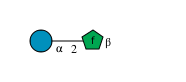
MoleculeChains Length2D Diagram GlycosylationD Interactions
beta-D-fructofuranose-(2-1)-alpha-D-glucopyranose
C
2N/A
Glycosylation Resources
GlyTouCan: G05551OP
GlyCosmos: G05551OP

Biologically Interesting Molecules (External Reference) 

1 Unique
Entity ID: 2
IDChains NameType/Class2D Diagram3D Interactions
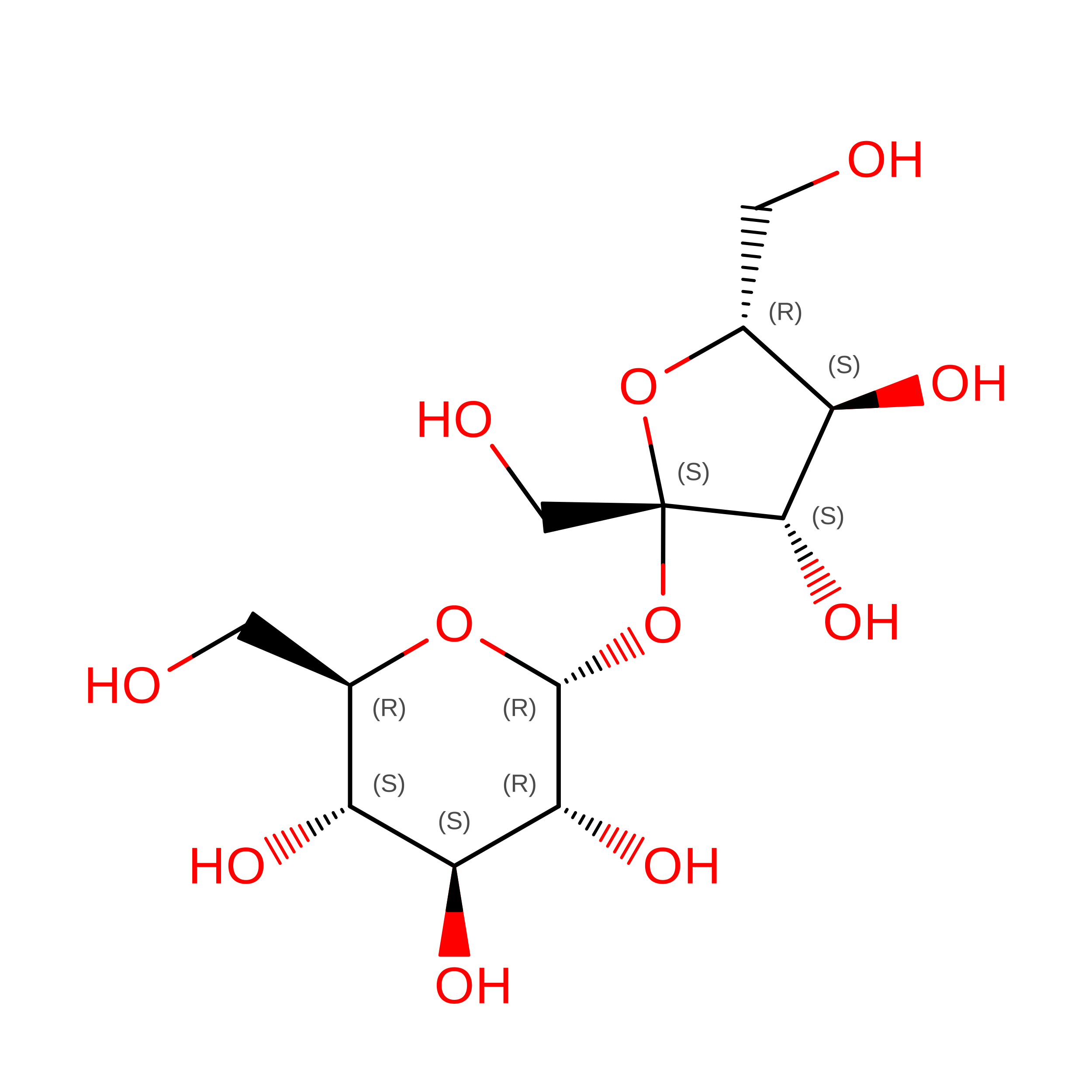
PRD_900003
Query on PRD_900003
C
sucroseOligosaccharide / Nutrient

Experimental Data & Validation

Experimental Data

  • Method: X-RAY DIFFRACTION
  • Resolution: 1.75 Å
  • R-Value Free:  0.213 (Depositor) 
  • R-Value Work:  0.191 (Depositor) 
  • R-Value Observed: 0.191 (Depositor) 
Space Group: P 65
Unit Cell:
Length ( Å )Angle ( ˚ )
a = 78.14α = 90
b = 78.14β = 90
c = 54.42γ = 120
Software Package:
Software NamePurpose
AMoREphasing
CNSrefinement
DENZOdata reduction
SCALEPACKdata scaling
CNSphasing

Structure Validation

View Full Validation Report


Entry History 

Deposition Data

Revision History  (Full details and data files)

  • Version 1.0: 2001-01-20
    Type: Initial release
  • Version 1.1: 2008-04-27
    Changes: Version format compliance
  • Version 1.2: 2011-07-13
    Changes: Version format compliance
  • Version 2.0: 2020-07-29
    Type: Remediation
    Reason: Carbohydrate remediation
    Changes: Atomic model, Data collection, Derived calculations, Non-polymer description, Structure summary
  • Version 2.1: 2024-02-07
    Changes: Data collection, Database references, Structure summary