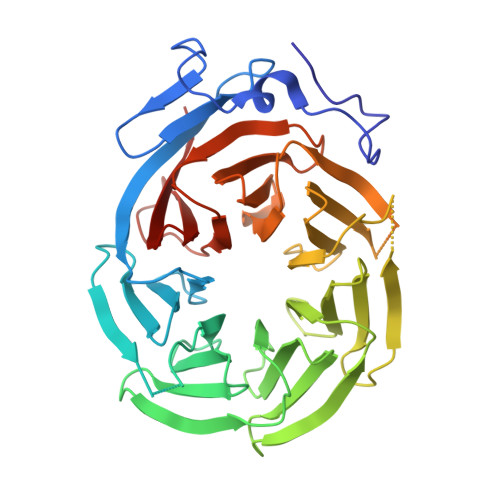
1ERJ | pdb_00001erj

CRYSTAL STRUCTURE OF THE C-TERMINAL WD40 DOMAIN OF TUP1


Experimental Data Snapshot

  • Method: X-RAY DIFFRACTION
  • Resolution: 2.30 Å
  • R-Value Free: 
    0.266 (Depositor), 0.265 (DCC) 
  • R-Value Work: 
    0.228 (Depositor), 0.228 (DCC) 

wwPDB Validation 3D Report Full Report

Validation slider image for 1ERJ

This is version 1.5 of the entry. See complete history

Literature

Structure of the C-terminal domain of Tup1, a corepressor of transcription in yeast.

Sprague, E.R.Redd, M.J.Johnson, A.D.Wolberger, C.

(2000) EMBO J 19: 3016-3027

  • DOI: https://doi.org/10.1093/emboj/19.12.3016
  • Primary Citation Related Structures: 
    1ERJ

  • PubMed Abstract: 

    The Tup1-Ssn6 corepressor complex regulates the expression of several sets of genes, including genes that specify mating type in the yeast Saccharomyces cerevisiae. Repression of mating-type genes occurs when Tup1-Ssn6 is brought to the DNA by the Matalpha2 DNA-binding protein and assembled upstream of a- and haploid-specific genes. We have determined the 2.3 A X-ray crystal structure of the C-terminal domain of Tup1 (accesion No. 1ERJ), a 43 kDa fragment that contains seven copies of the WD40 sequence motif and binds to the Matalpha2 protein. Moreover, this portion of the protein can partially substitute for full-length Tup1 in bringing about transcriptional repression. The structure reveals a seven-bladed beta propeller with an N-terminal subdomain that is anchored to the side of the propeller and extends the beta sheet of one of the blades. Point mutations in Tup1 that specifically affect the Tup1-Matalpha2 interaction cluster on one surface of the propeller. We identified regions of Tup1 that are conserved among the fungal Tup1 homologs and may be important in protein-protein interactions with additional components of the Tup1-mediated repression pathways.


  • Organizational Affiliation
    • Department of Biophysics and Biophysical Chemistry and Howard Hughes Medical Institute, Johns Hopkins University School of Medicine, Baltimore, MD 21205, USA.

Macromolecule Content 

  • Total Structure Weight: 129.92 kDa 
  • Atom Count: 8,244 
  • Modeled Residue Count: 1,055 
  • Deposited Residue Count: 1,179 
  • Unique protein chains: 1

Macromolecules

Find similar proteins by:|  3D Structure
Entity ID: 1
MoleculeChains  Sequence LengthOrganismDetailsImage
TRANSCRIPTIONAL REPRESSOR TUP1
A, B, C
393Saccharomyces cerevisiaeMutation(s): 0 
UniProt
Find proteins for P16649 (Saccharomyces cerevisiae (strain ATCC 204508 / S288c))
Explore P16649 
Go to UniProtKB:  P16649
Entity Groups
Sequence Clusters30% Identity50% Identity70% Identity90% Identity95% Identity100% Identity
UniProt GroupP16649
Sequence Annotations
Expand
Reference Sequence

Experimental Data & Validation

Experimental Data

  • Method: X-RAY DIFFRACTION
  • Resolution: 2.30 Å
  • R-Value Free:  0.266 (Depositor), 0.265 (DCC) 
  • R-Value Work:  0.228 (Depositor), 0.228 (DCC) 
Space Group: P 31
Unit Cell:
Length ( Å )Angle ( ˚ )
a = 119.28α = 90
b = 119.28β = 90
c = 77.07γ = 120
Software Package:
Software NamePurpose
MLPHAREphasing
CNSrefinement
DENZOdata reduction
SCALEPACKdata scaling

Structure Validation

View Full Validation Report


Entry History 

Deposition Data

Revision History  (Full details and data files)

  • Version 1.0: 2000-07-26
    Type: Initial release
  • Version 1.1: 2008-04-27
    Changes: Version format compliance
  • Version 1.2: 2011-07-13
    Changes: Version format compliance
  • Version 1.3: 2017-08-09
    Changes: Refinement description, Source and taxonomy
  • Version 1.4: 2022-12-21
    Changes: Database references
  • Version 1.5: 2024-05-22
    Changes: Data collection