1ZHH | pdb_00001zhh

Crystal Structure of the Apo Form of Vibrio Harveyi LUXP Complexed with the Periplasmic Domain of LUXQ


Experimental Data Snapshot

  • Method: X-RAY DIFFRACTION
  • Resolution: 1.94 Å
  • R-Value Free: 
    0.222 (Depositor), 0.228 (DCC) 
  • R-Value Work: 
    0.206 (Depositor), 0.216 (DCC) 
  • R-Value Observed: 
    0.207 (Depositor) 

wwPDB Validation 3D Report Full Report

Validation slider image for 1ZHH

This is version 1.3 of the entry. See complete history

Literature

Regulation of LuxPQ Receptor Activity by the Quorum-Sensing Signal Autoinducer-2.

Neiditch, M.B.Federle, M.J.Miller, S.T.Bassler, B.L.Hughson, F.M.

(2005) Mol Cell 18: 507-518

  • DOI: https://doi.org/10.1016/j.molcel.2005.04.020
  • Primary Citation Related Structures: 
    1ZHH

  • PubMed Abstract: 

    The extracellular signaling molecule autoinducer-2 (AI-2) mediates quorum-sensing communication in diverse bacterial species. In marine vibrios, binding of AI-2 to the periplasmic receptor LuxP modulates the activity of the inner membrane sensor kinase LuxQ, transducing the AI-2 information into the cytoplasm. Here, we show that Vibrio harveyi LuxP associates with LuxQ in both the presence and absence of AI-2. The 1.9 A X-ray crystal structure of apoLuxP, complexed with the periplasmic domain of LuxQ, reveals that the latter contains two tandem Per/ARNT/Simple-minded (PAS) folds. Thus, although many prokaryotic PAS folds themselves bind ligands, the LuxQ periplasmic PAS folds instead bind LuxP, monitoring its AI-2 occupancy. Mutations that disrupt the apoLuxP:LuxQ interface sensitize V. harveyi to AI-2, implying that AI-2 binding causes the replacement of one set of LuxP:LuxQ contacts with another. These conformational changes switch LuxQ between two opposing enzymatic activities, each of which conveys information to the cytoplasm about the cell density of the surrounding environment.


  • Organizational Affiliation
    • Department of Molecular Biology, Princeton University, Princeton, New Jersey 08544, USA.

Macromolecule Content 

  • Total Structure Weight: 66.91 kDa 
  • Atom Count: 4,772 
  • Modeled Residue Count: 552 
  • Deposited Residue Count: 586 
  • Unique protein chains: 2

Macromolecules

Find similar proteins by:|  3D Structure
Entity ID: 1
MoleculeChains  Sequence LengthOrganismDetailsImage
Autoinducer 2-binding periplasmic protein luxP344Vibrio harveyiMutation(s): 0 
Gene Names: luxP
UniProt
Find proteins for P54300 (Vibrio harveyi)
Explore P54300 
Go to UniProtKB:  P54300
Entity Groups
Sequence Clusters30% Identity50% Identity70% Identity90% Identity95% Identity100% Identity
UniProt GroupP54300
Sequence Annotations
Expand
Reference Sequence
Find similar proteins by:|  3D Structure
Entity ID: 2
MoleculeChains  Sequence LengthOrganismDetailsImage
Autoinducer 2 sensor kinase/phosphatase luxQ242Vibrio harveyiMutation(s): 0 
Gene Names: luxQ
EC: 2.7.13.3 (UniProt), 3.1.3 (UniProt)
UniProt
Find proteins for P54302 (Vibrio harveyi)
Explore P54302 
Go to UniProtKB:  P54302
Entity Groups
Sequence Clusters30% Identity50% Identity70% Identity90% Identity95% Identity100% Identity
UniProt GroupP54302
Sequence Annotations
Expand
Reference Sequence

Small Molecules

Ligands 1 Unique
IDChains Name / Formula / InChI Key2D Diagram3D Interactions
NHE

Query on NHE


Download:Ideal Coordinates CCD File
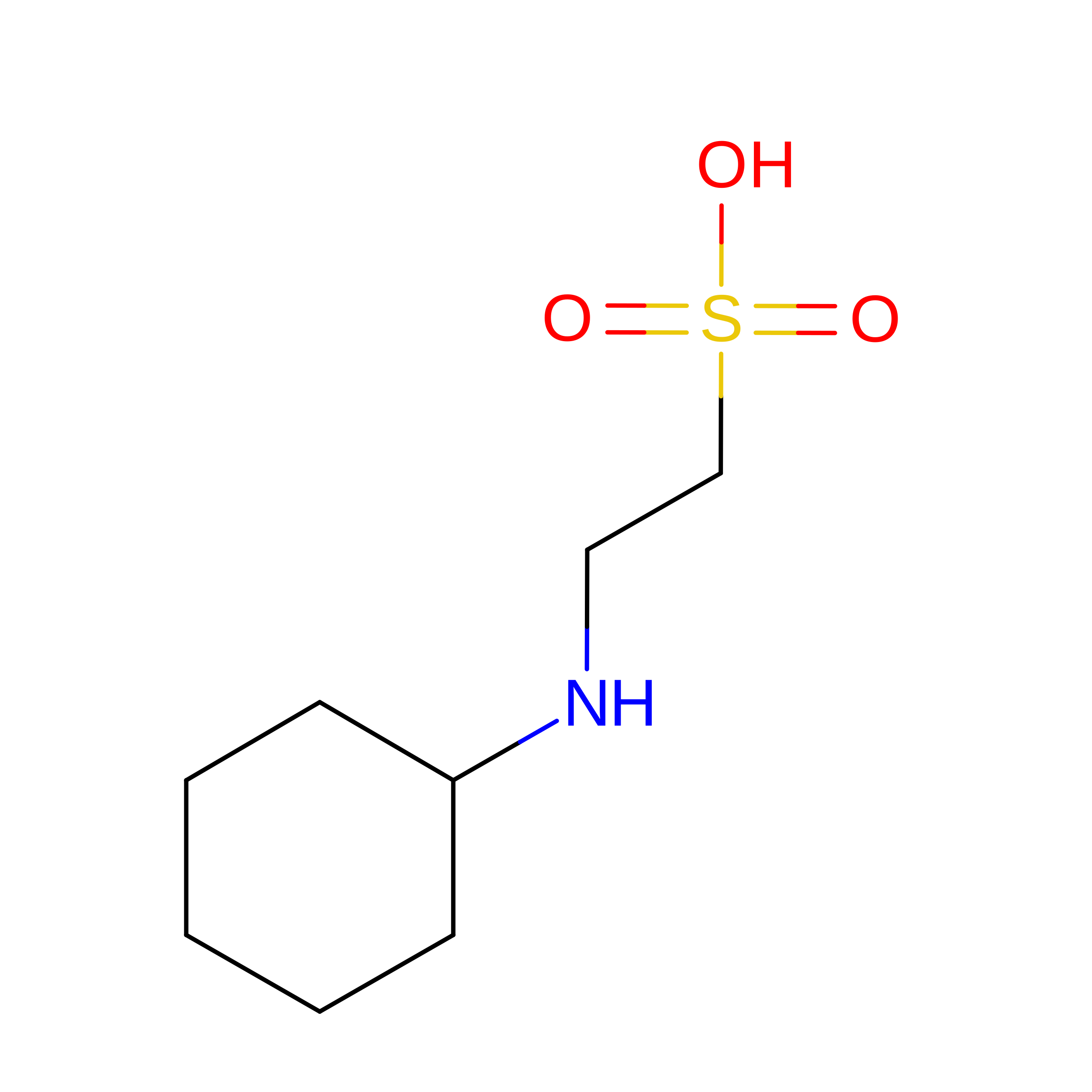
C [auth B]2-[N-CYCLOHEXYLAMINO]ETHANE SULFONIC ACID
C8 H17 N O3 S
MKWKNSIESPFAQN-UHFFFAOYSA-N

Experimental Data & Validation

Experimental Data

  • Method: X-RAY DIFFRACTION
  • Resolution: 1.94 Å
  • R-Value Free:  0.222 (Depositor), 0.228 (DCC) 
  • R-Value Work:  0.206 (Depositor), 0.216 (DCC) 
  • R-Value Observed: 0.207 (Depositor) 
Space Group: P 65
Unit Cell:
Length ( Å )Angle ( ˚ )
a = 128.468α = 90
b = 128.468β = 90
c = 95.671γ = 120
Software Package:
Software NamePurpose
DENZOdata reduction
SCALEPACKdata scaling
SOLVEphasing
REFMACrefinement

Structure Validation

View Full Validation Report


Entry History 

Deposition Data

Revision History  (Full details and data files)

  • Version 1.0: 2005-05-24
    Type: Initial release
  • Version 1.1: 2008-04-30
    Changes: Version format compliance
  • Version 1.2: 2011-07-13
    Changes: Advisory, Version format compliance
  • Version 1.3: 2024-02-14
    Changes: Data collection, Database references, Derived calculations