Download Mendeley
Structural and mutational analyses reveal the functional role of active-site Lys-154 and Asp-173 of Salmonella typhimurium AphA protein.
Makde, R.D., Gupta, G.D., Mahajan, S.K., Kumar, V.(2007) Arch Biochem Biophys 464: 70-79
- PubMed: 17570338 Search on PubMed
- DOI: https://doi.org/10.1016/j.abb.2007.03.043
- Primary Citation Related Structures:
1Z5G, 1Z88, 2AUT - PubMed Abstract:
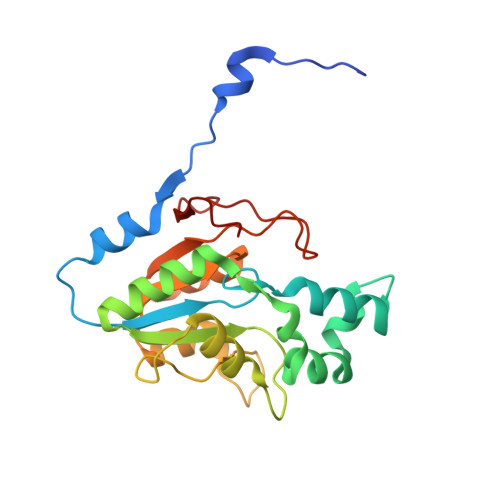
The Salmonella typhimurium class B nonspecific acid phosphatase (AphA protein) belongs to the L2-haloacid dehalogenase superfamily. The conserved Lys-154 interacts with substrate phosphate, nucleophile Asp-46, and Asp-173 in the wild-type AphA protein. Asp-173 also interacts with Mg(II) water ligand and with main-chain amide of loop-4. We report here the mutational analysis of Lys-154 and Asp-173, the crystal structures of the K154N and K154R mutants, and the results of electrostatic potential calculations. The K154N, K154R and D173N mutants display significant reduction in the phosphatase activity. Lys-154 may not be responsible for a juxtaposition of the substrate phosphate and the aspartyl nucleophile, but has an hitherto unknown functional role of rendering the substrate phosphorous atom electron deficient. Nearly 10,000-fold increase in the K(d) value for dissociation of the cofactor Mg(II) observed for the D173N mutant correlates well with theoretically estimated change in the binding free energy of Mg(II).
- High Pressure Physics Division, Bhabha Atomic Research Centre, Mumbai 400 085, India.
Organizational Affiliation: