1YRX | pdb_00001yrx

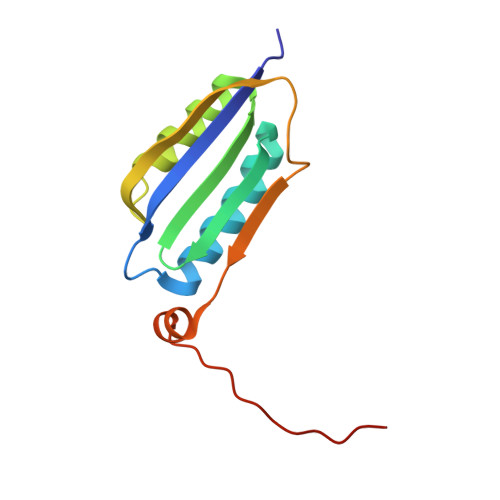
Structure of a novel photoreceptor: the BLUF domain of AppA from Rhodobacter sphaeroides


Experimental Data Snapshot

  • Method: X-RAY DIFFRACTION
  • Resolution: 2.30 Å
  • R-Value Free: 
    0.273 (Depositor) 
  • R-Value Work: 
    0.241 (Depositor) 
  • R-Value Observed: 
    0.243 (Depositor) 

wwPDB Validation 3D Report Full Report

Validation slider image for 1YRX

Ligand Structure Quality Assessment 


This is version 1.3 of the entry. See complete history

Literature

Structure of a Novel Photoreceptor, the BLUF Domain of AppA from Rhodobacter sphaeroides

Anderson, S.Dragnea, V.Masuda, S.Ybe, J.Moffat, K.Bauer, C.

(2005) Biochemistry 44: 7998-8005

  • DOI: https://doi.org/10.1021/bi0502691
  • Primary Citation Related Structures: 
    1YRX

  • PubMed Abstract: 

    The flavin-binding BLUF domain of AppA represents a new class of blue light photoreceptors that are present in a number of bacterial and algal species. The dark state X-ray structure of this domain was determined at 2.3 A resolution. The domain demonstrates a new function for the common ferredoxin-like fold; two long alpha-helices flank the flavin, which is bound with its isoalloxazine ring perpendicular to a five-stranded beta-sheet. The hydrogen bond network and the overall protein topology of the BLUF domain (but not its sequence) bear some resemblance to LOV domains, a subset of PAS domains widely involved in signaling. Nearly all residues conserved in BLUF domains surround the flavin chromophore, many of which are involved in an intricate hydrogen bond network. Photoactivation may induce a rearrangement in this network via reorientation of the Gln63 side chain to form a new hydrogen bond to the flavin O4 position. This shift would also break a hydrogen bond to the Trp104 side chain, which may be critical in induction of global structural change in AppA.


  • Organizational Affiliation
    • Consortium for Advanced Radiation Sources, Department of Biochemistry and Molecular Biology, University of Chicago, Chicago, Illinois 60637, USA. smander@uchicago.edu

Macromolecule Content 

  • Total Structure Weight: 43.62 kDa 
  • Atom Count: 2,962 
  • Modeled Residue Count: 349 
  • Deposited Residue Count: 363 
  • Unique protein chains: 1

Macromolecules

Find similar proteins by:|  3D Structure
Entity ID: 1
MoleculeChains  Sequence LengthOrganismDetailsImage
hypothetical protein Rsph03001874
A, B, C
121Cereibacter sphaeroides 2.4.1Mutation(s): 0 
UniProt
Find proteins for Q53119 (Cereibacter sphaeroides)
Explore Q53119 
Go to UniProtKB:  Q53119
Entity Groups
Sequence Clusters30% Identity50% Identity70% Identity90% Identity95% Identity100% Identity
UniProt GroupQ53119
Sequence Annotations
Expand
Reference Sequence

Small Molecules

Ligands 2 Unique
IDChains Name / Formula / InChI Key2D Diagram3D Interactions
FMN

Query on FMN


Download:Ideal Coordinates CCD File
D [auth A],
H [auth B],
I [auth C]
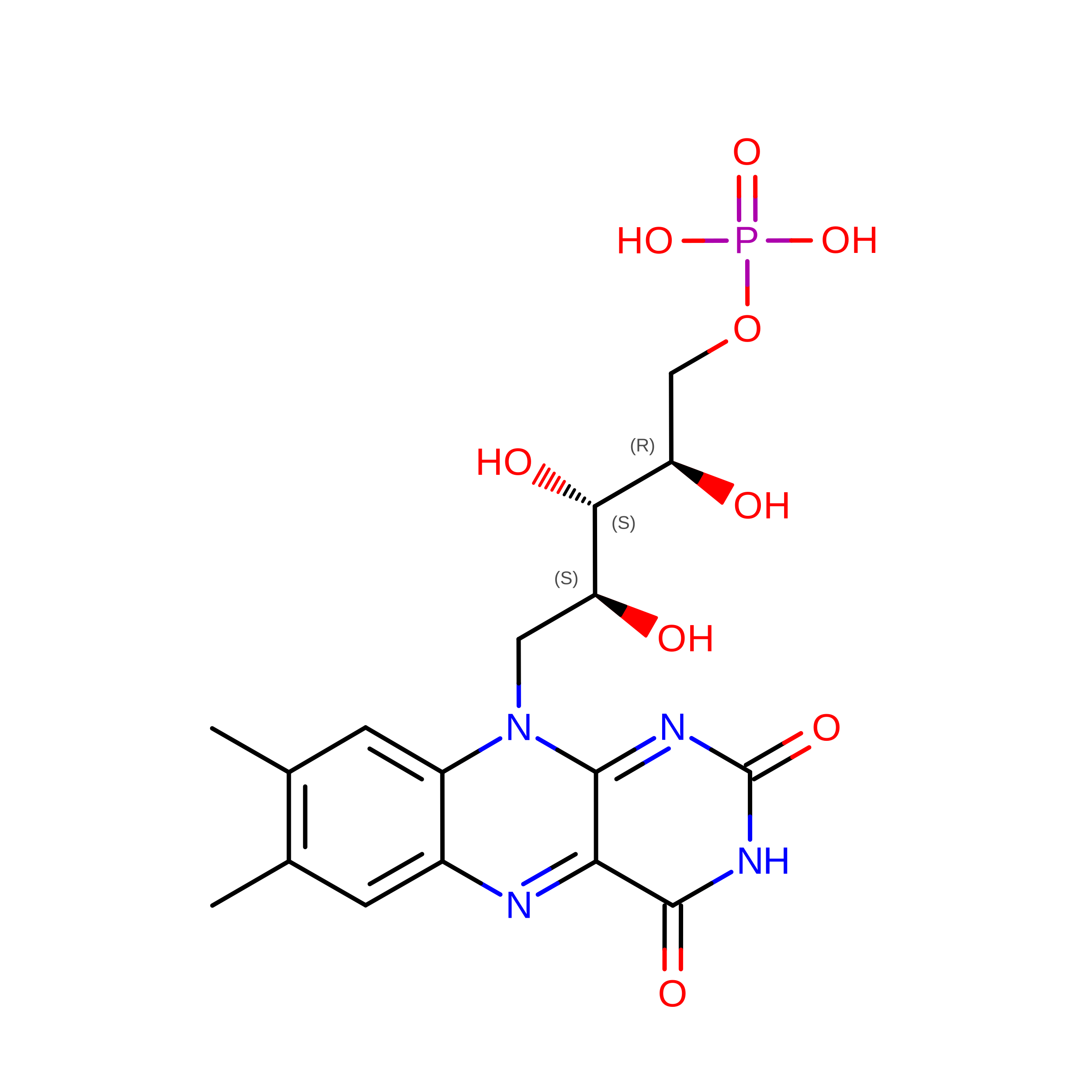
FLAVIN MONONUCLEOTIDE
C17 H21 N4 O9 P
FVTCRASFADXXNN-SCRDCRAPSA-N
D9G

Query on D9G


Download:Ideal Coordinates CCD File
E [auth A]
F [auth A]
G [auth A]
J [auth C]
K [auth C]
E [auth A],
F [auth A],
G [auth A],
J [auth C],
K [auth C],
L [auth C]
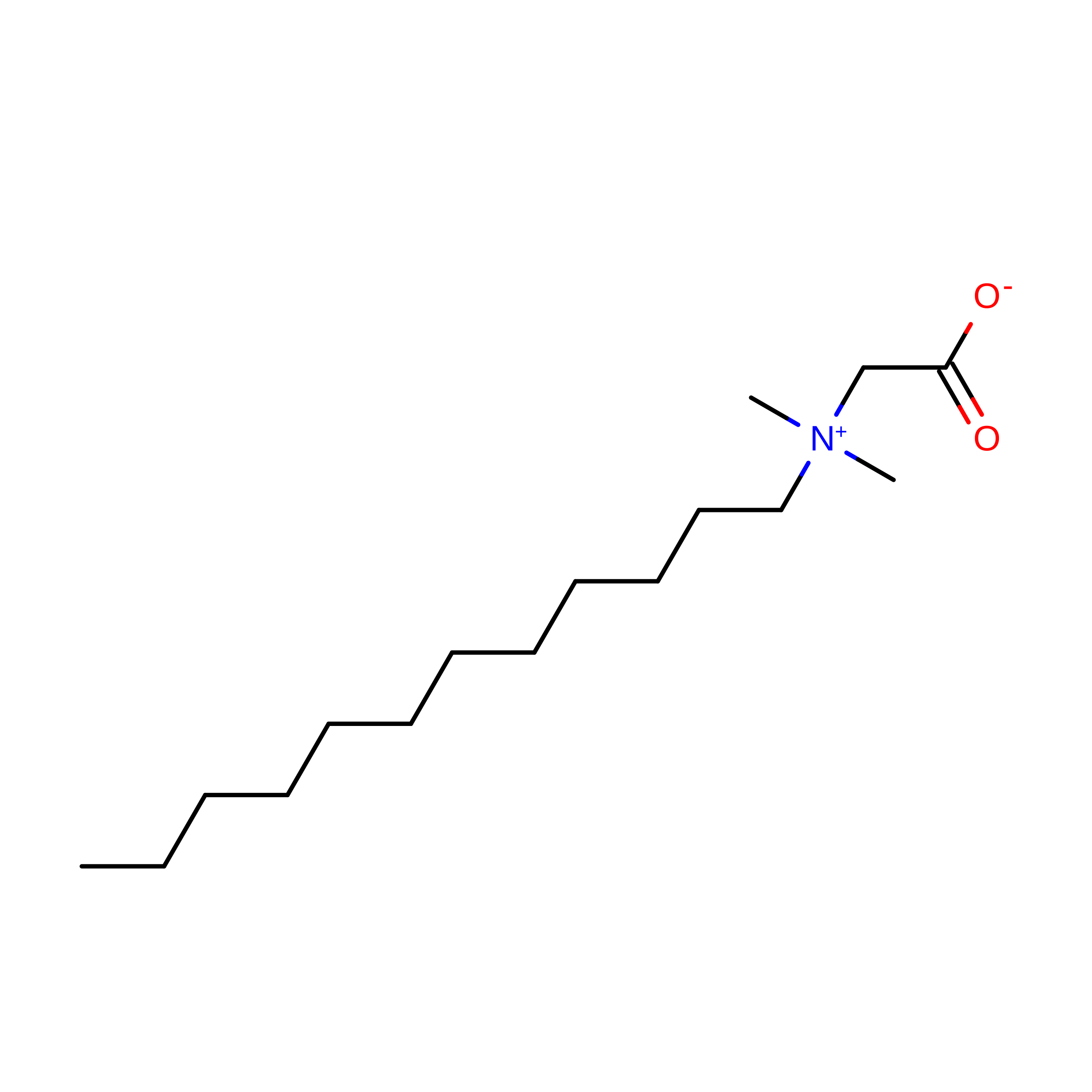
N-DODECYL-N,N-DIMETHYLGLYCINATE
C16 H33 N O2
DVEKCXOJTLDBFE-UHFFFAOYSA-N

Experimental Data & Validation

Experimental Data

  • Method: X-RAY DIFFRACTION
  • Resolution: 2.30 Å
  • R-Value Free:  0.273 (Depositor) 
  • R-Value Work:  0.241 (Depositor) 
  • R-Value Observed: 0.243 (Depositor) 
Space Group: P 41 21 2
Unit Cell:
Length ( Å )Angle ( ˚ )
a = 98.671α = 90
b = 98.671β = 90
c = 127.453γ = 90
Software Package:
Software NamePurpose
HKL-2000data collection
SCALEPACKdata scaling
XTALVIEWrefinement
REFMACrefinement
HKL-2000data reduction

Structure Validation

View Full Validation Report


Ligand Structure Quality Assessment 


Entry History 

Deposition Data

Revision History  (Full details and data files)

  • Version 1.0: 2005-06-28
    Type: Initial release
  • Version 1.1: 2008-04-30
    Changes: Version format compliance
  • Version 1.2: 2011-07-13
    Changes: Derived calculations, Version format compliance
  • Version 1.3: 2024-02-14
    Changes: Data collection, Database references, Derived calculations